 StadiumDB
Ursapharm-Arena an der Kaiserlinde
| Capacity | 15 500 |
|---|---|
| Country | Germany |
| City | Spiesen-Elversberg |
| Clubs | SV Elversberg |
| Category | Design being implemented |
| Cost | ? |
| Construction | 2013–2027 |
Advertisement
Ursapharm-Arena an der Kaiserlinde – design description
How can the SV Elversberg stadium expansion project be summarized?
Major changes to SV Elversberg’s stadium began in 2013, following the club’s first-ever promotion to the 3. Liga. A new main stand was built and completed in 2015, although its upper tier with VIP boxes was not opened until 2020 due to various issues.
The team returned to the 3. Liga in 2022 and achieved promotion to the 2. Bundesliga just a year later. The club’s sporting success led to the continuation of the stadium expansion project, which included plans for two additional modern stands – one behind the northern goal and another opposite the new main stand.
The new stand behind the northern goal was built between 2024 and 2025, while the stand opposite the main stand has been under construction since spring 2025 and is expected to be completed in 2027.
As a result of the works carried out since 2013, the stadium will feature three modern stands. Taking into account the reconstruction of the ultras section in 2016 (as well as its roofing at the turn of 2022 and 2023), the project effectively amounts to a complete redevelopment of the venue.
During the construction works, in the 2025/26 season, SV Elversberg secured a sensational promotion to the Bundesliga, while Spiesen-Elversberg – a small municipality in the state of Saarland – became the smallest German town ever to have a representative in the top division.
When were the first plans to expand SV Elversberg’s stadium created?
SV Elversberg’s current stadium was built between 1982 and 1983. At the turn of the 20th and 21st centuries, it underwent a series of upgrades that increased its capacity from 2,000 to 7,000 spectators, although it still remained a relatively modest venue.
In 2013, SV Elversberg reached the national level for the first time in its history by earning promotion to the 3. Liga. Following the promotion, ambitious plans emerged to expand the stadium to a capacity of 15,000 spectators.
What was the first stage of the SV Elversberg stadium expansion?
The first step was the construction of a completely new stand along Lindenstraße, on the south-western side of the stadium. Construction works began in June 2013. The lower tier of the new stand was completed relatively quickly and opened to supporters after just four months, in October 2013. At the same time, the away section also received a roof.
In November 2014, pharmaceutical company Ursapharm acquired the naming rights for the stadium. The venue was subsequently renamed Ursapharm-Arena an der Kaiserlinde, while still retaining part of its traditional name, Waldstadion an der Kaiserlinde.
Following the opening of the stand, work continued on the construction of its upper tier, including VIP boxes and a roof. The project was completed in 2015, but due to deficiencies identified in relation to fire safety regulations, the necessary operating permit could not be obtained for a long time.
After numerous modifications – including enlarging entrances, widening evacuation routes and replacing the roof cladding – and thanks to mediation by the interior minister of Saarland, the VIP boxes were finally put into use in the summer of 2020.
The new stand along Lindenstraße took over the role of the main stand, which had previously been located on the opposite side of the pitch. More modern and taller than the remaining stands, the structure significantly transformed the appearance of the entire stadium, while the venue’s capacity increased to 10,000 spectators.
What works were carried out at SV Elversberg’s stadium after the construction of the new main stand?
Following the completion of the new main stand, further investments were carried out at the stadium:
- At the end of 2015, a pitch heating system was installed. Its first activation took place in March 2016.
- In December 2015, demolition work began on the stand behind the southern goal, which had been designated for SV Elversberg’s most passionate supporters (Block C1). It was subsequently replaced by a new stand, which was opened in October 2016.
- In 2019, a large parking area was opened behind the stand on the opposite side of the stadium.
However, further expansion work slowed down, especially as the club failed to avoid relegation in its first season in the 3. Liga (2013/14) and returned to the Regionalliga.
How did further expansion of SV Elversberg’s stadium develop?
In 2022, SV Elversberg once again earned promotion to the 3. Liga, which revived discussions about further stadium expansion. As early as the turn of 2022 and 2023, the first upgrade was carried out, when a roof was installed over the reconstructed ultras stand from 2016.
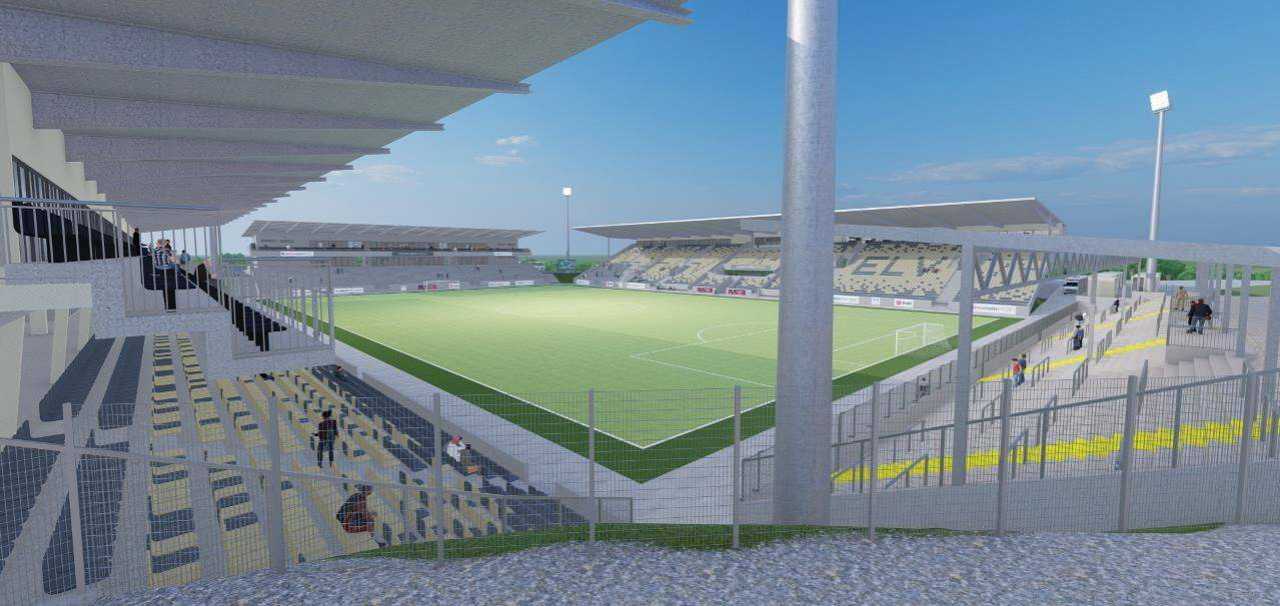
In March 2023, the first visualisations of the planned stadium expansion to a capacity of around 15,000 spectators were published in the media.
After the second promotion to the 3. Liga, the club continued its strong sporting performance and finished first in the table in the 2022/23 season, earning immediate promotion to the 2. Bundesliga.
Following promotion to the 2. Bundesliga, in the summer of 2023 two stands – the former main stand and the stand behind the northern goal – were temporarily expanded using modular metal structures, increasing the stadium’s capacity on a short-term basis. At the turn of 2023 and 2024, the temporary extension of the old main stand was replaced with a new, larger structure.
How is the further expansion of SV Elversberg’s stadium progressing?
Following the construction of the new main stand between 2013 and 2015, the aim became the development of two additional modern stands – behind the northern goal and opposite the main stand.
As a result, three modern stands will be built at the stadium since 2013. Taking into account the reconstruction of the ultras section in 2016, as well as its roofing at the turn of 2022 and 2023, this effectively constitutes a complete redevelopment of the venue.
The expansion will increase the stadium’s capacity to 15,500 seats, exceeding the minimum requirement for the 1. and 2. Bundesliga (15,000).
During the entire redevelopment process, matches have continued to be played at the stadium, although a small number of SV Elversberg home games were relocated to the Ludwigsparkstadion in Saarbrücken.
When was the new stand behind the northern goal built at SV Elversberg’s stadium?
In February 2024, the temporary stand behind the northern goal was demolished. In May 2024, a contract was signed with the construction company Peter Gross Bau, and from the summer of the same year the construction of the new stand (also referred to as the West Stand – Westtribüne) was underway.
The new stand was built as a reinforced concrete structure, featuring a roof and an upper VIP level, similar to the new main stand. It was gradually opened to supporters during the first months of 2025, while the upper VIP level became operational at the start of the 2025/26 season. A portion of the seats on this stand is allocated to away fans.
When will the new stand on the north-eastern side of SV Elversberg’s stadium be completed?
In April 2025, demolition work began on the temporary stand along the pitch on the north-eastern side of the stadium (the former main stand, also known as the North Stand – Nordtribüne).
In its place, construction started on another modern, fully covered stand, which, once completed, will increase the stadium’s capacity to 15,500 seats. The new stand is scheduled for completion in spring 2027.
During the construction works, SV Elversberg continued to perform strongly on the pitch. Already in 2025, the club came close to a historic promotion to the Bundesliga, which it ultimately achieved a year later. As a result, Spiesen-Elversberg became the smallest municipality ever to be represented in the Bundesliga.
A detailed overview of the construction works at SV Elversberg’s stadium can be found on a separate page
Advertisement
Renderings
-
2023 © SV Elversberg