 StadiumDB
Nacionalinis Stadionas
| Capacity | 18 000 |
|---|---|
| Country | Lithuania |
| City | Vilnius |
| Clubs | – |
| Category | Design being implemented |
| Cost | €52.4 M ($60.9 M) |
| Construction | 2023–2027 |
| Design | Cloud architektai, Populous |
| Contractor | Naresta |
Advertisement
Nacionalinis Stadionas – design description
What does the Vilnius National Stadium project look like in brief?
The saga of the Vilnius National Stadium began back in the Soviet era. Construction started in 1987, but after the fall of communism, work was halted, and the unfinished skeleton of the stadium “loomed” over the city for three decades.
An attempt to resume construction was made in 2008, but the allocated funds were sufficient for only a few months of work. A few years later, a new plan was drawn up: the “cursed” skeleton was to be demolished and replaced with a more modern, football-specific stadium, alongside a planned sports complex.
Complex procedures, tenders, and legal disputes caused further delays, and the project became known in the media as a “national disgrace.” The unfinished skeleton was finally dismantled in 2022, and construction of the new stadium began in autumn 2023 – only to be halted again after a few months.
After a change of the project’s private partner, construction resumed in July 2025. If all goes according to plan this time, Lithuania should finally have its National Stadium by the end of 2027.
What is the history of the Vilnius National Stadium?
What were the original plans for the Vilnius National Stadium?
The history of the Vilnius National Stadium goes back to the Soviet era, when it was intended to serve as a city or republic stadium. Planning began in the 1970s, and the design competition was concluded in 1984.
The winning concept was developed by a team of architects led by Algimantas Nasvytis (in collaboration with R. Stasėnas, R. Krištapavičius, and J. Rusteika).
What did the original Vilnius National Stadium project involve?
The investment was planned on the Šeškinė hill, over 3 km northwest of the city center. The new stadium was to feature an athletics track surrounded by stands with a capacity of 25,000 spectators. A striking feature of the design was an arch running over the entire structure.
The former Vilnius National Stadium project can be viewed on a separate subpage
How did the construction of the Vilnius National Stadium proceed according to the original plans?
Construction began in 1987, but by 1991 only part of the reinforced concrete skeleton had been completed. After the fall of communism, work was halted, and in 1993 the existing elements were secured to prevent degradation.
The unfinished concrete stands remained in this state for many years. In the meantime, the Akropolis shopping center was built right next to the site (opened in 2002), becoming the largest facility of its kind in the Baltic states.
In 2006, the project was granted the status of national importance, and preparatory work to resume construction began in 2007.
On 4 February 2008, work on the stadium officially resumed, and a time capsule was buried during the ceremony. Around 500 workers and seven cranes were present on the construction site, but after just a week, the main contractor, Veikmė, announced a halt to the works due to lack of funding.
In August 2008, the government allocated €29 million for construction, and work resumed. However, these funds were sufficient for only a few months, and by the end of 2008 construction was halted again. The Vilnius National Stadium project then remained stalled for several more years.
How is the Vilnius National Stadium being realized according to the new plan?
In 2013, an entirely new concept was developed: rather than completing the existing structure, it was to be demolished, and an entire sports complex was planned on the site. The project was named the “Vilnius Multifunctional Complex” (Vilniaus daugiafunkcis kompleksas).
The National Stadium remained the main element of the plan, but it was to be designed as a football-specific stadium (without an athletics track), located just next to the site of the unfinished skeleton. The complex was also to include a smaller athletics stadium, a sports hall, a cultural center, and training facilities.
Incorporating additional public-use facilities into the plans was intended to ensure that the project’s use of public funds would comply with European Union regulations, and also to make it eligible for EU co-financing.
When was the tender launched to select a private partner for the Vilnius National Stadium?
The project was intended to be carried out as a public-private partnership (PPP). The tender to select a private partner was launched in 2016. Axis Industries and the consortium Vilniaus nacionalinis stadionas both submitted bids.
At the beginning of 2018, the offer from Vilniaus nacionalinis stadionas was rejected for formal reasons, making Axis Industries the de facto winner of the tender. Subsequent appeals and legal disputes, however, blocked the project for several more years.
Who created the new design for the Vilnius National Stadium?
Both bidders prepared their own architectural concepts for the National Stadium during the tender process. The design submitted by Axis Industries was developed by the firm Cloud architektai in collaboration with Populous. This concept later served as the basis for the final design of the new stadium.
When was the agreement signed with the private investor to build the Vilnius National Stadium?
In 2019, the appellate court allowed the process with Axis Industries to continue, ending the complex legal disputes. However, Axis Industries ultimately withdrew from the project due to the risk of rising construction costs. They were replaced, as the PPP concessionaire, in 2021 by the investment firm BaltCap.
The agreement with BaltCap was signed on 8 October 2021, with the City of Vilnius and the Ministry of Education, Science, and Sport also being parties to the contract. Under the agreement, BaltCap received a 25-year concession (3 years for construction and 22 years for management). The city and the government covered all construction costs for the entire complex – over €150 million (€100 million from Vilnius and over €50 million from the government) – and provided the land lease free of charge.
When was the unfinished skeleton of the original National Stadium structure demolished?
Demolition of the unfinished skeleton began on 4 January 2022 and continued over the following months.
When did construction of the Vilnius National Stadium begin under the new design?
On 19 September 2023, an agreement was signed with Naresta, which became the main contractor for the stadium. Actual construction began in autumn 2023. The new stadium was planned not on the site of the demolished skeleton (where training pitches are now planned), but just next to it, slightly to the west.
How much will the construction of the Vilnius National Stadium cost?
Under the agreement, Naresta is carrying out the first phase of the entire complex, which primarily includes the construction of the National Stadium, as well as two training pitches and the main technical infrastructure networks. The contract is valued at €70 million, of which the stadium itself is estimated to cost €52.4 million.
Why was construction of the Vilnius National Stadium halted at the end of 2023, and why did the private investor withdraw?
Shortly after construction of the new stadium began, by the end of 2023, work was halted because BaltCap requested additional funding from the authorities due to rising costs.
It was eventually determined that the entire investment required an additional €2.4 million, a relatively modest increase (bringing total costs to €158.4 million). The city was willing to provide the additional funds, but extra public support required approval from the European Commission, which delayed the process.
At the same time, BaltCap became embroiled in a major financial scandal. Although the affair was not directly related to the stadium project, it negatively affected the fund’s reputation and, combined with the work stoppage and other issues, led to BaltCap withdrawing from the Vilnius National Stadium project.
Who became the new private investor for the Vilnius National Stadium?
The concession role was negotiated with the development company Hanner, which formally took over BaltCap’s shares in July 2025 for a symbolic €1. Slightly earlier, in May 2025, the European Commission approved additional funding, removing formal obstacles and allowing construction to resume.
When will the Vilnius National Stadium be completed?
Construction resumed in July 2025 (immediately after Hanner took over the project) and is being continued by the same contractor, Naresta.
Also in July 2025, Hanner reached an agreement with Kalvasta Statyba to build the remaining facilities of the complex, including the sports hall, cultural center, and athletics stadium.
The contract with Kalvasta Statyba is valued at €47.5 million, with a completion period of 30 months – by the end of 2027. The National Stadium is also expected to be completed by the end of 2027.
A report on the construction of the Vilnius National Stadium can be viewed on a separate subpage
What will Lithuania’s National Stadium be like?
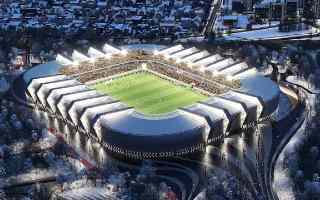
The stadium will be built in a modern, football-specific design. It will meet UEFA Category 4 requirements and have a capacity of 18,000 spectators, with fully covered stands. A sports museum is also planned within the stadium.
The stadium will be located on Šeškinė hill, over 3 km northwest of the city center, next to the Akropolis shopping center, the largest facility of its kind in the Baltic states.
Alongside the stadium, a sports complex is planned (the so-called “Vilnius Multifunctional Complex”), which will include a sports hall with 7,150 seats, a modest athletics stadium, training facilities, and a cultural center.
What is the context of Lithuania’s National Stadium project?
Although Lithuania is not a football powerhouse, and the sport is less popular than basketball in the country, football remains an important discipline. For many years, the country lacked a high-standard stadium where the national team and other major matches could be properly hosted.
The long-running saga of the Vilnius National Stadium and its abandoned skeleton became a symbol of stalled projects, earning the label of a “national disgrace” in the media. The first modern stadium in Lithuania was ultimately built not in Vilnius, but in Kaunas, where the Darius and Girėnas Stadium was redeveloped between 2018 and 2022.
Advertisement
Renderings

2023 © Cloud Architektai 
2023 © Cloud Architektai 
2023 © Cloud Architektai 
2023 © Cloud Architektai 
2023 © Cloud Architektai 
2023 © Cloud Architektai 
2019 © Axis Industries 
2019 © Axis Industries 
2019 © Axis Industries 
2018 © Cloud Architektai 
2018 © Cloud Architektai 
2018 © Cloud Architektai 
2018 © Cloud Architektai 
2018 © Cloud Architektai 
2017 © Axis Industries 
2017 © Axis Industries 
2017 © Axis Industries 
2017 © Axis Industries 
2017 © Axis Industries 
2017 © Axis Industries


2019:


2018:


2017:


Related news
2025
2024

2022

2021

2020

2018
-

Vilnius: Finally, green light for national stadium?
After years and years of no progress, it seems the hardest part is done and public-private partnership can be sealed. Government of Lithuania and mayor of Vilnius agreed on funding for the new national sports complex. Construction may begin in late 2019 or 2020.
-

Lithuania: Can Vilnius get the long-overdue stadium?
When it rains, it pours. For Vilnius the dream of having a new national stadium is over 30 years old and still not certain to end happily. Latest developments suggest dark clouds may be gathering once more...