 StadiumDB
Power Court Stadium
| Capacity | 25 000 |
|---|---|
| Country | England |
| City | Luton |
| Clubs | Luton Town |
| Category | Design being implemented |
| Cost | £100 M ($135 M) |
| Construction | 2026–2028 |
| Design | AECOM, SISA |
| Contractor | Limak Construction |
Advertisement
Power Court Stadium – design description
What does the Power Court Stadium project look like in brief?
The new Luton Town FC stadium stadium will be built almost in the very centre of the city, on the post-industrial site of Power Court, where a power station and other industrial facilities once operated. The venue will replace the current Kenilworth Road, which has been the club’s home for more than 120 years.
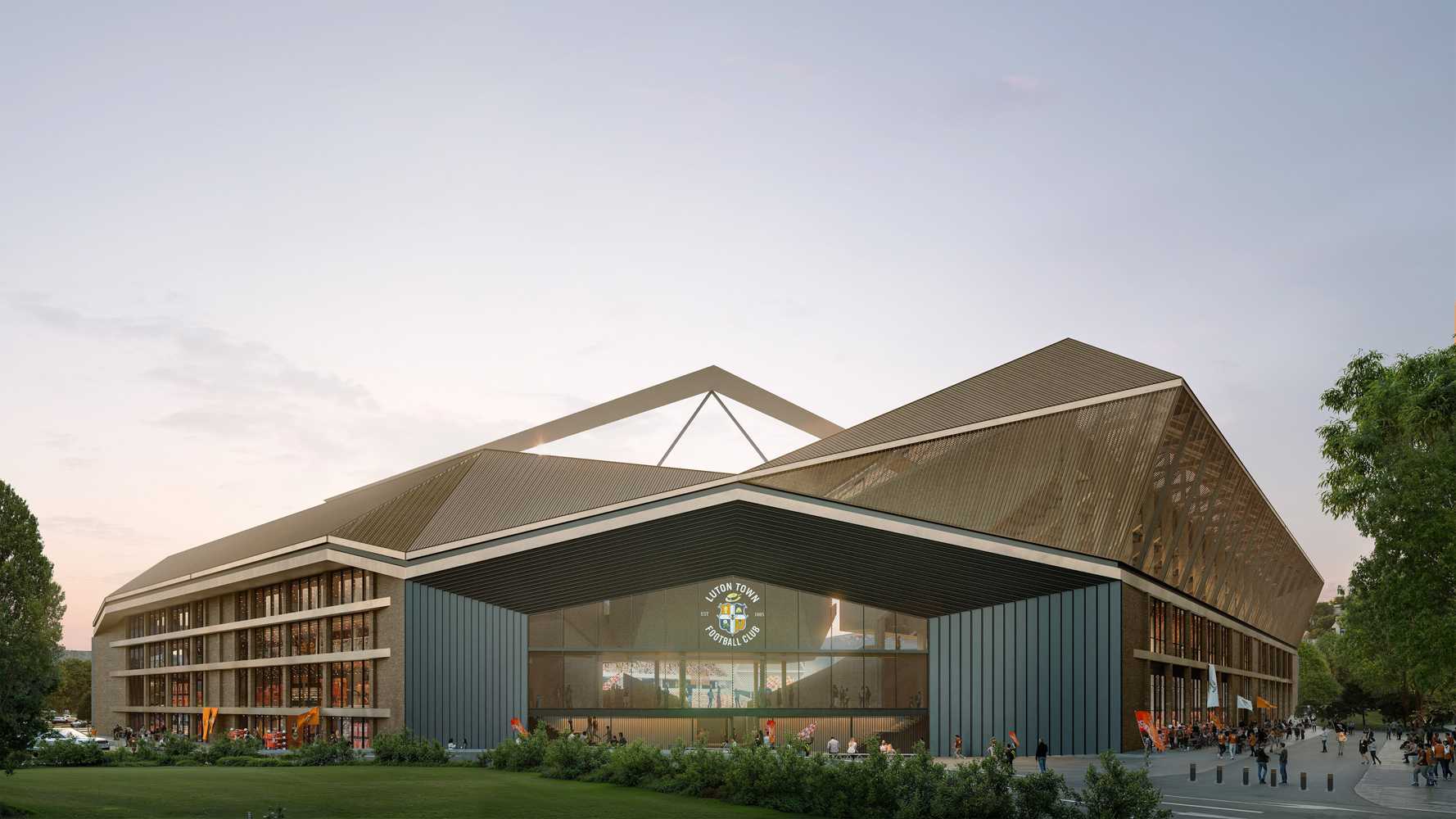
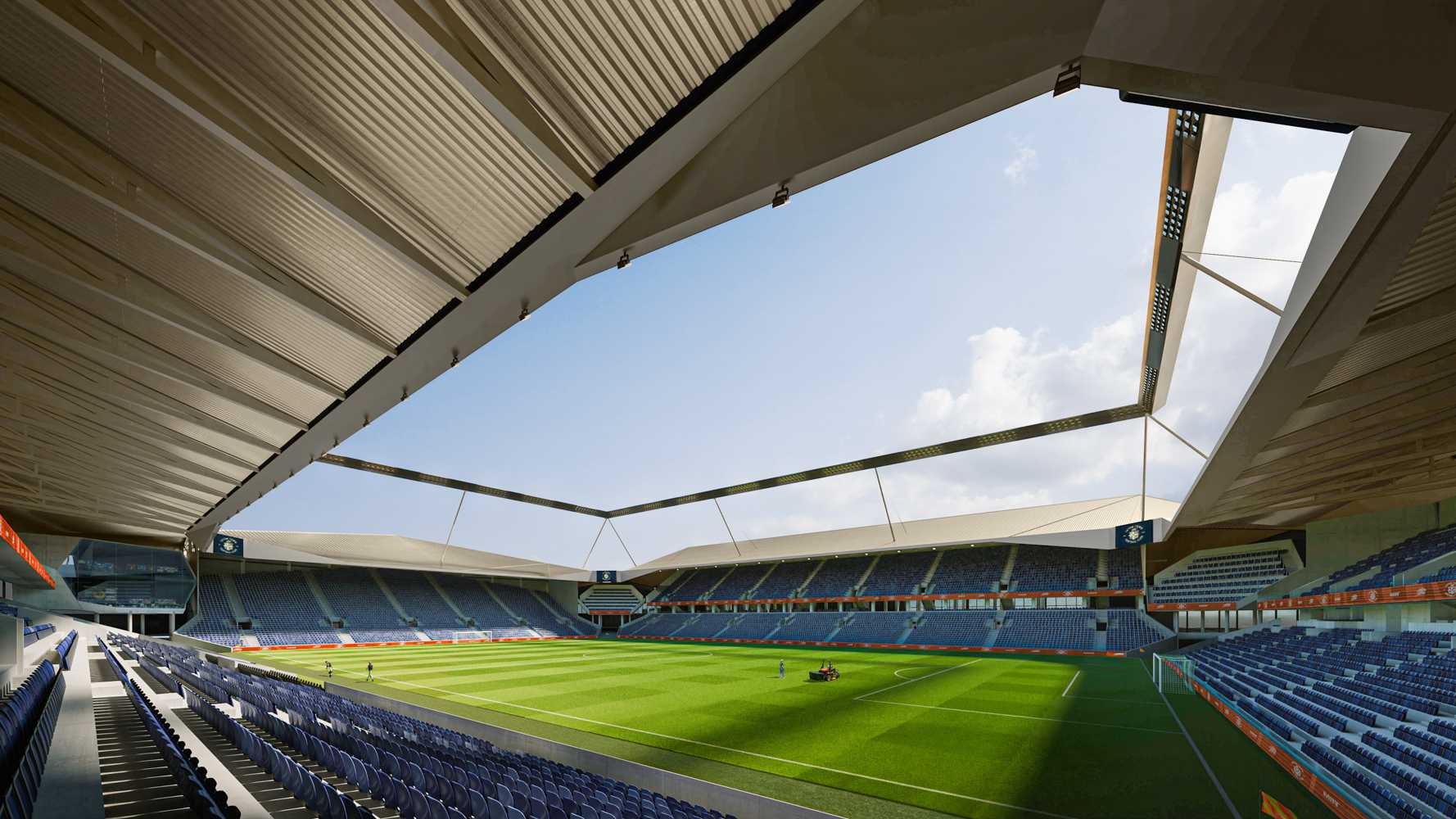
The design of the new stadium is defined by its distinctive “halo” – a steel rectangular frame suspended above the pitch. Symbolically, it is intended to represent a “hat”, in reference to Luton Town’s nickname. In functional terms, the structure will also provide optimal lighting for the pitch.
The stadium will feature a compact, modern form while retaining elements typical of traditional English football grounds. The new venue will have a capacity of 25,000 spectators.
The club first presented the stadium project in 2015, when former industrial buildings were demolished to prepare the site for redevelopment. However, prolonged planning procedures and other obstacles meant that construction only began a decade later. The project is expected to be completed ahead of the start of the 2028/29 season.
Who are Luton Town FC?
Luton Town FC is a professional football club founded in 1885. The team won the EFL Cup in 1988, reached the FA Cup final in 1959, and has spent several periods in the top flight of English football (1955–1960, 1974–1975, 1982–1992 and 2023–2024). The club and its supporters are commonly known as “The Hatters”, a reference to the town’s historic hat-making industry.
Where does Luton Town FC currently play?
Since 1905, the club has played its home matches at Kenilworth Road, located in Bury Park, around one mile east of central Luton. The stadium has a capacity of 12,000 and retains a distinctive traditional English football atmosphere, although it falls short of modern standards and no longer meets the club’s requirements.
The ground is tightly squeezed into a constrained site surrounded by residential housing and the trace of a former railway line, which effectively prevents any significant expansion. It is also famous for its unusual Oak Road stand entrance (behind the east goal), where fans climbing the stairs can quite literally look into nearby back gardens.
How did the Luton Town FC stadium project come about?
What were the first ideas for a new Luton Town FC stadium?
Plans to leave Kenilworth Road date back to 1955, following the club’s first promotion to the top flight. Over the following decades, various proposals for a new stadium repeatedly emerged, including the controversial idea of relocating to Milton Keynes, as well as an ambitious plan by David Kohler, the club chairman in the 1990s, which envisaged the construction of a fully enclosed stadium.
In 2007, a proposal was made to build a stadium on the distant northern outskirts of the town, near the M1 motorway junction close to the villages of Harlington and Toddington. Later, the club also considered other potential sites, as well as the option of redeveloping Kenilworth Road.
When was the Power Court stadium project developed?
In 2015, plans emerged to build a new stadium on the Power Court site, located almost in the very centre of Luton. The area was a post-industrial brownfield site, where various industrial facilities had previously operated. The largest of these was a power station in operation between 1901 and 1969, distinguished by two tall cooling towers.
After the power station was closed, the site continued to be used by other businesses. In 2015, most of the existing buildings were demolished, making way for regeneration of the area and new investment opportunities.
The club first formally presented plans for a stadium at Power Court in December 2015. The original architectural concept was designed by And Architects.
What steps were taken to develop the Power Court stadium project?
To facilitate the stadium project, a development company linked to the club, 2020 Developments, was established. In 2016 it acquired most of the land required for the scheme, and in 2018 it gained full control of the site.
The financing model envisaged funding the stadium through property-led development across two locations: the immediate surroundings of the stadium at Power Court, and the southern part of Luton near the M1 motorway junction (the Newlands Park project).
A planning application was submitted in 2016, but outline planning permission was not granted by the local authority until January 2019. A subsequent legal challenge by the operator of a nearby shopping centre, combined with the outbreak of the COVID-19 pandemic, caused further delays to the project.
In 2023, the club secured promotion to the Premier League, which further intensified discussions about the need for a new stadium.
Meanwhile, the stadium design continued to evolve, with updated concepts developed in collaboration first with Leslie Jones Architects, and later with AECOM and SISA. The final version still retains many features of the original And Architects concept, particularly the distinctive roof “frame” above the stands.
Initially, the stadium capacity was set at 17,500 spectators, but this was later increased to 23,000 and eventually to 25,000 seats.
How is the construction of Power Court Stadium progressing?
Intensive earthworks have been carried out at Power Court since 2024. The project required the relocation of an on-site electrical substation and a sewer collector, as well as the diversion of the River Lea. Early enabling works were undertaken by the local company Capital Sky.
On 30 April 2025, it was announced that the main contractor for the stadium construction would be the Turkish company Limak International. The firm is known, among other projects, for redeveloping Camp Nou in Barcelona.
In January 2026, piling works began, marking the start of the main construction phase. The new stadium is scheduled to be completed ahead of the start of the 2028/29 season. The construction cost is expected to amount to £100 million.
Construction progress updates for Power Court Stadium are available on a dedicated subpage
What does the Power Court Stadium project include?
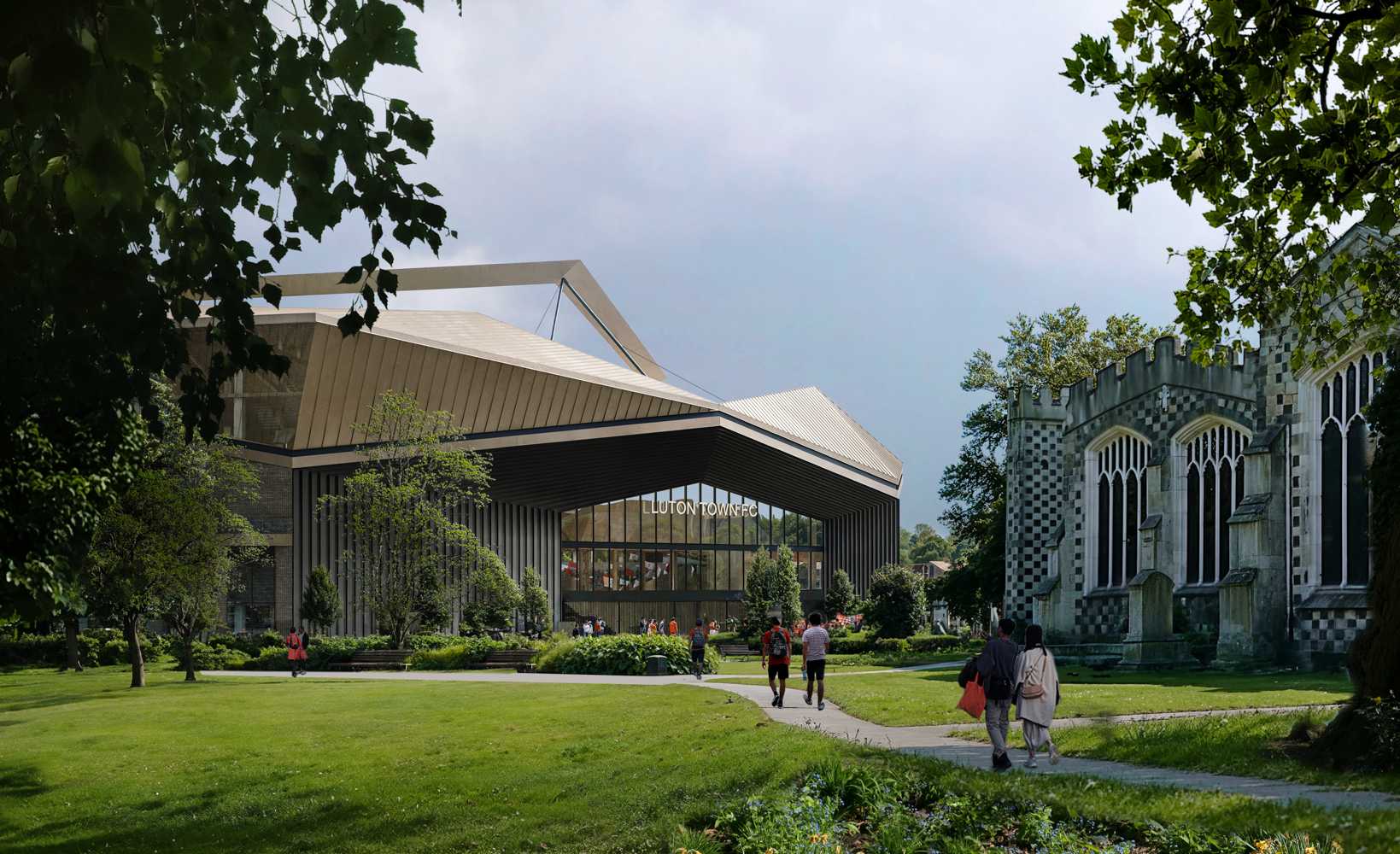
The scheme envisages the construction of a football-specific stadium with a capacity of 25,000 spectators. The building will feature a compact, enclosed form with an irregular silhouette, characterised by brick facades and gold-copper toned panels.
The defining feature of the stadium will be its “halo” – a rectangular steel frame rising above the roofline, providing optimal lighting for the pitch. This distinctive element was inspired by Luton Town’s nickname and is intended to symbolise a hat.
The stadium will have a modern appearance, while retaining references to the traditional English football ground style, including a four-stand configuration surrounding the pitch.
The venue will be located on the Power Court site, on former industrial land almost in the very centre of Luton. Directly opposite the site stands one of the city’s most important landmarks – St Mary's Church.
The surrounding area is planned to include mixed-use development projects featuring new apartments, retail units, and other commercial spaces, as well as parking facilities.
Thanks to its proximity to the main railway station and the transport interchange, access to the stadium by public transport will be very convenient.
Advertisement
Renderings
-

2024 © Luton Town FC / AECOM + SISA 
2024 © Luton Town FC / AECOM + SISA 
2024 © Luton Town FC / AECOM + SISA 
2024 © Luton Town FC / AECOM + SISA 
2024 © Luton Town FC / AECOM + SISA 
2024 © Luton Town FC / AECOM + SISA 
2024 © Luton Town FC / AECOM + SISA 
2024 © Luton Town FC / AECOM + SISA 
2024 © Luton Town FC / AECOM + SISA 
2021 © Luton Town FC / Leslie Jones Architects Ltd. 
2021 © Luton Town FC / Leslie Jones Architects Ltd. 
2021 © Luton Town FC / Leslie Jones Architects Ltd. 
2021 © Luton Town FC / Leslie Jones Architects Ltd. 
2021 © Luton Town FC / Leslie Jones Architects Ltd. 
2021 © Luton Town FC / Leslie Jones Architects Ltd. 
2015 © Luton Town FC / AndArchitects 
2015 © Luton Town FC / AndArchitects 
2015 © Luton Town FC / AndArchitects 
2015 © Luton Town FC / AndArchitects 
2015 © Luton Town FC / AndArchitects 
2015 © Luton Town FC / AndArchitects 
2015 © Luton Town FC / AndArchitects 
2015 © Luton Town FC / AndArchitects 
2015 © Luton Town FC / AndArchitects 
2015 © Luton Town FC / AndArchitects 
2015 © Luton Town FC / AndArchitects 
2015 © Luton Town FC / AndArchitects 
2015 © Luton Town FC / AndArchitects 
2015 © Luton Town FC / AndArchitects 
2015 © Luton Town FC / AndArchitects






2021:


2015:


Related news
2026

2025
-

England: Major changes at English stadiums – 15 projects for the future!
English football has been known for decades for its traditions and passionate stadiums, but the coming years herald a new era – bold investments, modern solutions, and world-class designs. Across the country, clubs – both from the Premier League and lower leagues – are preparing to modernize their grounds or build entirely new facilities.
-

England: Camp Nou builders to construct new stadium for Luton Town
Summer 2025 will mark a long-awaited milestone for Luton Town fans, as the club has officially announced the start of construction on new Power Court Stadium, which is set to replace aging Kenilworth Road in the near future.
2024
-

England: Green light for Power Court Stadium!
Luton Town's final plans for a new 25,000-seat stadium have received planning approval. The initial consent for constructing the stadium at Power Court, located in the heart of the city, was granted back in 2019.
-

England: Luton Town releases renderings of new stadium!
A new stadium for Luton Town will be built. A detailed planning application submitted by the club has been formally approved by Luton Borough Council. The renderings of the new arena look phenomenal!
-

England: A new stadium for Luton Town in just 3 years?
Luton Town F.C. has submitted a detailed planning application for the construction of a new 25,000-seat stadium in the city center. The document, submitted for the Power Court site was handed over to Luton Borough Council on September 13th.
-

England: What next for Luton's stadium expansion plans after relegation?
Accessing the millions on offer that the Premier League hands out to promoted teams from the Championship can often lead to a rush of blood in the boardroom as the powers that be begin ambitiously panning for a prosperous new tomorrow.
-

England: New stadium for Luton possible thanks to river diversion
Football clubs face a variety of problems. Replacing grass, rebuilding stands or renovating club buildings are the most common challenges. A club from central England will have to confront nature by changing the natural course of the River Lea in order to be able to start building a stadium.
2023
-

England: Luton with promotion and new stadium design
Luton Town FC is famous not only for their historic promotion to the Premier League, but also for their stadium, which has stolen the hearts of fans from all over the world with its old-school style. The club's board of directors, while proud of the age-old arena, has made concrete plans for a new facility.
-

England: Where will Luton Town play after promotion to the Premier League?
Just one game separates the Luton team from playing in England's top division. They will play for a place in the Premier League against either Middlesbrough or Coventry City. If Luton win at Wembley, the club's authorities will have to consider their future stadium.
2022

2021

2020
-

England: Luton Town rethinking stadium design due to COVID-19
In an online conference with supporters executive director Gary Sweet informed them that changes are necessary to the new stadium design. Amended documentation should be filed within weeks.
-

England: Have Luton Town won, finally?
Each time it seems they're close to construction in Luton, something pops up. But now nothing more should indeed stand in their way, main opponents decided to step back and no longer obstruct.
2019
-

England: Luton hit by new delay
Request for judicial review by potential competition is the latest setback for Luton Town. It remains unclear how much time it could cost but the football club and borough council remain defiant in their decision to proceed.
-

England: Luton plans won't be called in
The biggest remaining threat for Luton Town's stadium plans is no more. Secretary of state decided not to commission a review of the Newlands Park planning permission, which would have delay the project.
-

England: Power Court one more step closer
With the supporting commercial development now approved, Luton Town's stadium scheme can officially go forward. Two issues may still arise but unless planning permission is challenged, we should see construction this year.
-

England: Go Luton, unanimous approval!
With no concil member against, the long-desired Power Court stadium received the go-ahead on Wednesday night! This paves the way for construction, though one more vote is awaited in January.
-

England: Luton stadium recommended for approval
The proposed 23,000-seater at Power Court received backing in official report, which suggests it should be granted planning permission. If council members agree, the council could push it forward next week.
