 StadiumDB
Stadion Oldenburg
| Capacity | 10 604 |
|---|---|
| Country | Germany |
| City | Oldenburg |
| Clubs | VfB Oldenburg |
| Category | Design awaiting implementation |
| Cost | €57.3 M ($66.5 M) |
| Construction | 2027–2028 |
| Contractor | Hellmich Unternehmensgruppe |
Advertisement
Stadion Oldenburg – design description
What is the project for the new stadium in Oldenburg in brief?
In 1991, VfB Oldenburg left its former stadium in the Donnerschwee district, which had been sold to reduce the club’s debt, and moved to the multi-purpose Marschweg Stadion, designed for both football and athletics.
Although the first years at the “new” venue were relatively successful, it soon became clear that further development of the club and competition at a professional level would require the construction of a new stadium.
Early concepts for a new facility began to emerge at the beginning of the 21st century, but it was not until VfB Oldenburg’s promotion to the 3. Liga in 2022 that decisive steps were taken. Over more than two decades of debate in the city, civic movements emerged both in support of and in opposition to the project.
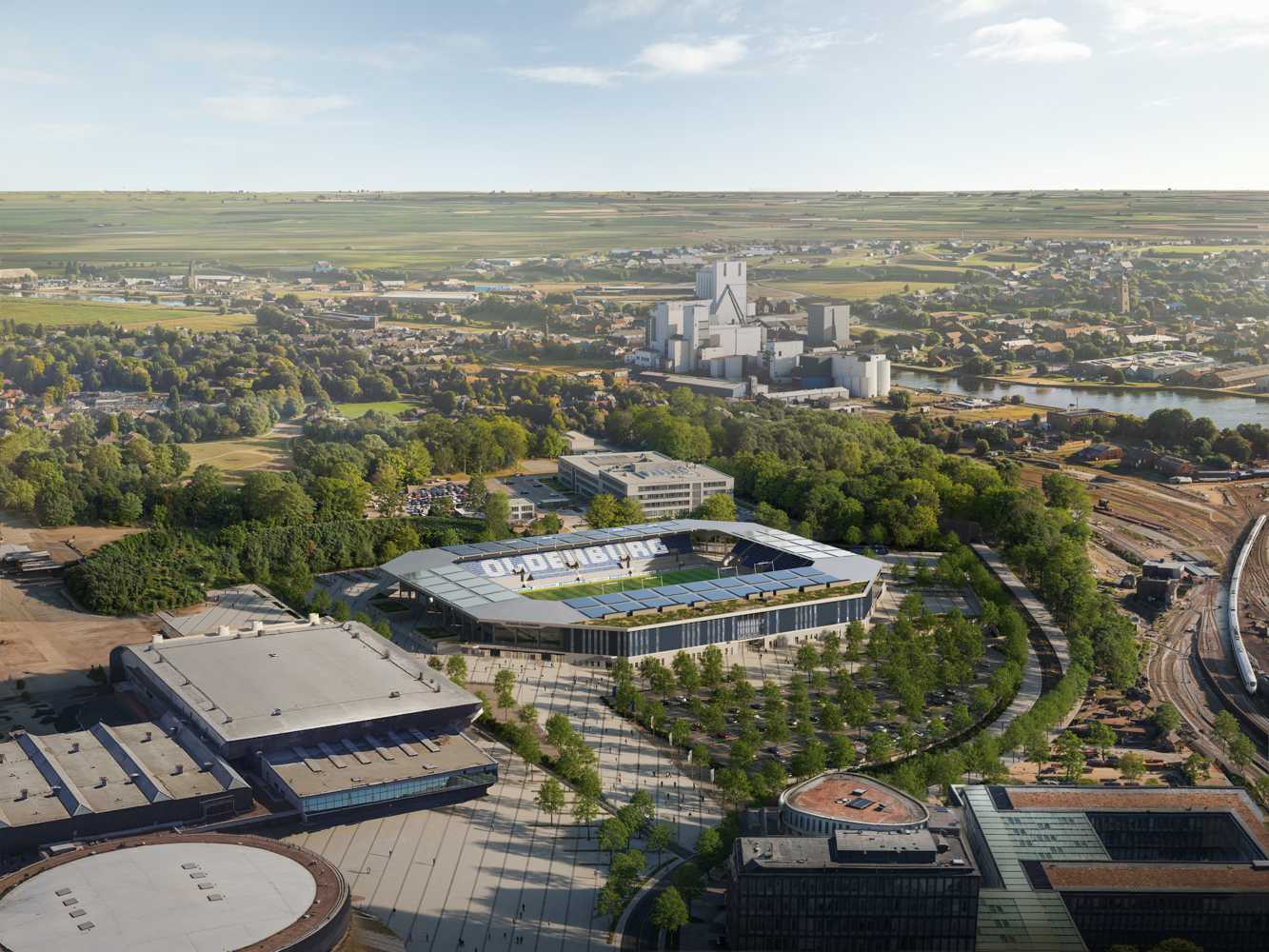
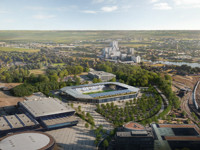
The stadium is planned to be built on Maastrichter Straße, next to the Weser-Ems-Hallen complex, close to the city center and the main railway and bus station. The location also has symbolic significance, as it is situated not far from the site of VfB Oldenburg’s former Donnerschwee stadium.
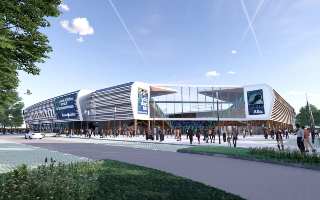
The modern arena will accommodate more than 10,000 spectators on four stands arranged in a traditional football configuration and covered by a unified roof, whose most distinctive feature will be a load-bearing wooden structure. The construction is scheduled to take place between 2027 and 2028.
How did the plans for the new stadium in Oldenburg come about?
Where did VfB Oldenburg originally play its matches?
For many years, VfB Oldenburg’s home ground was the stadium in the Donnerschwee district (Stadion Donnerschwee), which, thanks to its intense atmosphere, was even referred to as the “Hell of the North” (“Hölle des Nordens”). Its origins date back to the late 19th century, when it was built as a cycling track.
When did VfB Oldenburg move to Marschweg Stadion?
Due to the club’s financial difficulties, the stadium in Donnerschwee was sold, and VfB Oldenburg played its final match there in June 1991. The disused stadium was not demolished until 2007, and in 2008 supermarkets were opened on the site.
After leaving Donnerschwee, VfB Oldenburg moved to the city’s other major stadium – the multi-purpose Marschweg Stadion, opened in 1951.
The first season at the “new” ground (1991/92) turned out to be the most successful in the club’s history, with VfB competing for promotion to the Bundesliga until the final matchday. In 1996, a new main stand was opened at Marschweg Stadion.
In the 1996/97 season, VfB Oldenburg last competed in the 2. Bundesliga, after which the club spent a long period playing in the regional leagues.
When did the first ideas for a stadium at Maastrichter Straße appear?
In 2005, the first of two sports halls named EWE Arena was opened in the vicinity of the Weser-Ems-Hallen exhibition and event complex, in the Maastrichter Straße area. Around the same time, urban development studies suggested further expansion of sports facilities in this area, including the construction of a new stadium.
When was the first concept for a stadium at Maastrichter Straße developed?
In 2007, the private initiative “GO-OL”, led by developer Jochen Rehling, gained widespread attention. Together with partners, he developed the concept for a new stadium at Maastrichter Straße, which was to be named Ashampoo-Arena – after Ashampoo, a local software company intended to serve as the naming-rights sponsor.
The concept was designed by architect Lars Frehrichs and envisaged a 15,000-seat stadium with an estimated cost of €20 million. The group launched a campaign promoting the project and encouraged public support through donations, auctions (including the auctioning of a Porsche owned by one of the shareholders), and the purchase of stylised commemorative bricks.
In 2008, the club was relegated to the fifth tier of German football, and the stadium project ultimately failed to materialise. Funds that had already been raised were redirected to VfB Oldenburg’s youth development programme.
When were plans for a new VfB Oldenburg stadium revived?
In 2014, as the club began to achieve improved sporting results, the stadium debate resurfaced. The city initially considered modernising Marschweg Stadion, but later concluded that constructing a new stadium at a different site would be the better option.
The city commissioned a study analysing potential locations for a new stadium. The study was carried out by Albert Speer + Partner and identified five suitable areas: Maastrichter Straße, Holler Landstraße, Krugweg, Wechloy, and the site of a former airbase.
In the subsequent process, the Krugweg and Wechloy locations were ruled out, and the Maastrichter Straße site was ultimately identified as the most suitable, located close to the city center and the main railway and bus station.
The Maastrichter Straße location had already previously been considered for a new stadium. Its proximity to the Weser-Ems-Hallen exhibition center and two sports halls of the EWE Arena (the second, larger hall opened in 2013) made it suitable for the development of a multifunctional sports district.
The area also carries additional symbolic significance, as it lies in the Donnerschwee district, relatively close to the site of VfB Oldenburg’s former stadium.
In 2014, a citizens’ initiative called NordWestStadion was also formed, advocating for the construction of a new stadium. The group produced visual concepts illustrating how the future stadium could look.
In 2017, Albert Speer + Partner prepared another study commissioned by the city – a feasibility study for a new stadium at Maastrichter Straße. However, weaker sporting results of VfB Oldenburg and a lack of political consensus meant that the project was again deprioritised in the following years.
Why was VfB Oldenburg’s relocation from Marschweg Stadion considered a better option?
One possible solution would have been the redevelopment of the existing Marschweg Stadion. However, its location comes with certain constraints, including restrictions due to nearby residential buildings, such as a ban on matches starting after 6:30 p.m.
Choosing an alternative location would also allow Marschweg Stadion to be preserved in its current form, as redevelopment would have required the removal of the running track, thereby eliminating its function as an athletics venue.
When was the project for a new VfB Oldenburg stadium developed?
The question of a new stadium resurfaced following VfB Oldenburg’s promotion to the 3. Liga in 2022. The issue became even more urgent as Marschweg Stadion did not fully meet licensing requirements and was granted only conditional approval for competition.
On 27 February 2023, the city council adopted a resolution obliging the administration to begin planning and preparatory procedures for the construction of a new stadium. On 20 March 2023, the municipal company Stadionplanungsgesellschaft mbH was established for this purpose.
Although the club was relegated from the 3. Liga after just one season, the process towards constructing a new stadium did not stop. On the contrary, the public debate intensified. Alongside the initiative supporting the project (NordWestStadion), an opposing movement was also formed (KEIN StadionBau). One of the supporters of the new stadium was the Mayor of Oldenburg, Jürgen Krogmann.
When did the city council vote in favour of the new stadium in Oldenburg?
On 15 April 2024, the long-anticipated city council vote on the approval of the project took place. Due to high public interest, the meeting was moved to the congress hall of the Weser-Ems-Hallen complex, where around 700 spectators gathered, mainly supporters of the project and VfB Oldenburg fans.
The vote resulted in the approval of the resolution: by 32 votes to 18 (with one abstention), councillors approved the construction of a new stadium with an estimated cost of approximately €50 million.
Following the vote, the existing Stadionplanungsgesellschaft mbH was merged into the newly established municipal company Stadion Oldenburg GmbH & Co. KG, which was tasked with implementing the project.
What further steps were taken towards the construction of the new stadium in Oldenburg?
On 28 October 2024, the city adopted the financing model for the investment. The authorities decided to provide the Stadion Oldenburg GmbH & Co. KG with €15 million in equity funding, while the remaining costs (then estimated at €50.4 million) were to be covered by the company through external financing.
In June 2025, a Europe-wide tender procedure was launched to select a general contractor responsible for both the design and construction of the stadium.
On 13 April 2026, the city council adopted a new land-use plan enabling the construction of the stadium at Maastrichter Straße.
The European tender for the design and construction of the stadium was conducted on a confidential basis, and therefore no information about its progress was disclosed. However, on May 8, 2026, visualizations of the new stadium were presented, prepared by the consortium that had received the backing of Stadion Oldenburg GmbH & Co. KG (at the time, its name had not yet been revealed).
On May 19, 2026, the company’s shareholders approved the awarding of the contract to the winning consortium. The final decision to sign the agreement rested with the city council. The vote took place on June 1, 2026, and ended in favor of the supporters of the new stadium. Due to the significance of the matter and the high level of public interest, the session was once again moved – this time to the Cäcilienschule auditorium.
Following the positive outcome of the vote, on June 4, 2026, a contract was signed with the tender winner for the role of general contractor for the project – Hellmich Unternehmensgruppe.
What does the design of the new stadium in Oldenburg include?
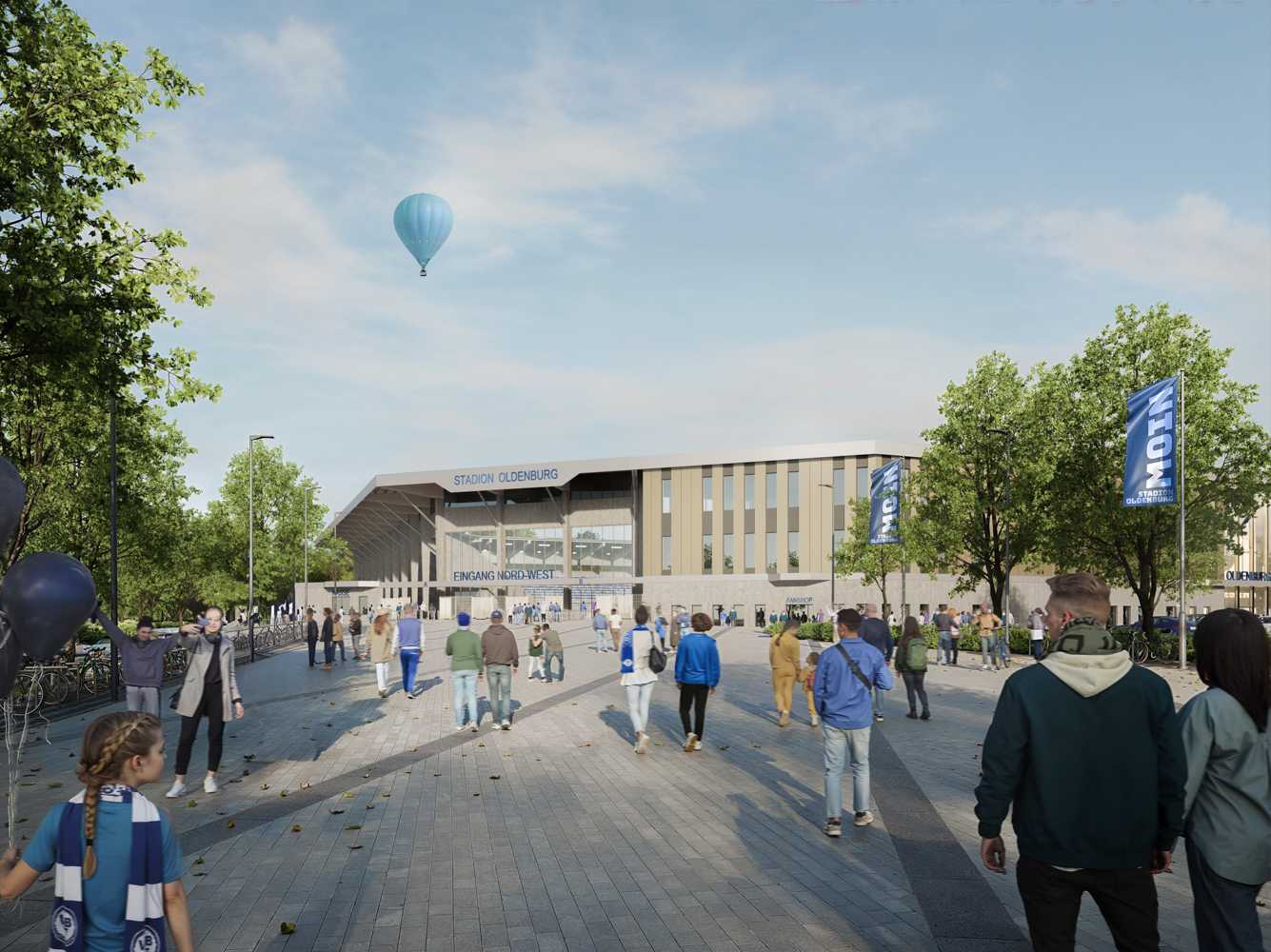
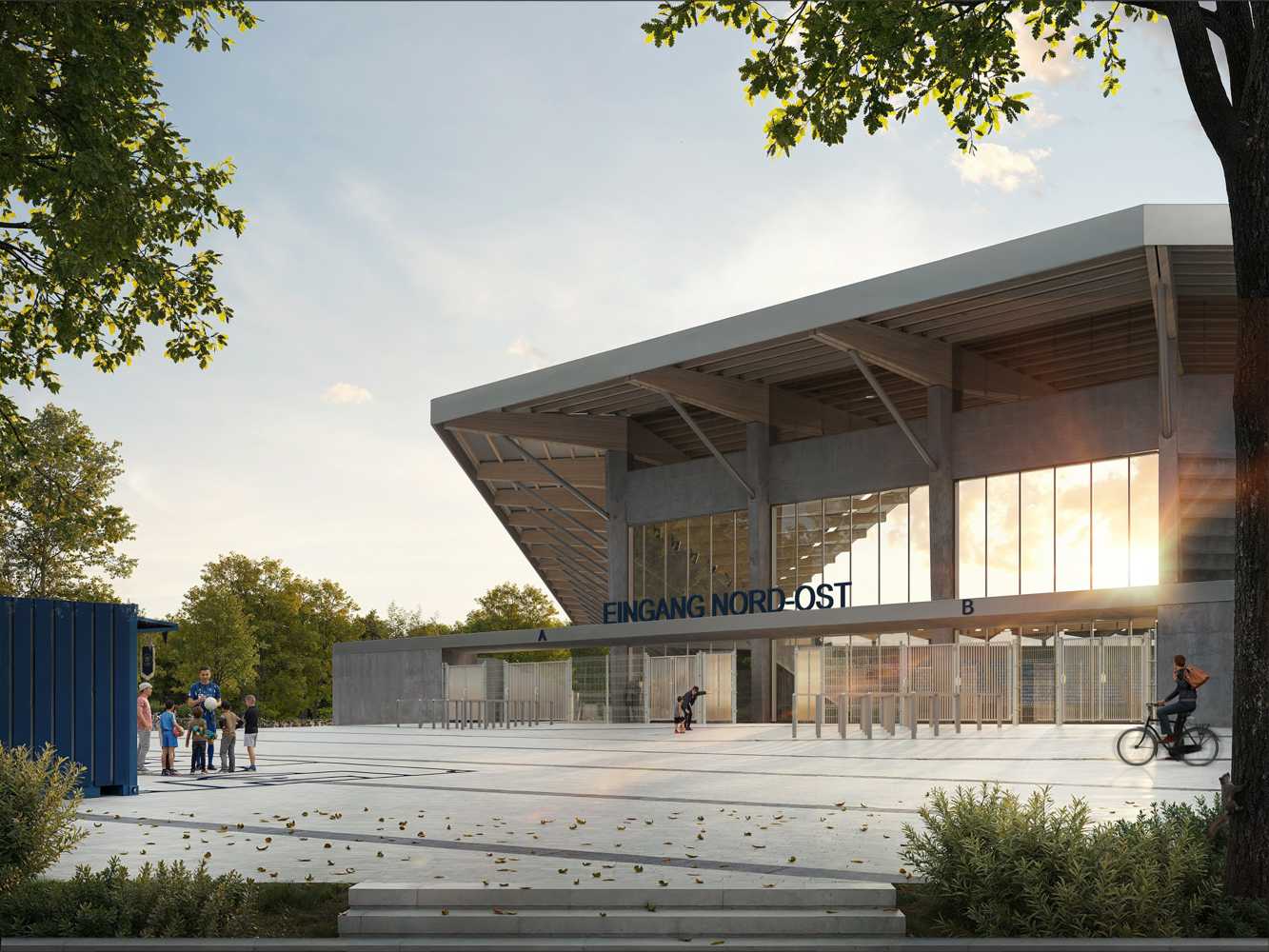
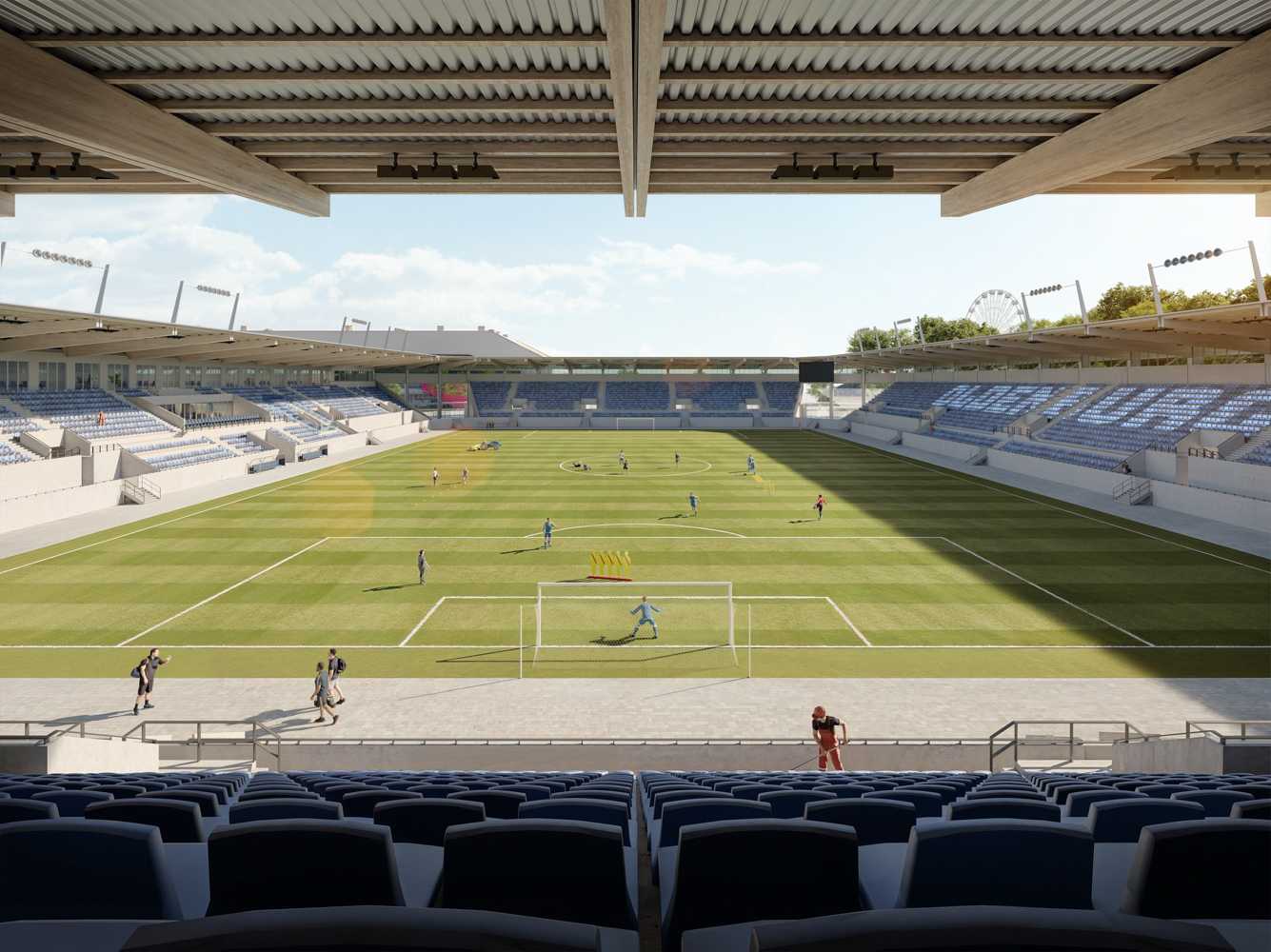
The new stadium is set to be built in a traditional football layout with four separate stands on each side of the pitch. The stands will be connected by a unified flat roof, giving the structure a coherent appearance, while the “chamfered” corners will shape the stadium into an octagonal form.
The main stand on the western side will include boxes and VIP facilities and will be integrated with a building housing auxiliary and service areas. The stadium will also be equipped with two video screens and artificial lighting.
The arena will have a capacity of 10,604 spectators, including 4,409 standing places. Nearly 100 spaces will be reserved for wheelchair users. The stadium will also include catering facilities and restrooms. In the future, expansion to a capacity of 15,000 spectators will be possible.
The stands will be constructed in reinforced concrete, while the roof structure will be supported by timber elements, which in combination with high-quality materials is intended to give the stadium a distinctive and aesthetically refined appearance.
The open corners will be enclosed externally with glass walls, allowing more natural light into the interior while also providing acoustic protection.
The facility will incorporate environmentally friendly solutions, including photovoltaic panels on the roof and a heat pump system. Parking spaces, bicycle facilities, and new tree plantings will be developed around the stadium.
Who will the new stadium in Oldenburg serve?
The stadium is intended to meet at least 3. Liga requirements and will primarily serve VfB Oldenburg. It will also be adapted for various cultural events. American football team Oldenburg Knights has also expressed interest in using the venue.
Where will the new VfB Oldenburg stadium be built?
The new stadium is planned for Maastrichter Straße, in the vicinity of the Weser-Ems-Hallen exhibition and event complex and the two sports halls collectively known as the EWE Arena. The site is located close to the city center and the main railway and bus station.
The area is also situated within the Donnerschwee district, in close proximity to the site of VfB Oldenburg’s former stadium (Stadion Donnerschwee). This carries a certain symbolic and emotional significance, and the idea of building the stadium in this location is sometimes described as a return to the club’s roots or an attempt to create a new “Hell of the North”.
When will the new VfB Oldenburg stadium be built?
Preparatory works are scheduled for summer 2026, while the start of main construction is planned for July 1, 2027. The new facility is expected to be completed at the end of 2028 or at the beginning of 2029. The total cost of the investment is €57.3 million.
Advertisement
Renderings
-
2026 © Stadion Oldenburg GmbH & Co. KG 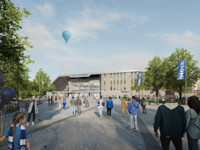
2026 © Stadion Oldenburg GmbH & Co. KG 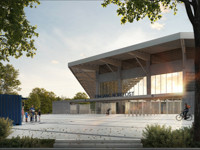
2026 © Stadion Oldenburg GmbH & Co. KG 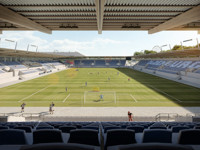
2026 © Stadion Oldenburg GmbH & Co. KG