 StadiumDB
Aloha Stadium
| Capacity | 31 000 |
|---|---|
| Country | United States of America |
| City | Honolulu |
| Clubs | Hawaii Rainbow Warriors |
| Category | Design awaiting implementation |
| Cost | $650 M |
| Construction | 2026–2029 |
Advertisement
Aloha Stadium – design description
How can the new Aloha Stadium project be summarized?
Aloha Stadium was the largest and most important stadium in Hawaii. Located near Pearl Harbor, it was known for its modular, movable stands and hosting the annual NFL all-star game (Pro Bowl).
Over time, corrosion of the steel structure led to growing concerns about the stadium’s stability. Initial plans to build a replacement for the aging stadium were developed even before its closure became necessary at the turn of 2020 and 2021.
However, preparations for the investment took a long time – it was not until 2024 that a private partner was selected, and demolition of the old facility began at the turn of 2025 and 2026.
Construction of the new venue is expected to begin in late 2026, with opening planned for 2029. More than half of the costs will be covered by the state authorities, while the remainder will be financed by private developers, who in return will be allowed to deliver a large commercial development around the stadium.
The new stadium will have a capacity of 31,000 (significantly less than its predecessor), with the possibility of future expansion to 40,000 seats. The seating bowl will be designed for a rectangular field, with a large upper tier and premium suites on the western side. Access to the stadium will be facilitated by the Skyline light rail system, which opened in 2023.
How did the plans for a new Aloha Stadium emerge?
What was the old Aloha Stadium like?
Opened in 1975, Aloha Stadium was the main stadium in Hawaii. It was built on the western outskirts of Honolulu, near Pearl Harbor (close to the Pearl Harbor National Memorial), and was owned by the state authorities.
The stadium was known for its steel stands divided into movable sections, which could be reconfigured depending on whether it hosted football, baseball games, or concerts. From 2007 onwards, the seating remained in a football configuration only. The capacity was 50,000.
Aloha Stadium was home to the Hawaii Rainbow Warriors college football team, as well as other teams. For many years, it served as the traditional host of the Pro Bowl (the NFL all-star game), and also staged the Hula Bowl (a college football all-star game), along with numerous other sporting events and concerts.
The condition of the stadium had been deteriorating for some time, with progressive corrosion of the steel structure being one of its most serious issues. In late 2020, a decision was made to close the stands to the public. The Hula Bowl was still played in early 2021, but without spectators, and it was the final event held at Aloha Stadium.
What steps were taken in response to Aloha Stadium’s ongoing deterioration?
As early as 2016, the Stadium Authority commissioned a comprehensive report on the condition of the structure, which was prepared by Wiss, Janney, Elstner Associates (WJE).
In 2017, Foley & Lardner LLP developed a study on potential redevelopment. The study also included an initial concept for a replacement for Aloha Stadium, created by Populous.
What were the next steps toward building a new Aloha Stadium?
The new stadium was planned in cooperation with a private partner, who, in exchange for building the stadium, would receive the opportunity to carry out a development project around it. Part of the construction costs of the new stadium was to be covered by the state authorities.
The project was named the New Aloha Stadium Entertainment District. In 2019, the state approved $350 million in funding for the stadium and commissioned another report presenting three design options for the new stadium and the surrounding development, prepared by Crawford Architects.
When Aloha Stadium closed at the turn of 2020 and 2021, the state was left without a large venue for major events, and the Hawaii Rainbow Warriors moved to the much smaller Clarence T. C. Ching Athletics Complex.
The need for a new stadium became even more urgent, yet the process proceeded slowly and was delayed for several more years.
It is worth noting that on June 30, 2023, the Hālawa station opened near the stadium on Honolulu’s new Skyline light rail line. In the future, the station is expected to greatly improve access to the stadium and the surrounding commercial complex.
When was a private developer selected for the new Aloha Stadium?
At the end of 2023, the state issued a Request for Proposals (RFP) to select the main developer responsible for the project. In March 2024, two consortia – Aloha Hālawa District Partners and Waiola Development Partners – were shortlisted, with one to be chosen as the winner.
In June 2024, Waiola Development Partners withdrew from the process, leaving Aloha Hālawa District Partners as the sole candidate and, effectively, the winner.
The Aloha Hālawa District Partners (AHDP) consortium is composed of the following entities:
- Developers: Development Ventures Group, Stanford Carr Development, Ameresco, Aloha Stadium Community Development
- Architects: RMA Architects, Populous, SB Architects, Henning Larsen, Alakea Design Group, WCIT Architects
- General contractors: Hawaiian Dredging Construction Company, AECOM Hunt
- Other partners: Castle & Cooke Hawaii, Wilson Okamoto Corp
In November 2024, Aloha Hālawa District Partners unveiled the first renderings of their new stadium and surrounding development. Updated plans were released in early 2026, following the start of demolition of the old stadium.
When will the new Aloha Stadium be built?
Demolition of the long-unused Aloha Stadium began in late 2025, with work intensifying in March 2026. Once demolition is complete, construction of the new stadium is expected to start in late 2026, with opening planned for 2029.
The stadium will be among the first components to be built within the larger New Aloha Stadium Entertainment District project. Initial development investments around it will also begin, though the full plan is expected to take 20 to 30 years to complete.
The total project is estimated to cost $4 billion. The stadium itself is expected to account for $650 million, with $350 million covered by the state and the remaining $300 million financed by private developers.
What does the new Aloha Stadium plan include?
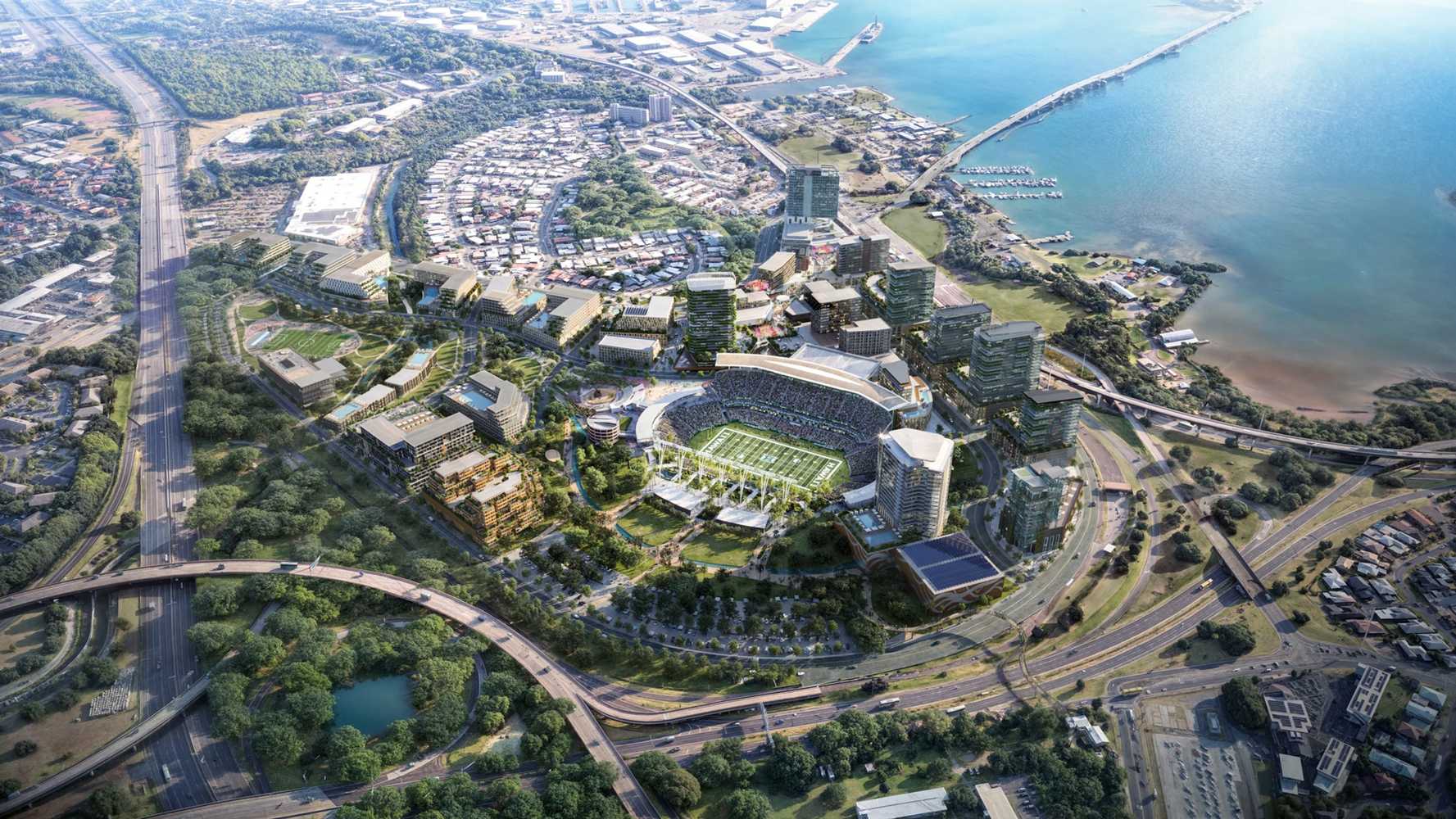
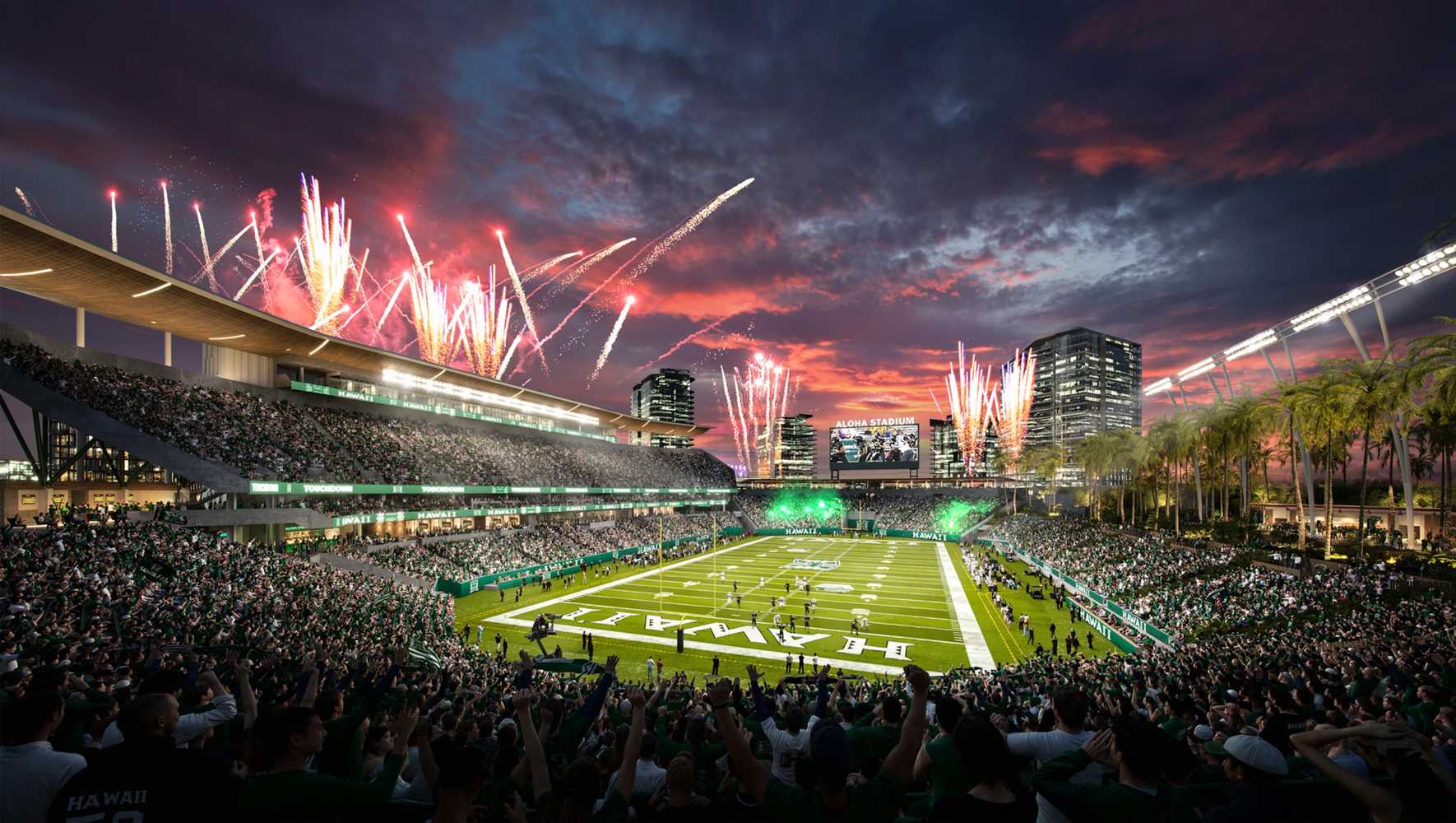
The project calls for a completely new stadium to be built on the site of the former Aloha Stadium. The seating bowl will be designed for a rectangular field, suitable for American football as well as soccer and rugby.
The tallest, western stand will feature an extensive upper tier and premium suites. The stadium will have a capacity of 31,000 – significantly less than its predecessor – with all spectators provided individual seats.
The design allows for future expansion of the end zone stands with a second tier, which would increase capacity to 40,000 seats.
The surrounding area is planned to include a major development project, featuring new apartments, hotels, offices, restaurants, and retail spaces.
Advertisement
Renderings
-

2026 © Aloha Hālawa District Partners 
2026 © Aloha Hālawa District Partners