 StadiumDB
Oklahoma City Stadium
| Capacity | 10 000 |
|---|---|
| Country | United States of America |
| City | Oklahoma City |
| Clubs | OKC for Soccer |
| Category | Design being implemented |
| Cost | $121 M |
| Construction | 2026–2027 |
| Design | Populous |
| Contractor | Lingo Construction |
Advertisement
Oklahoma City Stadium – design description
What is the Oklahoma City Stadium project in brief?
OKC Energy FC was unable to meet the growing infrastructure requirements of the USL Championship, leading the club to withdraw from the league before the 2022 season. However, the team was expected to return after a few years, with a new stadium already in the planning stages, made possible through funding from the city’s MAPS 4 development program.
The stadium is planned near downtown Oklahoma City, on a plot freed up after the demolition of a former cotton mill.
The attractive location drew private investors, who were interested not only in carrying out real estate projects around the stadium but also in getting involved with the club itself, which is set to receive new branding and a new name ahead of its return to competition.
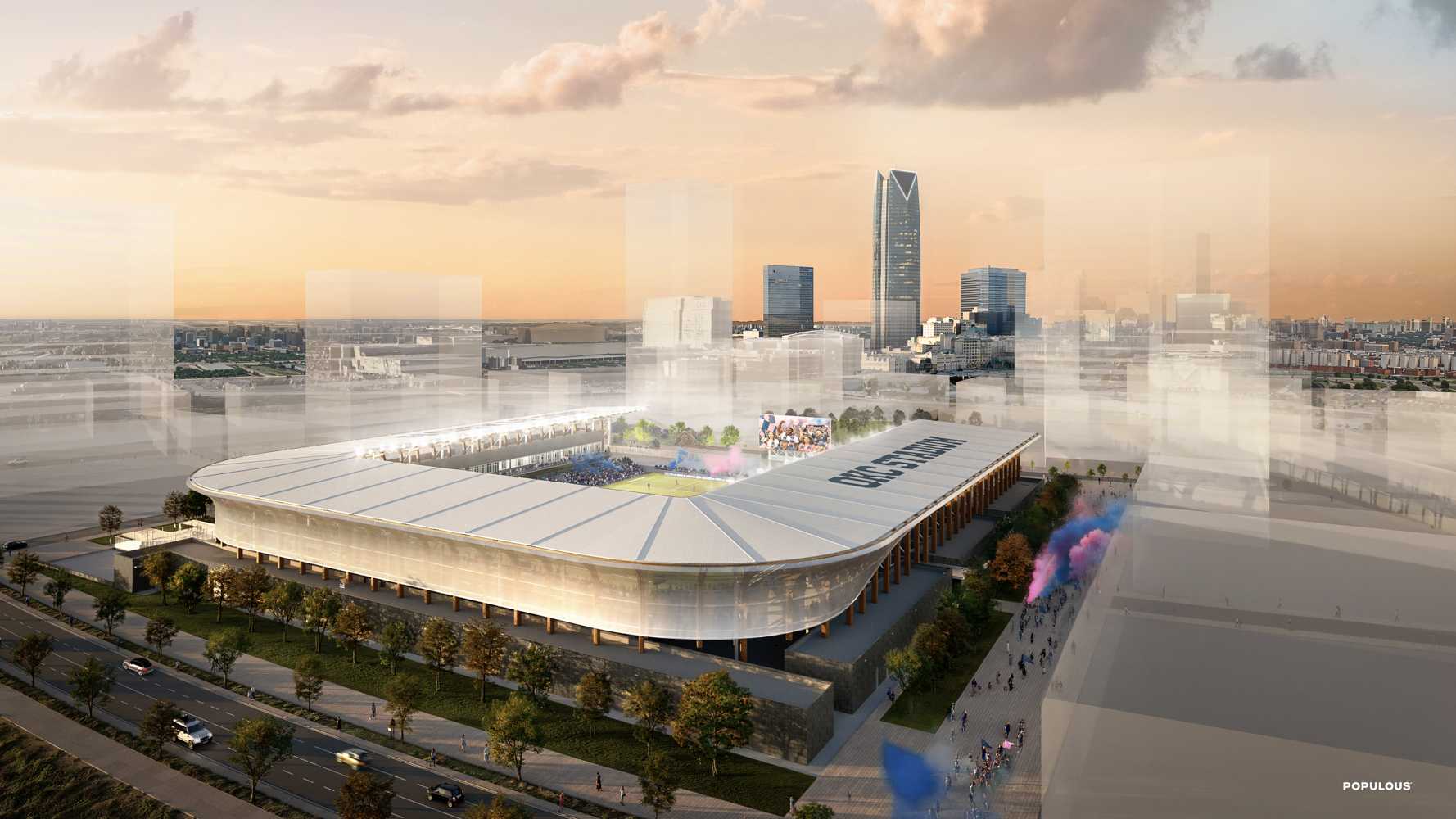
The investors hired the renowned architectural firm Populous to work on the project. Their vision includes a U-shaped soccer stadium that opens toward the downtown skyline. The design draws inspiration from Oklahoma’s landscapes, while the venue is planned to accommodate 10,000 spectators.
Construction of the stadium officially began on June 1, 2026. The venue is expected to be ready for the start of the 2028 season, when the team is set to return to USL.
When were plans for a new soccer stadium in Oklahoma City developed?
In 2013, a new soccer club, OKC Energy FC, was established in Oklahoma City. In 2014, the team joined the USL (then known as USL Pro, now USL Championship – the second tier of U.S. soccer, just below MLS).
After the 2021 season, the club decided to temporarily suspend its participation in the league because the modest Taft Stadium, where the team played its home games, no longer met the USL’s updated requirements. While the issue seemed minor (mainly related to field dimensions), necessary upgrades were not made, keeping the club out of competition for a longer period.
During this time, plans for a new arena for OKC Energy FC were already underway, made possible by the approval of the city’s MAPS 4 development program. This plan involved a temporary increase in the sales tax to finance various public investments in Oklahoma City. A key step was a vote on the MAPS 4 sales tax increase, held on December 10, 2019, in which residents approved the measure.
Among the 16 projects set to receive funding from the tax increase was the construction of a new stadium for OKC Energy FC. According to the original plan, $41 million from MAPS 4 was allocated for the stadium. Once the new stadium is completed, the club intends to return to the USL Championship.
How did the development of the new OKC Energy FC stadium progress?
Construction of the stadium did not begin immediately. In early 2024, the city increased the stadium budget by $30 million, bringing it to $71 million. This was intended to cover rising costs and allow for an expanded scope of the project, including increasing the planned capacity from 8,000 to 10,000 spectators.
A few months later, Echo Investment Capital became the majority owner of OKC Energy FC. The firm established a dedicated subsidiary, Echo Soccer, headed by Court Jeske, a soccer executive who previously served as CEO of MLS club Nashville SC and played a key role in the construction of the modern Geodis Park for the team.
According to the vision of the new owners, OKC Energy FC will receive completely new branding and a new name, to be determined in collaboration with the fans (the project is temporarily referred to as “OKC for Soccer”). The club also plans to establish a professional women’s soccer team.
On April 9, 2026, the United Football League (UFL) announced that it would expand for the 2028 season with a new team in Oklahoma City. The franchise will also be based at the new stadium.
Where will Oklahoma City Stadium be built?
The site for the stadium was selected on the grounds of the former Producers Cooperative Oil Mill. It was a large complex consisting of massive warehouses and industrial facilities, primarily used for processing cottonseed.
After the company relocated, the mill was closed in 2015, and between 2017 and 2018 almost all structures were demolished, leaving only the oldest grain elevator intact.
The cleared industrial site created an attractive, ready-to-develop plot located just south of downtown Oklahoma City, near Bricktown, close to a railway station and the intersection of highways I-40, I-35, and I-235.
Nearby are also the Paycom Center (home of the NBA’s Oklahoma City Thunder) and a whitewater kayaking course, which will host events for the 2028 Olympic Games.
The entire site covers 60 acres, of which 9 acres are planned for the stadium. The remaining 51 acres will be developed for real estate projects, which Echo Investment Capital plans to carry out in collaboration with Robinson Park and other partners.
The stadium itself will be primarily funded with public money, while investors see it as an important element of the project that will increase the area’s appeal and attract more visitors. As part of a mutually beneficial collaboration, the investors will donate the 9-acre stadium site to the city.
When was the Oklahoma City Stadium project developed?
After the club was taken over by new owners, preliminary renderings of the new stadium were created by LaBella Associates. In May 2025, however, it was announced that the final project would be handled by the renowned firm Populous. The design by Populous was first made public on December 3, 2025, one day before their presentation to the City Council.
What does the Oklahoma City Stadium design include?
The stadium is planned as a multi-purpose venue, designed to host a variety of events – sports (including soccer, lacrosse, and even rodeo) as well as non-sporting events such as concerts and festivals.
Despite its versatile use, the primary function will be soccer matches. Accordingly, the stands will have a rectangular layout, tailored to the dimensions of a soccer field. The arena’s capacity is expected to slightly exceed 10,000 spectators.
Tall, covered stands will be built on three sides, forming a U-shape. Only a few rows of seating and a large video board are planned behind the north end of the field, allowing the stadium to “open up” to the Oklahoma City skyline.
The stands will offer a wide range of seating options, from standard seats to sections for the most passionate fans, as well as exclusive suites on the west side.
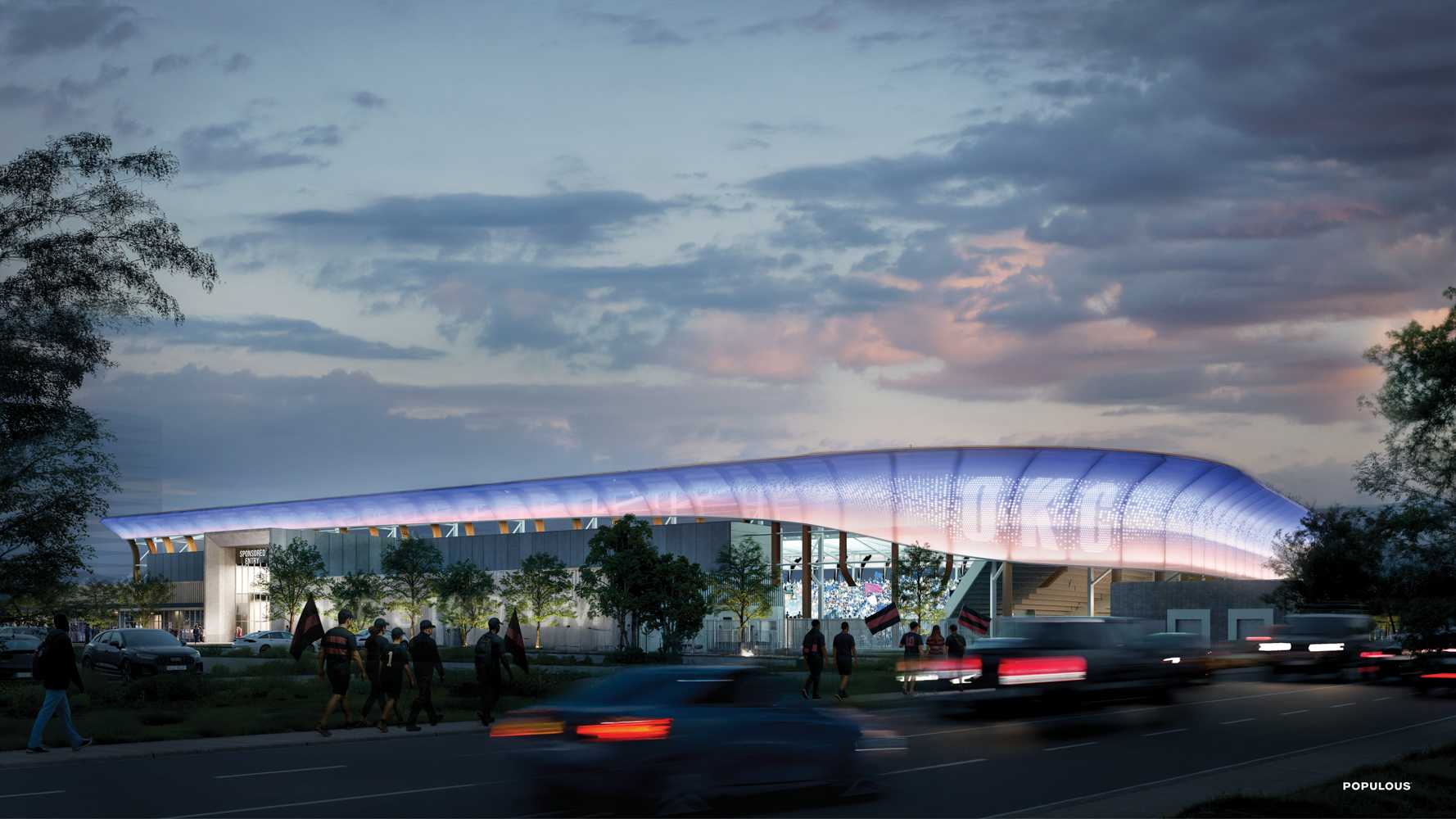
The exterior will be enhanced by a lightweight fabric façade. Its widest section will be on the south side, visible from Interstate 40. With its ability to display colorful images and animations, the façade can serve as an eye-catching advertising banner.
The entire design is inspired by the landscapes of Oklahoma, exemplified by the curved roof supports, which are intended to evoke stalks of wheat.
When will Oklahoma City Stadium be built?
In January 2026, Lingo Construction was selected as construction manager. The official groundbreaking ceremony, attended by Oklahoma City Mayor David Holt among others, took place on June 1, 2026. Construction is scheduled to continue through the end of 2027, allowing the venue to be ready for the start of the 2028 season, when a team from Oklahoma City is set to return to the USL Championship.
The estimated cost of the project is $121 million. A significant portion of the budget will come from public funds, including the MAPS 4 program, as well as Tax Increment Financing (TIF) and bond issuance. Private funding, including investments, donations, and sponsorship, will complement the financing.
Updates on the Oklahoma City Stadium construction can be found on a dedicated subpage
Advertisement