 StadiumDB
Mercedes-Benz Stadium
| Capacity | 71 000 |
|---|---|
| 7,500 (Business seats) | |
| Country | United States of America |
| City | Atlanta |
| Clubs | Atlanta United FC, Atlanta Falcons |
| Inauguration | 26/08/2017 (Atlanta Falcons – Arizona Cardinals) |
| Construction | 19/05/2014 – 08/2017 |
| Cost | $ 1.6 billion |
| Design | HOK, tvsdesign |
| Contractor | Hunt Construction Group, Holder Construction, H. J. Russell & Co. & C. D. Moody Construction Co. |
| Address | 1 AMB Drive NW, Atlanta, GA 30313, Atlanta, USA |
Advertisement
Mercedes-Benz Stadium – stadium description
Where does Mercedes-Benz Stadium get its name from?
The name Mercedes-Benz Stadium comes from a naming-rights agreement between the venue’s owner, AMB Group led by Arthur Blank, and the German automobile manufacturer Mercedes-Benz. The contract was signed in 2015, while the stadium was still under construction, and functions as a long-term naming-rights deal. The financial terms were not disclosed, but U.S. media emphasized that it ranks among the most valuable agreements of its kind in American sports, underscoring the prestige of the project.
Choosing a strategic title sponsor was a key element of financing and commercializing the stadium in Atlanta. The partnership with Mercedes-Benz was intended to align the venue with a brand associated with innovation, luxury and high quality, complementing the stadium’s futuristic concept. Since opening in 2017, the name has become integral to the stadium’s identity and marketing across both the NFL and Major League Soccer, where Atlanta Falcons and Atlanta United FC play their home games.
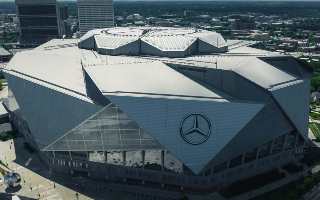
The Mercedes-Benz logo is prominently displayed on the building’s façade and on its signature retractable roof composed of eight movable panels. Sponsor branding plays an important role in the stadium’s visual identity and is widely recognized internationally, especially during broadcasts of major sporting events. This has helped the stadium become one of the most recognizable sports venues in the United States and a symbol of modern commercial partnerships in sport.
Where is Mercedes-Benz Stadium located?
Mercedes-Benz Stadium is located in Atlanta, the capital of the state of Georgia in the United States. The venue stands on the west side of Downtown Atlanta, making it one of the city’s central sports and commercial landmarks. The stadium’s location is closely tied to urban development and the revitalization of Atlanta’s western downtown.
The stadium was built in the Vine City neighborhood, directly adjacent to the Georgia World Congress Center and near Centennial Olympic Park. This area is part of the so-called Entertainment District,
which concentrates the city’s most important sports and events facilities and hosts major civic gatherings.
Mercedes-Benz Stadium occupies a site previously home to the Georgia Dome, the former arena of the NFL’s Atlanta Falcons. Its placement fits into the city’s urban plan to grow the downtown core as the metropolitan center of sports, business and entertainment.
What is the seating capacity of Mercedes-Benz Stadium?
Mercedes-Benz Stadium has an official capacity of about 71,000 seats for NFL games played by the Atlanta Falcons. The structure was designed with a modular approach, allowing the number of seats to be adjusted for different types of events. For major sporting occasions—such as NFL playoffs, the Super Bowl or college football championships—capacity can be increased to roughly 75,000 with temporary seating.
For Major League Soccer fixtures featuring Atlanta United FC, the stadium typically operates in a closed upper level
configuration, reducing capacity to around 42,500. This setup creates a more compact, intimate atmosphere for regular-season matches. For high-demand games, such as MLS playoffs or finals, the stadium opens to full configuration, pushing attendance above 70,000.
When was Mercedes-Benz Stadium opened?
Mercedes-Benz Stadium officially opened on August 26, 2017, after three years of construction. The formal launch followed a ceremonial topping-off and test events designed to verify the stadium’s technical and operational systems. Groundbreaking took place in 2014, and the project was delivered as a strategic investment for the City of Atlanta and the State of Georgia, replacing the aging Georgia Dome. The opening drew significant national media attention due to the venue’s innovative architecture and advanced technology.
The first official event held at the new stadium was the Chick-fil-A Kickoff Game in college football between the Alabama Crimson Tide and Florida State Seminoles. Staged soon after opening, it drew major fan and media interest and symbolically launched the venue’s operations. On September 10, 2017, the first Major League Soccer home game took place, with Atlanta United FC debuting at the new stadium—an event that kick-started the record-breaking MLS crowds for which the stadium quickly became famous.
The first NFL game at Mercedes-Benz Stadium was played on September 17, 2017, when the Atlanta Falcons defeated the Green Bay Packers in a regular-season matchup, further marking the sporting inauguration of the venue. In the months that followed, the stadium attracted numerous major sporting and entertainment events, rapidly becoming one of the most active multi-purpose arenas in the United States. Thanks to a carefully phased opening, Mercedes-Benz Stadium earned an immediate reputation as a modern, efficient venue fully prepared to host top-tier events.
Who uses Mercedes-Benz Stadium on a daily basis?
Mercedes-Benz Stadium is the home venue for two professional Atlanta clubs: the Atlanta Falcons of the National Football League (NFL) and Atlanta United FC of Major League Soccer (MLS). Both teams use the stadium for their home fixtures and as an operational base for sporting and marketing activities.
The Atlanta Falcons are the primary user, as team owner Arthur Blank led the investment and manages the venue through AMB Group. The NFL club plays all regular-season and playoff games here, and the stadium was designed with American football in mind, including an advanced audiovisual setup highlighted by the unique 360-degree Halo Board,
the only one of its kind in the world.
The stadium’s second permanent tenant is Atlanta United FC, which since its 2017 inception has quickly become one of MLS’s most popular clubs. The team consistently posts record soccer attendances in North America, and the venue can be converted to a soccer configuration, including concealing the upper deck to create a more compact atmosphere. Beyond these two clubs, the stadium hosts special events, but remains primarily the home of the Falcons and Atlanta United day-to-day.
What events have taken place at Mercedes-Benz Stadium?
Since opening in 2017, Mercedes-Benz Stadium has staged many prestigious events of national and international importance. In its first year, it hosted the Chick-fil-A Kickoff Game and the SEC Championship Game in college football—both of which continue to be played here regularly. In 2018, the venue hosted the College Football Playoff National Championship. The largest American-football event to date was Super Bowl LIII on February 3, 2019, between the New England Patriots and Los Angeles Rams.
The stadium also plays a central role in domestic and international soccer. Since 2017 it has hosted numerous Major League Soccer matches, including playoff games featuring Atlanta United FC, which celebrated its MLS Cup title here in 2018. The venue has also staged CONCACAF Gold Cup fixtures and international friendlies, and in 2024 it was one of the stadiums for the Copa América, including the tournament’s opening match. In 2026, Mercedes-Benz Stadium will be among the host venues for the FIFA World Cup, co-hosted by the United States, Canada and Mexico.
Beyond sports, the stadium is a major entertainment and cultural hub. It regularly hosts concerts by the world’s biggest artists—such as Beyoncé, Taylor Swift, Ed Sheeran and The Weeknd. It is also used for mass events, conventions, showcases and charity functions. Thanks to its multi-purpose design, modern infrastructure and large capacity, Mercedes-Benz Stadium has become one of the most active and prestigious event venues in the United States.
What does the architecture of Mercedes-Benz Stadium look like?
Mercedes-Benz Stadium features one of the most innovative and futuristic architectural forms among stadiums worldwide. Designed by HOK, the building showcases a dynamic, geometric mass inspired by a spiral motif. The façade combines vast glazed panels with aluminum cladding arranged to create a sense of motion. One signature exterior feature is the huge glass wall facing downtown Atlanta—the Window to the City
—which opens the interior to the skyline and floods the stands with natural light.

The most spectacular architectural element is the unique retractable roof composed of eight triangular panels that rotate and slide in a way reminiscent of a camera aperture or a mechanical eye.
This world-first solution allows the venue to transform from an enclosed stadium into an open-air arena within minutes. The roof works in concert with a natural ventilation strategy, reducing energy consumption and reinforcing the stadium’s sustainable design.
Inside, the venue is optimized for spectator comfort and modern event operations. The multi-tiered seating layout provides excellent sightlines from every seat. The visual centerpiece is the monumental circular LED display—the Halo Board—that encircles the upper edge of the roof above the field. With a circumference exceeding 330 meters, it is among the largest installations of its kind and a defining element of the stadium. Minimalist, contemporary interiors, exposed concrete and glass surfaces, and extensive commercial zones underscore the project’s cutting-edge character.

What amenities and technological solutions does Mercedes-Benz Stadium offer?
Mercedes-Benz Stadium is considered one of the most technologically advanced stadiums in the world, offering a broad range of modern amenities for fans and event organizers alike. Its showpiece is the aforementioned Halo Board—the first ever ring-shaped video display encircling an entire roofline—ensuring that game information, replays and animations are visible from every section. It is complemented by the NFL’s largest array of LED boards, including exterior displays that create striking visuals for night events.
The stadium provides an advanced digital infrastructure, delivering fast, free Wi-Fi for tens of thousands of users simultaneously. A network of thousands of access points enables smooth use of mobile apps, video streaming and interactive services around the venue. Mercedes-Benz Stadium also runs an extensive cashless operation, and many concession and retail points use Grab & Go
formats with automated checkout to reduce queuing times.
One distinctive amenity is the fan-friendly pricing philosophy known as Fan First Pricing,
which offers food and beverages at lower, fixed prices than at most U.S. stadiums. The venue also features advanced water and energy systems, including solar panels, rainwater harvesting and energy-efficient LED lighting. As a result, Mercedes-Benz Stadium holds LEED Platinum certification, the highest green-building rating. The blend of technology, comfort and sustainability makes it a model of modern sports infrastructure.
How can you get to Mercedes-Benz Stadium and what transport options are available?
Mercedes-Benz Stadium benefits from its central location in Atlanta. It is accessible via both public and private transport, enabling efficient ingress and egress during major sports and concert events. The venue sits near key city arteries such as Northside Drive and Martin Luther King Jr. Drive, facilitating car access from across the metro area. Several large on-site and nearby garages and surface lots are available, with advance online reservations offered for parking.
A crucial public transport option is the MARTA rail network (Metropolitan Atlanta Rapid Transit Authority). The closest stations—Vine City Station and GWCC/Philips Arena/CNN Center Station—are both within a short walk, leading many fans to choose rail to avoid traffic and parking constraints. Numerous MARTA bus routes in the vicinity connect the stadium with other parts of the city.
The venue is also pedestrian- and bicycle-friendly. In recent years, sidewalk and pedestrian links to the stadium have been expanded, and bike racks and bike-share docking points have been added. During major events, designated rideshare zones for services like Uber and Lyft operate as a popular alternative. Thanks to the diversity of transport options and its convenient location, the stadium remains easily accessible to both residents and visitors.
What sporting events are held at Mercedes-Benz Stadium?
Mercedes-Benz Stadium hosts numerous sporting events of national and international significance. Day-to-day, it serves two professional teams: the Atlanta Falcons of the NFL and Atlanta United FC of MLS. Regular-season and playoff fixtures for both leagues are played here, and the stadium has repeatedly set MLS attendance records, establishing itself as one of the most important soccer venues in the United States.
The stadium also plays a major role in college football. It regularly stages high-profile collegiate games such as the SEC Championship Game, the Peach Bowl, the Celebration Bowl and the Chick-fil-A Kickoff Game to open the season. In 2018, it hosted the College Football Playoff National Championship, and another title game is scheduled for 2025, highlighting the venue’s importance within the college football structure.
Mercedes-Benz Stadium has also staged events at the very pinnacle of American sport. In 2019 it hosted Super Bowl LIII, one of the world’s most prominent sporting spectacles. The venue is increasingly central to international soccer as well, having hosted CONCACAF Gold Cup matches and the Copa América 2024 opening match. It has also been selected as a host venue for the 2026 FIFA World Cup, where it will stage multiple matches.
What attendance records have been set at Mercedes-Benz Stadium?
Mercedes-Benz Stadium has repeatedly set attendance records in both American football and soccer. The highest official figures come from NFL games featuring the Atlanta Falcons, when the stadium operates at maximum configuration. During playoff matchups, attendance has exceeded 75,000, the highest achieved at the venue.
The stadium is equally renowned for MLS records. Atlanta United FC matches have regularly drawn the league’s largest crowds, with the club repeatedly breaking its own marks. The highest single-game attendance was recorded on August 11, 2018, against Seattle Sounders, drawing 72,243 spectators. As a result, Mercedes-Benz Stadium has hosted the most-attended matches in MLS history.
Record interest has also accompanied special events. The Copa América 2024 opener drew a massive crowd, and the 2018 MLS Cup final—won by Atlanta United in front of roughly 73,000 fans—also filled the stadium. These numbers confirm Mercedes-Benz Stadium as one of the most popular and intensively used sports venues in the United States.
Has Mercedes-Benz Stadium undergone renovations or expansions?
Since opening, Mercedes-Benz Stadium has undergone several technical upgrades and refinements, though not large-scale architectural expansions. In the early period of operation, issues with the retractable roof mechanism meant that for a time the roof could not function automatically and required manual control. Work to fully mechanize and calibrate the system concluded in mid-2018, and in July the stadium demonstrated smooth opening and closing in the designed time of about eight minutes.
In subsequent years, several important infrastructure modifications and amenities were added. In 2018, additional egress doors and main entrances were installed to reduce congestion and improve crowd flow during major events. In January 2019, a pedestrian bridge over the street was completed at a cost of around $33 million, featuring an impressive glazed span and LED lighting, which improved pedestrian access to the venue.
Another upgrade involved replacing the playing surface. In 2019, the artificial turf was replaced with a new system as part of ongoing capital investment, with plans to refresh the surface roughly every two seasons. In 2024, to meet Copa América requirements, natural grass was temporarily laid over the artificial base for soccer matches. Despite these upgrades, the stadium has not seen major structural additions or a reworked building form—the adaptations have focused mainly on mechanical systems, event infrastructure and operational amenities. In recent years, the in-house production center has also been modernized—by 2024, new visual production control technologies (SMPTE 2110 systems) were implemented in the control rooms, improving broadcast execution and media event operations.
What are the future plans for Mercedes-Benz Stadium?
Future plans for Mercedes-Benz Stadium focus on further developing the infrastructure and strengthening the venue’s status as one of the most advanced multi-purpose arenas in the world. In the coming years, expansions of premium areas and hospitality spaces are planned to enhance attendee comfort and increase the stadium’s commercial potential. One announced project is the creation of new exclusive areas—such as the 300 Level Club and additional hospitality lounges—to be used for NFL and MLS games as well as special events.
Ongoing plans also include continued modernization of the stadium’s technological systems. These include new LED boards at field level and expanded digital infrastructure for live sports broadcasts. The venue is also investing in innovative spectator-service solutions such as automated retail systems, expanded self-service zones and upgraded audiovisual systems to deliver even more immersive show experiences.
Mercedes-Benz Stadium is preparing for major international events, which requires meeting additional technical and organizational standards. In connection with the 2026 FIFA World Cup, natural grass will be installed for soccer, and selected areas of the stadium will be adapted to FIFA specifications. The venue will also continue collaborating with the City of Atlanta on urban projects in the surrounding area, including the expansion of the Centennial Yards district, further reinforcing its role as the region’s leading sports and entertainment hub.
Advertisement
Pictures
-

29.05.2024 © Grzegorz Kaliciak 
29.05.2024 © Grzegorz Kaliciak 
29.05.2024 © Grzegorz Kaliciak 
30.05.2024 © Grzegorz Kaliciak 
30.05.2024 © Grzegorz Kaliciak 
29.05.2024 © Grzegorz Kaliciak 
30.05.2024 © Grzegorz Kaliciak 
30.05.2024 © Grzegorz Kaliciak 
30.05.2024 © Grzegorz Kaliciak 
30.05.2024 © Grzegorz Kaliciak 
29.05.2024 © Grzegorz Kaliciak 
29.05.2024 © Grzegorz Kaliciak 
29.05.2024 © Grzegorz Kaliciak 
29.05.2024 © Grzegorz Kaliciak 
29.05.2024 © Grzegorz Kaliciak 
30.05.2024 © Grzegorz Kaliciak 
29.05.2024 © Grzegorz Kaliciak 
29.05.2024 © Grzegorz Kaliciak 
29.05.2024 © Grzegorz Kaliciak 
30.05.2024 © Grzegorz Kaliciak 
29.05.2024 © Grzegorz Kaliciak 
29.05.2024 © Grzegorz Kaliciak 
29.05.2024 © Grzegorz Kaliciak 
29.05.2024 © Grzegorz Kaliciak 
29.05.2024 © Grzegorz Kaliciak 
29.05.2024 © Grzegorz Kaliciak 
29.05.2024 © Grzegorz Kaliciak 
29.05.2024 © Grzegorz Kaliciak 
30.05.2024 © Grzegorz Kaliciak 
30.05.2024 © Grzegorz Kaliciak 
08.2017 © Atlanta Falcons / Mercedes-Benz Stadium 
01.01.2018 © elisfkc (CC BY-SA 2.0) 
08.2017 © Atlanta Falcons / Mercedes-Benz Stadium 
01.01.2018 © elisfkc (CC BY-SA 2.0) 
01.01.2018 © elisfkc (CC BY-SA 2.0) 
01.01.2018 © elisfkc (CC BY-SA 2.0) 
08.2017 © Atlanta Falcons / Mercedes-Benz Stadium 
24.11.2019 © Lisa Ferdinando, U.S. Secretary of Defense (CC BY 2.0) 
08.2017 © Atlanta Falcons / Mercedes-Benz Stadium 
16.10.2017 © Bruno Valenzano 
16.10.2017 © Bruno Valenzano


Related news
2026
-
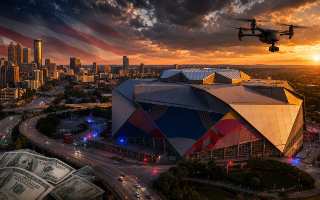
USA: Inside the billion-dollar machine behind World Cup 2026. Costs, controversy and complexity
Although the 2026 FIFA World Cup will be a joint effort of the United States, Canada and Mexico, it is the USA that bears the greatest organizational burden of the tournament. Most matches — including the final — will be played on American soil, which has required massive investment in stadiums, transport and security systems.
-
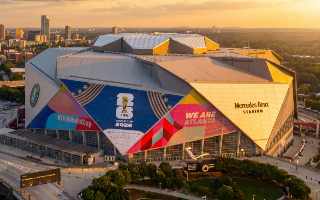
WC 2026: How US stadiums are preparing for the World Cup? Grass, construction, and criticism
Preparations for the 2026 FIFA World Cup involved extensive upgrades that transformed NFL venues into stadiums meeting FIFA requirements. The key changes included switching to natural grass surfaces, adjusting pitch geometry and expanding technical infrastructure and operational facilities.
-
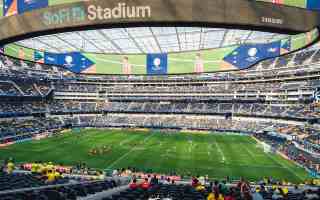
USA: A revolution underfoot. Have scientists perfected the World Cup pitch?
For eight years, scientists have been working on a pitch designed to withstand the biggest World Cup in history. As BBC reports, the grass for the 2026 FIFA World Cup will not be just another part of the stadium, but the result of advanced research, testing and technological refinement of every detail.
-
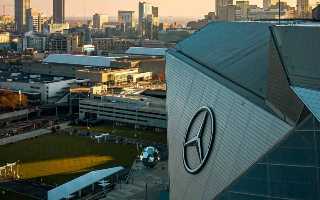
USA: The logo is too large for FIFA to cover. A unique case at Mercedes-Benz Stadium
The World Cup reshapes even the most iconic stadiums. Mercedes-Benz Stadium will lose its name and almost all branding for 2026—except for one detail that makes Atlanta stand out from the rest.
2025
-
World Cup 2026: Key matches and stadiums for the biggest national teams
As the 2026 World Cup schedule takes shape, fans around the globe are eagerly planning the football journey of a lifetime. This could be the final chance to witness Messi and Ronaldo shine on the world’s biggest stage! Here’s where the top national teams will play, which stadiums will host their battles, and how to track ticket availability before it’s too late.
-
USA: World Cup 2026 under extreme heat as stadiums surpass safe limits
Ten of the 16 stadiums set to host the 2026 FIFA World Cup in the United States, Canada and Mexico currently exceed safe playing limits due to extreme temperatures, according to a report by Football for Future, Common Goal and Jupiter Intelligence.
-
USA: One year to the 2026 World Cup! Did the Club World Cup test deliver?
A new format and a major dress rehearsal ahead of the 2026 World Cup. From political undertones and turbulent weather conditions to controversies over attendance and pitch quality – did the expanded edition of the Club World Cup live up to expectations?
-

WC 2026: Infantino shocked by… summer? Heatwave exposes FIFA unprepared
FIFA president Gianni Infantino announced that during the 2026 World Cup, to counter expected heat, matches scheduled for early hours will be played primarily in stadiums that are covered and air-conditioned.
-
USA: Inside Club World Cup 2025. Stadiums, format and controversy
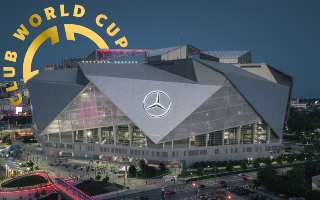
The 21st edition of the FIFA Club World Cup is about to begin — and this time, the United States will host the tournament for the first time in its history. Along with a new host comes a complete overhaul of the competition’s format. Here's your full guide to the 2025 Club World Cup.
2024
-
USA: World Cup 2026 stadiums to host 2025 Club World Cup as a dress rehearsal
The 12 US stadiums that will host 2025’s new look FIFA Club World Cup have been named, with many of these already preparing for what follows in 2026, namely the biggest sporting event on the planet, the FIFA World Cup.
-
USA: Stadiums for 2025 FIFA Club World Cup revealed!
FIFA has announced the names of 12 stadiums that will host the revamped Club World Cup in the United States next year. The tournament, scheduled from June 15 to July 13, 2025, will be the first edition of the expanded competition, featuring 32 teams.
-
USA: Mercedes-Benz Stadium ranked among the top NFL stadiums for food
Foodies rejoice! Mercedes-Benz Stadium, the home of the Atlanta Falcons, has earned acclaim for its exceptional fare, ranking fourth among NFL stadiums for food. A recent study evaluated stadiums based on concession variety, pricing, and fan reviews. While AT&T Stadium in Texas stole the spotlight, Mercedes-Benz stands out for its wallet-friendly offerings, with hot dogs, soft drinks, and popcorn priced at just $2.
-

Copa América 2024: Empty seats, narrow pitches, high prices and heat - failure ahead of World Cup
The Copa América 2024, taking place in the USA, was supposed to be a spectacular event. However, the decision to use smaller sized pitches and high ticket prices caused a wave of controversy among managers, players and fans, which could be seen in the stands.
-
USA: Players and coaches complain about Copa América organization. "It's frustrating"
A few days ago, top-tier soccer arrived in the United States, but one aspect is causing significant concern – the turf. "Catastrophic," "frustrating" - these are just some of the terms used to describe the pitches at the stadiums hosting the Copa América 2024 tournament.
-

Copa América: World Cup teaser in Euro 2024 shadow
16 teams, 14 stadiums, 2 federations plus two national teams from the top five of the FIFA ranking - Copa América 2024 promises to be extremely interesting. The tournament will not only be a foretaste of the upcoming World Cup, but also a serious test for the U.S. as host of a major sporting event. There is also no shortage of controversy.
-

World: All stadiums with 360-degree video board
Real Madrid boasts it, Barcelona gives it up. The first 360-degree video board in a stadium appeared in the United States. In Europe it was pioneered by a rather unexpected venue. Is having a panoramic screen crucial?
-
World Cup 2026: Locations, stadiums and schedule
FIFA has already announced the details of the 2026 World Cup, which will be held in the USA, Mexico and Canada. As happens when a tournament of this size is co-hosted by several countries, there was no shortage of controversial decisions. So let's check what we already know about the 2026 World Cup.
2023
-

World Cup 2026: A guide to all the stadiums from the USA
Every World Cup is a unique event. Every four years, the tournament transports spectators to a different part of the globe, offering a fresh perspective on the beauty of football. What can you expect to see in the USA this time? And above all - which stadiums will host the participating teams?
-

USA: Atlanta and Miami - centre of Copa America 2024
Copa America 2024 will kick off at Mercedes-Benz Stadium in Atlanta before culminating at Hard Rock Stadium in Miami. This is a significant event as the tournament takes place outside its home continent for the second time, promising an electrifying atmosphere in these iconic arenas.
