 StadiumDB
Dignity Health Sports Park
| Capacity | 27 000 |
|---|---|
| Country | United States of America |
| City | Carson |
| Clubs | LA Galaxy |
| Other names | Home Depot Center (2003–2013), StubHub Center (2013–2018) |
| Inauguration | 07.06.2003 (Los Angeles Galaxy – Colorado Rapids) |
| Record attendance | 27 000 |
| Cost | $ 150 million |
| Address | 18400 Avalon Blvd., Carson, CA |
Advertisement
Dignity Health Sports Park – stadium description
Where does Dignity Health Sports Park get its name?
The name Dignity Health Sports Park comes from Dignity Health, one of the largest hospital and healthcare networks in the United States. Based in San Francisco, the organization operates as part of the non-profit CommonSpirit Health group and manages hundreds of hospitals, clinics, and rehabilitation centers across multiple states. Its mission focuses on promoting community health and well-being through ethical and accessible care — a vision reflected in the stadium’s name.
Naming rights to the facility were acquired by Dignity Health in 2019 under a sponsorship agreement that replaced the previous deal with telecommunications company StubHub. Between 2013 and 2018, the venue was known as StubHub Center, and before that, from its opening in 2003, as The Home Depot Center. The change to Dignity Health Sports Park was meant to emphasize local identity and values tied to health, active living, and community well-being, especially in the context of youth and family sports.
The choice of Dignity Health as title sponsor also carried symbolic meaning — the name reflects the idea of respect and dignity
in both sport and everyday life. The agreement covers not only the main soccer stadium but the entire sports complex in Carson, including training fields, tennis courts, and track and field facilities.
Where is Dignity Health Sports Park located?
Dignity Health Sports Park is located in Carson, a city in the southern part of Los Angeles County, California, approximately 25 kilometers south of downtown Los Angeles. The stadium sits within the campus of California State University, Dominguez Hills (CSUDH), making it an integral part of a large academic and athletic complex.
The venue is close to two major highways — Interstate 405 (San Diego Freeway) and Interstate 110 (Harbor Freeway) — which provide quick access to downtown Los Angeles, Long Beach, and other parts of the metropolitan area. This location makes it convenient for both local residents and visitors from outside the region.
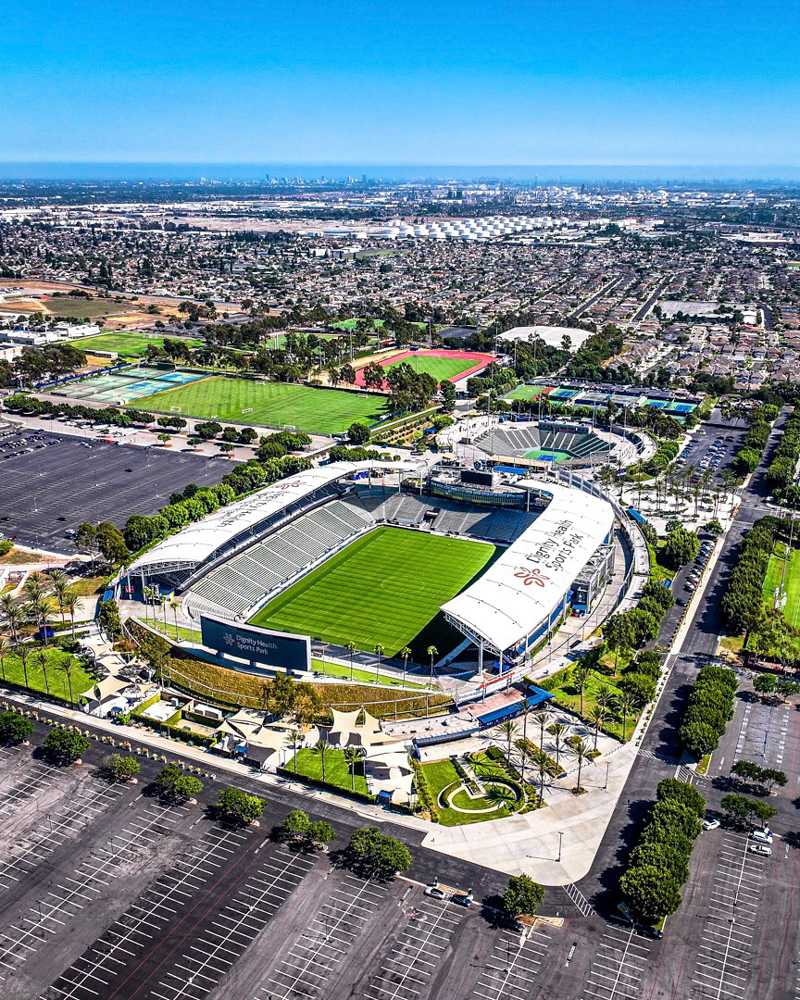
The stadium is situated on the southern edge of the university campus, surrounded by athletic and green areas, just a few kilometers from the Pacific coast. Its location in Carson provides a balance between accessibility and space for expansion, making Dignity Health Sports Park one of the best-positioned stadiums in Southern California.
What is the capacity of Dignity Health Sports Park?
Dignity Health Sports Park has a capacity of approximately 27,000 spectators, making it one of the largest soccer-specific stadiums in the United States. The capacity was designed to balance scale and atmosphere — the steep, close-to-the-pitch stands create an immersive and intimate fan experience.
The stadium was built with a modular design that allows the number of seats to be adjusted depending on the event. For concerts or major matches, capacity can temporarily increase to around 30,000 by utilizing field-level and temporary seating areas.
The continuous, enclosed seating bowl enhances the stadium’s acoustics and intensity, often compared to that of European arenas. Most seats are covered, and the venue offers a variety of experiences — from standard seating to VIP boxes and club lounges — meeting both event organizers’ and fans’ expectations for comfort and proximity to the action.
Compared to many other Major League Soccer venues, Dignity Health Sports Park stands out for its proportions and intimate design, creating a dynamic and electric matchday atmosphere when filled to capacity.
When was Dignity Health Sports Park opened?
Dignity Health Sports Park officially opened on June 7, 2003, following less than two years of construction. The inauguration coincided with LA Galaxy’s first home game of the MLS season against the Colorado Rapids, which ended in a 2–0 victory for the hosts. This match marked a new chapter in both the club’s history and the evolution of soccer in Los Angeles.
Construction began in 2001 and was completed at record speed considering the project’s scale and complexity. The total cost reached approximately $150 million, making it one of the most expensive and advanced soccer venues in the U.S. at the time.
The opening of what was then known as The Home Depot Center represented a milestone for American sports — it was the first purpose-built complex in the country designed to host soccer, athletics, tennis, and track cycling. The stadium quickly gained recognition as a model for future MLS developments and symbolized soccer’s growing presence in American sports culture.
Who uses Dignity Health Sports Park on a daily basis?
The main tenant of Dignity Health Sports Park is LA Galaxy, one of the most successful clubs in Major League Soccer (MLS) history. The team moved to the stadium in 2003 and has played all of its home matches there since. The venue also houses the club’s offices, training facilities, and youth academy, making it the operational heart of the organization.
In the past, the stadium was also home to Chivas USA, which shared the venue with LA Galaxy between 2005 and 2014. This made Dignity Health Sports Park one of the few U.S. stadiums to simultaneously host two top-division professional soccer clubs.
Beyond soccer, the stadium has accommodated other professional teams. From 2017 to 2019, it served as the temporary home of the NFL’s Los Angeles Chargers before their move to SoFi Stadium in Inglewood. It also hosts training sessions and events for USA Rugby and various collegiate and youth sports organizations.
The stadium is part of a larger multi-sport complex used year-round for events such as tennis, athletics, and cycling. This constant activity makes Dignity Health Sports Park one of the most vibrant and important sports hubs in Southern California.
What events have been held at Dignity Health Sports Park?
Since its opening in 2003, Dignity Health Sports Park has hosted numerous prestigious sporting and cultural events, establishing itself as one of the leading multi-purpose venues in the United States. The stadium regularly stages Major League Soccer matches, including LA Galaxy’s home games and multiple MLS Cup Finals — in 2003, 2004, 2008, 2011, and 2012. It was here that LA Galaxy secured several of its championship titles, often in front of sold-out crowds.
In addition to soccer, the stadium has hosted a wide variety of sporting events. Between 2017 and 2019, it was home to the NFL’s Los Angeles Chargers, making it one of the few U.S. venues to accommodate both American football and soccer. The complex has also welcomed rugby matches, including international fixtures and World Rugby Sevens Series events, as well as athletics competitions and tennis tournaments held at neighboring facilities.
Dignity Health Sports Park has also hosted U.S. national team matches — for both men and women — along with CONCACAF tournaments, including Gold Cup fixtures. Its facilities and location in Carson make it a frequent choice for major international sporting events organized by the U.S. Soccer Federation.
Beyond sports, the stadium serves as a cultural venue, hosting concerts, festivals, and charity events that attract audiences from across California.
What is the architecture of Dignity Health Sports Park like?
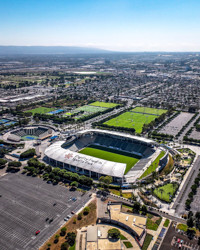
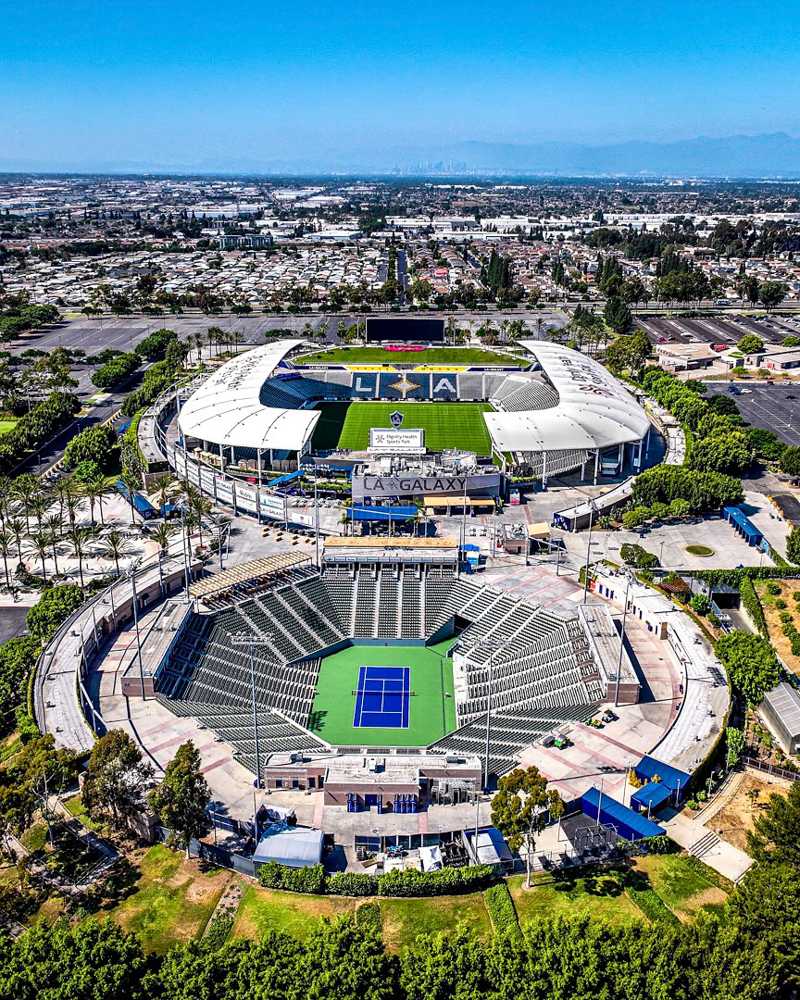
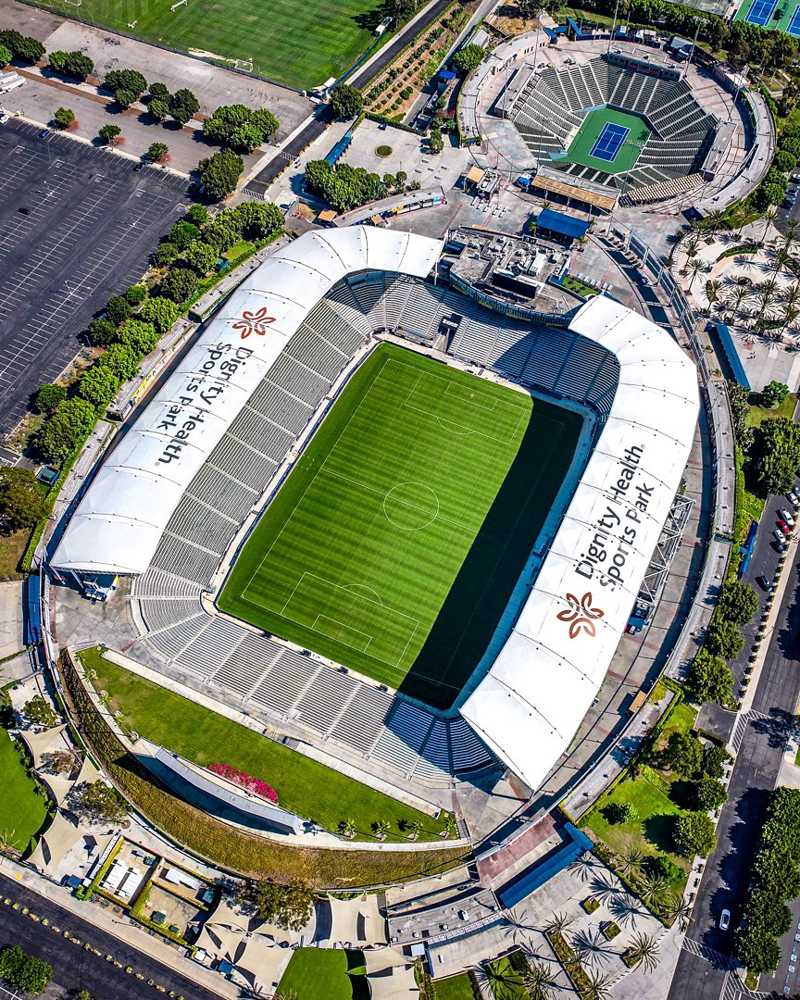
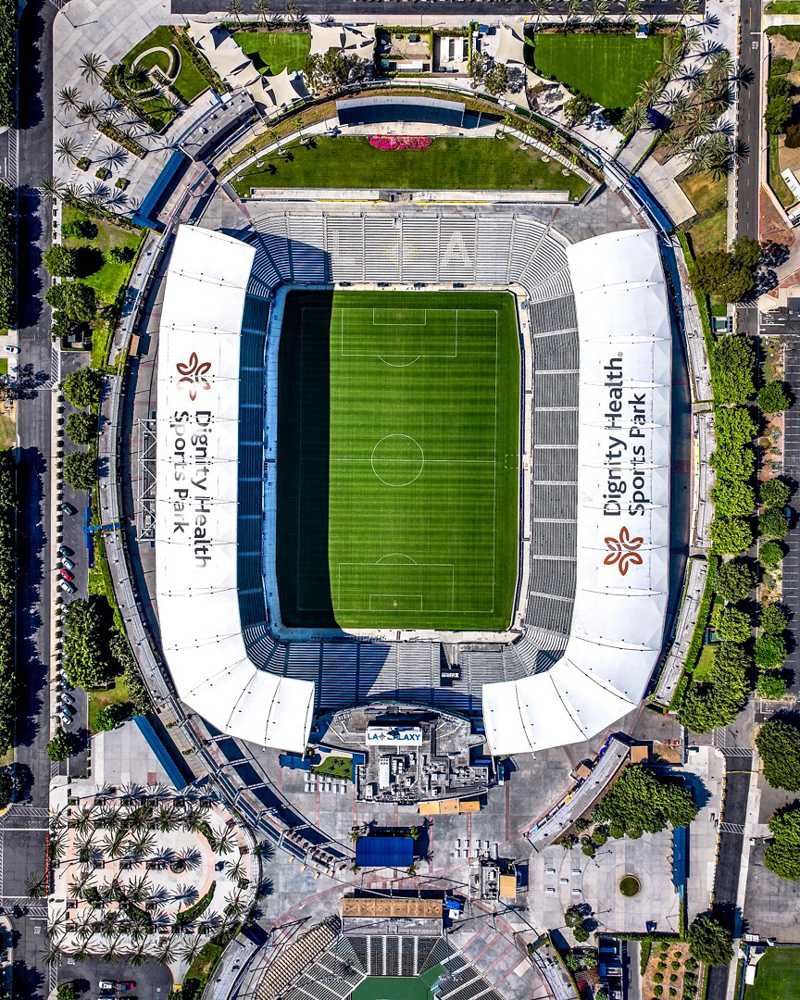
Dignity Health Sports Park was designed to combine functionality, modernity, and spectator comfort while maintaining the intimacy typical of soccer-specific venues. The design, created by Rossetti Architects, embraces an open concept that integrates seamlessly with the Southern California landscape and climate.
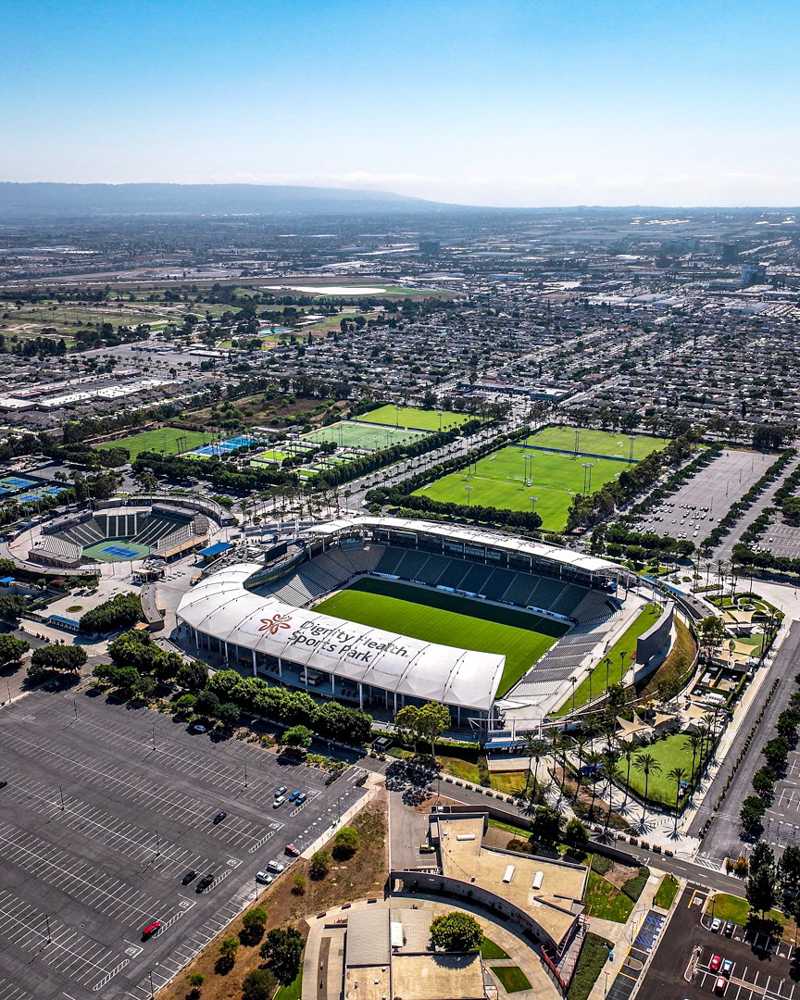
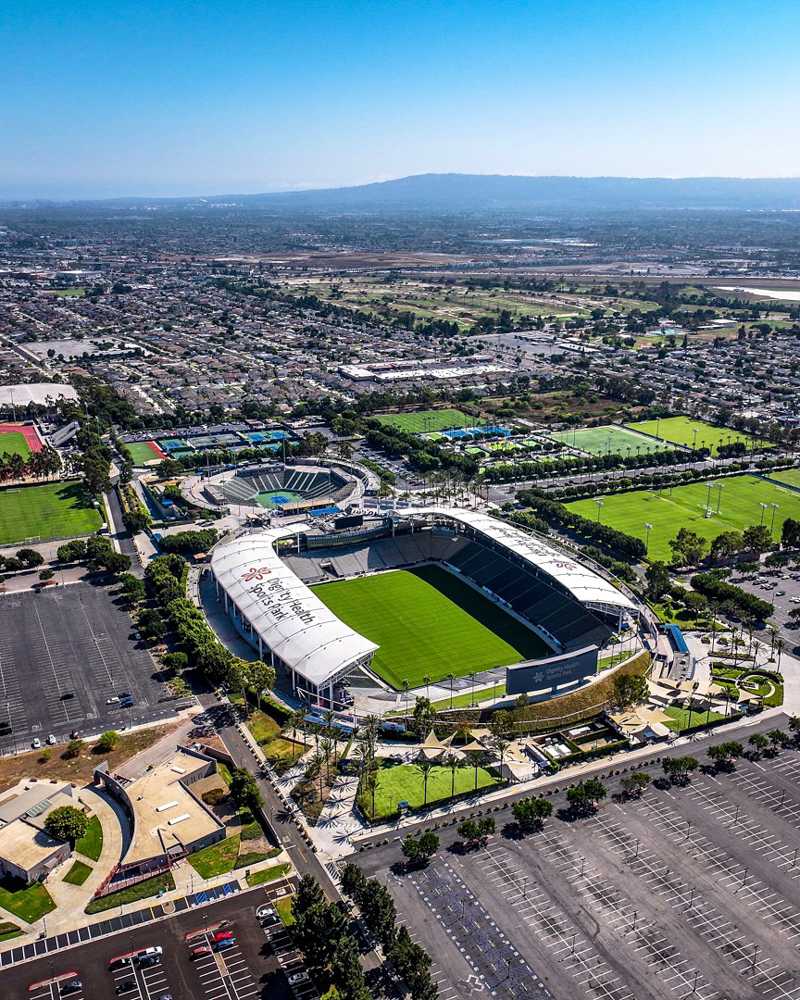
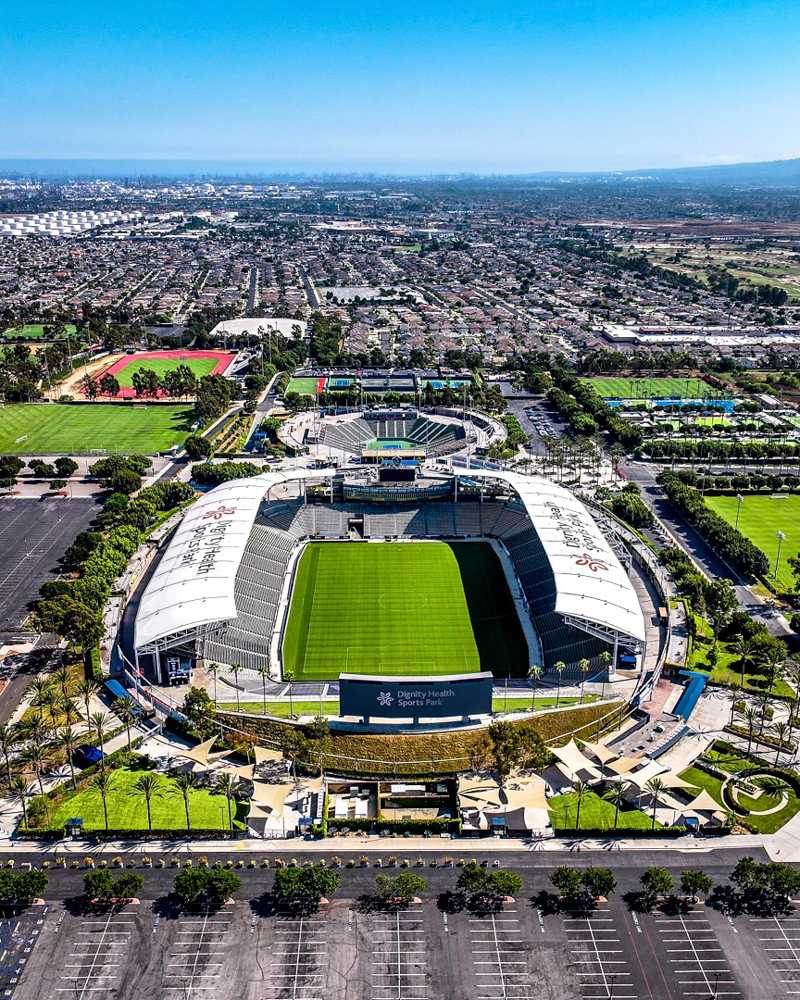
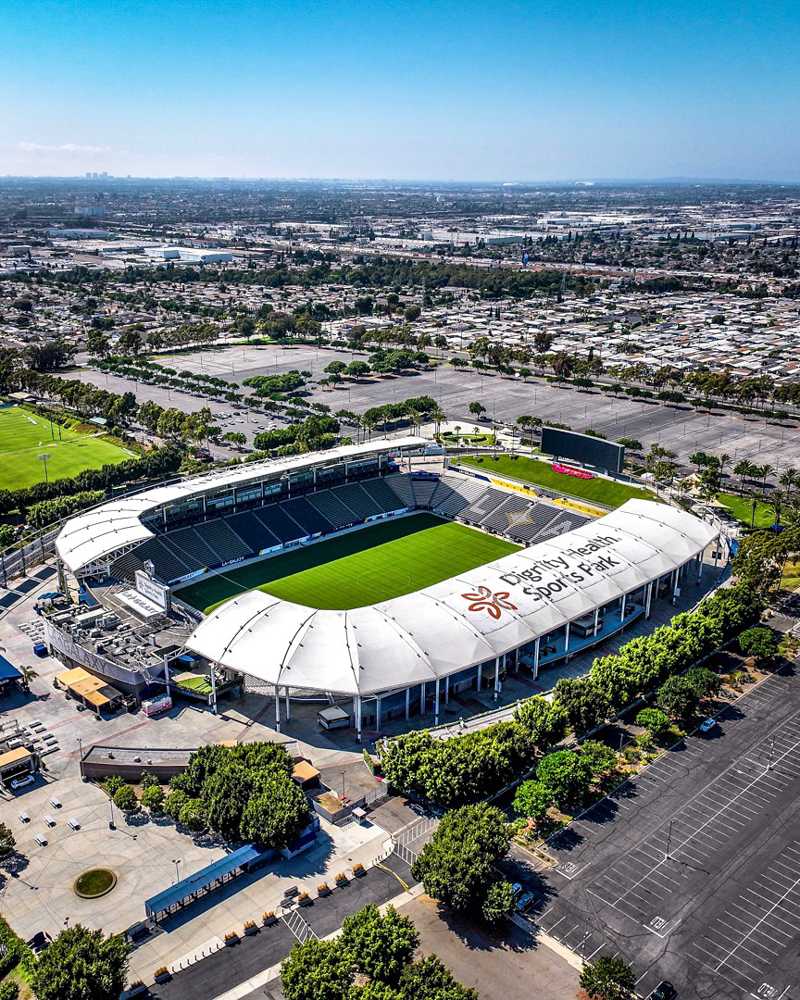
The structure features clean geometric lines and a light steel-and-concrete framework. Its relatively low profile and compact form ensure excellent sightlines from every seat. Most stands are covered to protect spectators from the sun while allowing natural airflow — a key consideration for the region’s warm weather. The roof’s slender steel supports contribute to the stadium’s airy, modern appearance.
The continuous seating bowl surrounds the pitch, creating a lively and enclosed atmosphere. The capacity of around 27,000 seats provides proximity to the field, enhancing the fan experience. The north end of the stadium houses the LA Galaxy supporters’ section, serving as the focal point for chants and matchday displays.
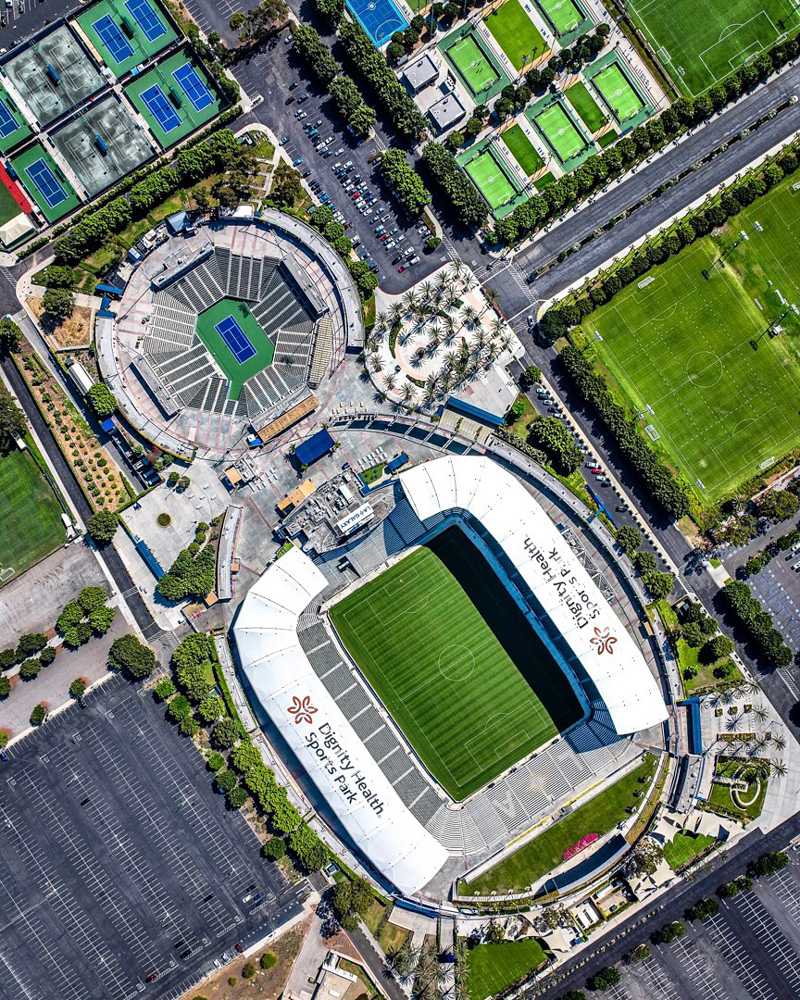
The architecture integrates seamlessly with the broader sports complex, which includes athletics tracks, tennis courts, a multi-purpose arena, and a velodrome. The design creates a cohesive and functional environment across the entire facility.
Visually, Dignity Health Sports Park embodies California minimalism — light-colored concrete, aluminum, and glass give the structure an elegant, timeless look. Natural landscaping and open promenades around the stadium enhance its ecological and spacious character.
What amenities and technological features does Dignity Health Sports Park offer?
Dignity Health Sports Park is a state-of-the-art complex combining convenience, functionality, and technology for fans, athletes, and event organizers alike. Since opening in 2003, it has undergone multiple upgrades to meet evolving MLS standards and international sporting requirements.
The venue features extensive multimedia infrastructure, including a high-definition LED scoreboard located behind the north goal, displaying replays, stats, and promotional content. A powerful sound system ensures consistent audio coverage throughout the stadium, while modern LED lighting supports dynamic visual effects and 4K broadcast capabilities.
To enhance the fan experience, the stadium includes numerous food and beverage outlets offering a variety of Southern California cuisine, bars, and food courts. VIP lounges, business suites, and banquet halls with panoramic views cater to premium guests. Wide concourses allow smooth circulation, with services and amenities strategically placed for convenience.
The stadium is fully accessible for visitors with disabilities, offering elevators, ramps, designated seating areas, and accessible restrooms. Complimentary Wi-Fi is available throughout, enabling fans to access club apps, order concessions, and view live stats in real time.
Dignity Health Sports Park also functions as a smart venue,
with centralized control systems managing lighting, energy, and security to improve efficiency and sustainability. Eco-friendly initiatives include waste separation, reduced single-use plastics, and water-saving installations.
Beyond soccer, the 125-acre complex includes indoor arenas, tennis courts, a velodrome, and multiple training fields, making it one of the most comprehensive sports facilities in the United States.
How can you get to Dignity Health Sports Park and what transport options are available?
Dignity Health Sports Park is located in Carson, Los Angeles County, at 18400 South Avalon Boulevard, about 25 kilometers south of downtown Los Angeles. Its strategic location between major highways — Interstate 110, Interstate 405, and State Route 91 — makes driving the most convenient option for most visitors, with easy access from surrounding cities like Long Beach, Torrance, and Anaheim.
The venue offers multiple parking lots, including general and VIP areas, all within short walking distance from the entrances. Parking is cashless, with payment via card or mobile app. Because of heavy traffic on event days, fans are advised to arrive early or purchase parking passes in advance.
Public transportation also serves the area. Several Metro Bus lines — including 51, 205, and 246 — as well as Torrance Transit and Long Beach Transit routes stop near the stadium. On matchdays, the free Galaxy Express shuttle operates between the venue and major transit hubs such as Harbor Gateway Transit Center and Del Amo Station.
Dedicated zones for rideshare services like Uber and Lyft are located at the intersection of Avalon Boulevard and 184th Street. The stadium area is also pedestrian-friendly, with nearby bus stops just a few minutes’ walk away.
What sporting events are held at Dignity Health Sports Park?
Dignity Health Sports Park serves as the home of LA Galaxy, one of the most iconic clubs in Major League Soccer (MLS). The stadium hosts all of the team’s home fixtures, including regular-season and playoff matches. It has also been the stage for multiple MLS Cup Finals, where LA Galaxy secured several championships, cementing its status as one of the league’s most historic venues.
In addition to MLS matches, the stadium hosts numerous international fixtures. The U.S. men’s and women’s national teams have both played here, alongside international friendlies and tournaments featuring clubs from Latin America and Europe. Events such as the CONCACAF Gold Cup, SheBelieves Cup, and Campeones Cup have been held at the venue, drawing fans from across Southern California.
The stadium is also used for other sports. Within the larger complex, there are facilities for athletics, tennis, and track cycling, hosting events such as national championships and professional tournaments. From 2017 to 2019, the NFL’s Los Angeles Chargers played their home games here, showcasing the stadium’s multi-sport versatility.
Are concerts or cultural events held at Dignity Health Sports Park?
Dignity Health Sports Park is not just a sports venue — it is also one of Southern California’s premier destinations for cultural and entertainment events. Its open design and excellent acoustics make it ideal for large-scale concerts across various genres, from pop and rock to hip-hop, country, and Latin music. The stadium’s capacity allows tens of thousands of fans to attend a single show.
Over the years, the venue has hosted some of the world’s top artists as well as local performers from Los Angeles’ vibrant music scene. Many concerts and special events held here have been broadcast live, and during the summer months, the stadium transforms into an open-air stage with full lighting and sound infrastructure, reinforcing its reputation as a major concert venue.
Beyond music, the complex regularly hosts festivals, family events, film screenings, exhibitions, charity galas, and community gatherings. The venue collaborates with local educational institutions and civic organizations to support public and cultural initiatives, strengthening its role as a hub for community engagement in the region.
What attendance records have been set at Dignity Health Sports Park?
Dignity Health Sports Park has repeatedly sold out during major sports and entertainment events, confirming its status as one of California’s most frequently visited venues. The highest attendance was recorded during the 2012 MLS Cup Final between LA Galaxy and Houston Dynamo, which drew 30,510 spectators — the stadium’s all-time record.
The previous year’s final between the same teams attracted 30,281 fans, also filling the venue to capacity. The inaugural MLS Cup held at the stadium in 2003 drew approximately 27,000 spectators, marking the start of a tradition of sellout championship events.
Regular-season matches, especially local derbies between LA Galaxy and Los Angeles FC, consistently approach full capacity, with attendances averaging between 27,000 and 28,000 fans. High attendance figures have also been recorded during U.S. national team matches, CONCACAF Gold Cup fixtures, and the SheBelieves Cup, often surpassing 25,000 spectators. Major concerts and festivals hosted at the complex have also reached the stadium’s full capacity, reinforcing its reputation as a leading sports and entertainment hub in Southern California.
Has Dignity Health Sports Park undergone renovations or expansions?
Since its opening in 2003, Dignity Health Sports Park has undergone several modernization phases to maintain its high technical and spectator standards. The first major renovation took place in 2017, when the stadium became the temporary home of the NFL’s Los Angeles Chargers. To meet league requirements, the venue upgraded VIP areas, media facilities, and locker rooms. Additional seating was installed on the north side, and amenities were improved to accommodate larger crowds, enhancing the stadium’s multi-sport functionality.
In the following years, a series of smaller upgrades improved sound and lighting systems, accessibility features, and food service areas. Renovations also extended to locker rooms and operational spaces to meet evolving MLS and international standards.
In late 2024, a comprehensive renovation program began, including the replacement of all seats in the lower stands, modernization of restrooms and concessions, and a complete overhaul of premium areas. These upgrades aim to elevate spectator comfort and align the venue with the latest technological and organizational standards for major sports and entertainment events.
Advertisement
Pictures
-
2025 © ᎳᎾᏒᏞᎠ ᎳᎪᏞᏦᎬᏒᏃ 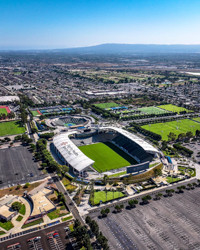
2025 © ᎳᎾᏒᏞᎠ ᎳᎪᏞᏦᎬᏒᏃ 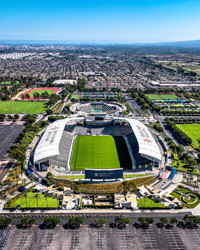
2025 © ᎳᎾᏒᏞᎠ ᎳᎪᏞᏦᎬᏒᏃ 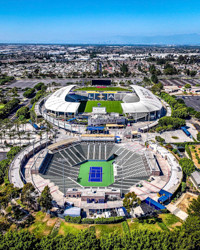
2025 © ᎳᎾᏒᏞᎠ ᎳᎪᏞᏦᎬᏒᏃ 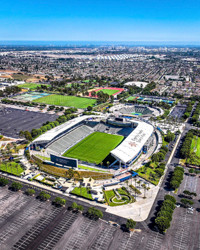
2025 © ᎳᎾᏒᏞᎠ ᎳᎪᏞᏦᎬᏒᏃ 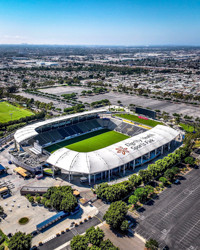
2025 © ᎳᎾᏒᏞᎠ ᎳᎪᏞᏦᎬᏒᏃ 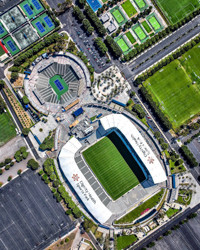
2025 © ᎳᎾᏒᏞᎠ ᎳᎪᏞᏦᎬᏒᏃ 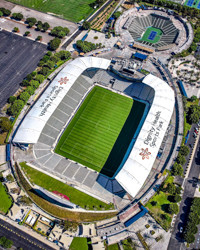
2025 © ᎳᎾᏒᏞᎠ ᎳᎪᏞᏦᎬᏒᏃ 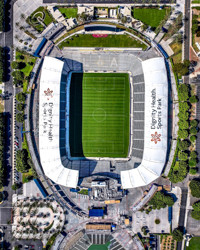
2025 © ᎳᎾᏒᏞᎠ ᎳᎪᏞᏦᎬᏒᏃ 
19.08.2020 © Alexis Avila 
19.08.2020 © Alexis Avila 
19.08.2020 © Alexis Avila 
21.01.2019 © Alexis Avila 
19.08.2020 © Alexis Avila


Related news
2022

2021
![USA: Your stadium guide for MLS 2021 is ready! [Western Conference]](https://stadiumdb.com/img/news/2021/04/18741-thumbnail.jpg)
2020

2018

2016

2015
-

USA: Los Angeles takes over for 2024 Olympics
Speculations are now confirmed as we look into Los Angeles 2024 bid book. This would be the third time for LA to hold the Olympics and third time at the very same stadium…
-

New design: Second soccer stadium for Los Angeles
The football/soccer map of LA is about to change a whole lot by 2018. 4-time champions Galaxy are to finally have a worthy derby rival. Will Los Angeles FC raise to the challenge? Their stadium should.