 StadiumDB
Tsentralnyi Stadion Profsoyuzov – until 2025
| Capacity | 32 750 |
|---|---|
| Country | Russia |
| City | Voronezh |
| Clubs | FC Fakel Voronezh |
| Retire year | 2025 |
| Other names | OSPS (1934–1936), Pishchevik (1936–1953), Znamya (1953–1958), Trud (1958–1973) |
| Floodlights | 1300 lux |
| Inauguration | 12/06/1934 |
| Construction | 1927–1934 |
| Renovations | 1949–1954, 1962–1965, 1984–1991 |
Advertisement
Tsentralnyi Stadion Profsoyuzov – historical stadium description
How does the Tsentralnyi Stadion Profsoyuzov look in brief?
The Tsentralnyi Stadion Profsoyuzov (Trade Unions Central Stadium) was built during the interwar period. Initially, it was not even the largest stadium in the city, but it was located close to the center and, in addition to an athletics track, it also had a cycling track.
The stadium was heavily damaged during World War II. After the war, it was rebuilt in an interesting neoclassical style, featuring numerous decorative elements such as columns and sculptures. Subsequent renovations in the 1960s and 1980s caused the stadium to lose some of these architectural features, although its capacity increased significantly.
The stadium was home to Fakel Voronezh, a football club that occasionally played at the highest level of Soviet and Russian football. The team attracted large crowds and enjoyed strong fan interest. Besides football matches, the stadium also hosted various festivals, celebrations, and other events.
In the 21st century, the condition of the stadium deteriorated, although in 2010 it still hosted – for the only time in its history – a friendly match of the Russian national team.
In 2023, the stadium was taken over by the regional authorities with the intention of carrying out a major renovation. Ultimately, a decision was made to demolish it and build a modern, football-specific stadium with a capacity of 25,000 in the same location.
Demolition work began at the end of 2025 and is expected to continue until spring 2026, after which construction of the new stadium should start.
How was the Tsentralnyi Stadion Profsoyuzov built?
The stadium in Voronezh was built on the site of the former Sennaya Square. In September 1927, the city council passed a resolution transferring the site to the municipal council of physical culture for the construction of a new arena.
Sennaya Square was located right next to Cadets’ Square (now the Orlyonok Park), where the first football matches in Voronezh were played.
The project was overseen by the Voronezh Regional Trade Unions Council (OSPS), which became the stadium’s owner – hence in its early years it was known as the OSPS Stadium.
The pitch was ready for matches in 1929. In August 1930, the stadium hosted the German workers’ team Kampfgemeinschaft für rote Sporteinheit. Construction, however, took longer than planned, and the stadium was fully completed only in 1934.
The official opening took place on 12 June 1934, with a friendly match between the Voronezh teams Dynamo and Aviatchast, which ended 6–3.
Before the stadium’s inauguration, in 1932 the Dynamo Stadium opened in the northern part of the city; at that time, it was larger than the OSPS Stadium.
How did the names of the Tsentralnyi Stadion Profsoyuzov change?
The stadium’s original name (OSPS) was changed in 1936 to Pishchevik. After the war, further renamings followed: from 1953 to 1958 it was called Znamya, then Trud, and finally, in 1973, it was officially renamed Tsentralnyi Stadion Profsoyuzov in honor of the trade unions that owned it for many years.
What did the Tsentralnyi Stadion Profsoyuzov look like before World War II?
Before the war, the stadium featured an athletics track surrounded by a dedicated cycling track. A distinctive element of the landscape was the Shukhov-designed water tower standing next to the stadium, built in 1916. The tower measured 25.6 meters and was the largest water tower of this type ever constructed.
How did World War II affect the Tsentralnyi Stadion Profsoyuzov?
During World War II, Voronezh became the scene of intense fighting. German forces reached the city in the summer of 1942 and captured its western part. Following a Soviet counteroffensive, the city was liberated in January 1943.
The Germans never managed to capture all of Voronezh, which represented the furthest point of their advance on this section of the front. The intense fighting, however, destroyed over 90% of the city’s buildings – including the stadium and the nearby water tower.
How was the Tsentralnyi Stadion Profsoyuzov rebuilt after the war?
The stadium was rebuilt between 1949 and 1954. During this reconstruction, the cycling track was removed and new stands were constructed, accommodating 10,000 spectators.
The stadium was rebuilt in a monumental neoclassical style, adorned with sculptures and colonnades. A high archway was installed at the entrance from Studencheskaya Street. The stadium was also equipped with floodlight masts.
How did the Tsentralnyi Stadion Profsoyuzov change in the 1960s?
Another renovation took place from 1962 to 1965. Larger stands were built along the sides of the pitch, increasing the stadium’s capacity to 32,000. The main stand also received a metal roof. However, during this modernization, the stadium lost much of its neoclassical character.
How did Tsentralnyi Stadion Profsoyuzov change in the 1980s?
Another major renovation began in 1984. Over the following years, new stands were built on the curves, the eastern stand was expanded with a second tier, and the western (main) stand was rebuilt from scratch. The new western stand mirrored the shape of the eastern stand and also featured an added second tier.
The reconstruction slowed after a few years. By 1991, around 90% of the planned work had been completed. Although the main objectives were achieved, the project was never fully finished.
What did Tsentralnyi Stadion Profsoyuzov look like toward the end of its existence?
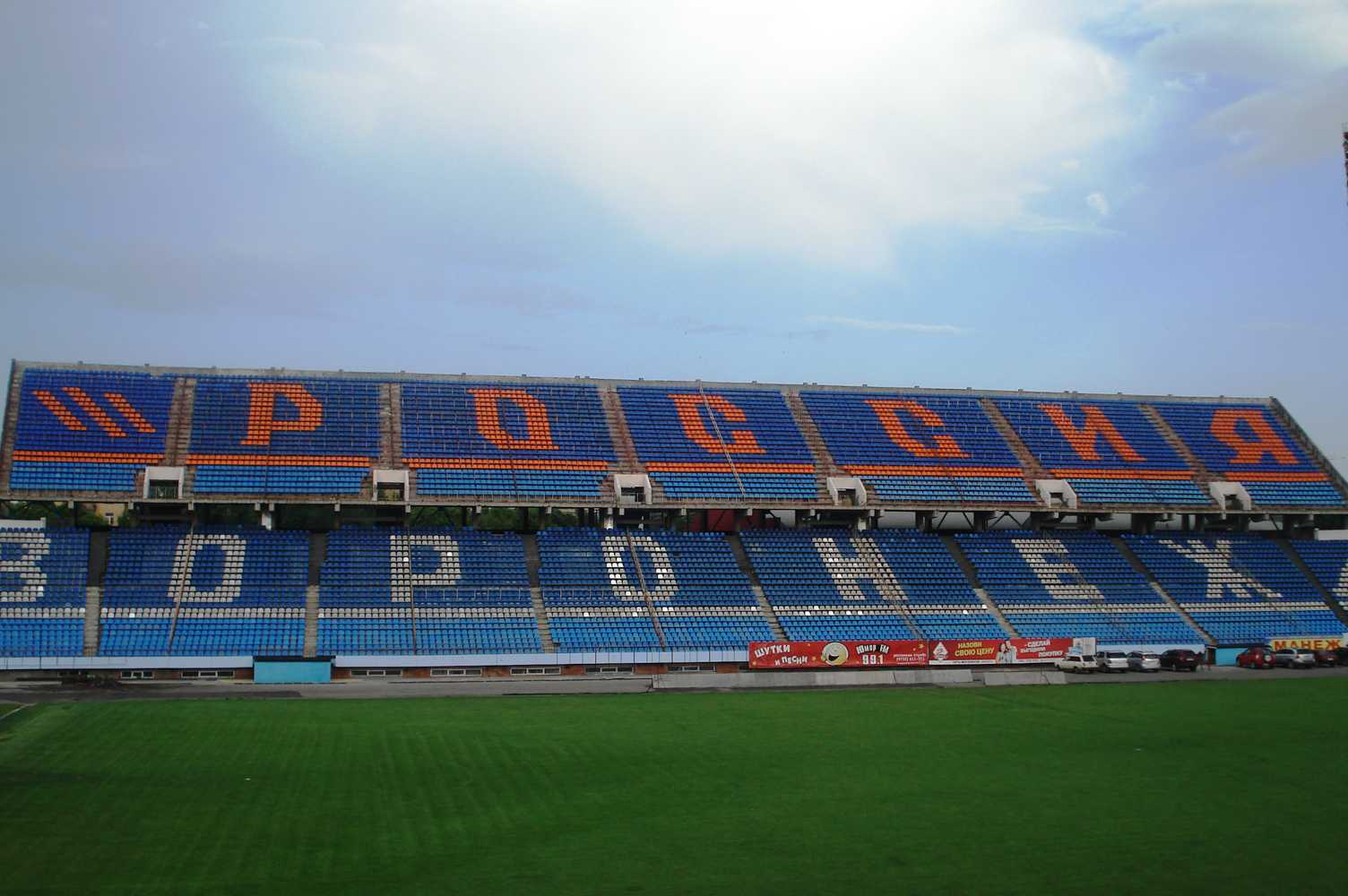
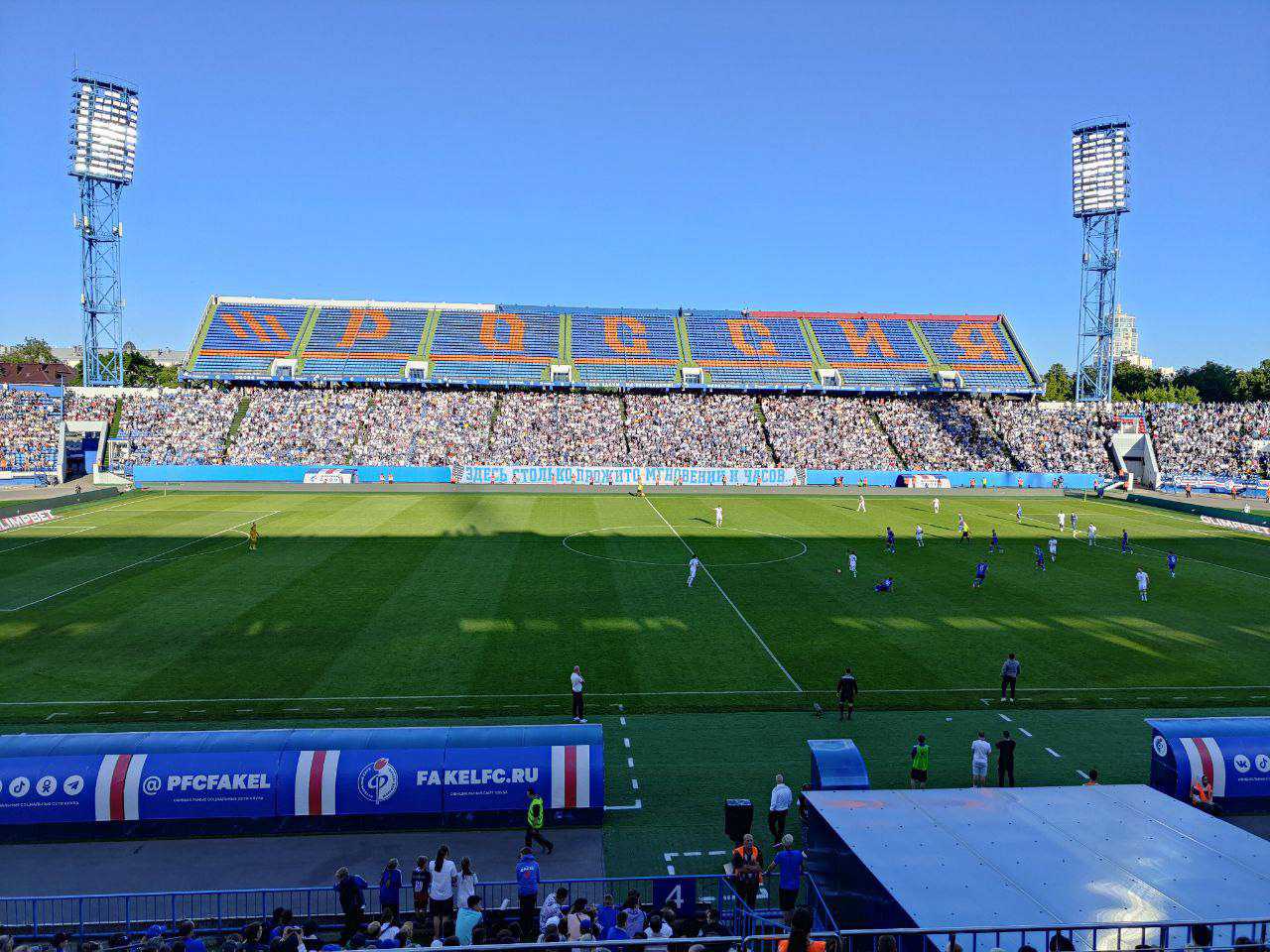
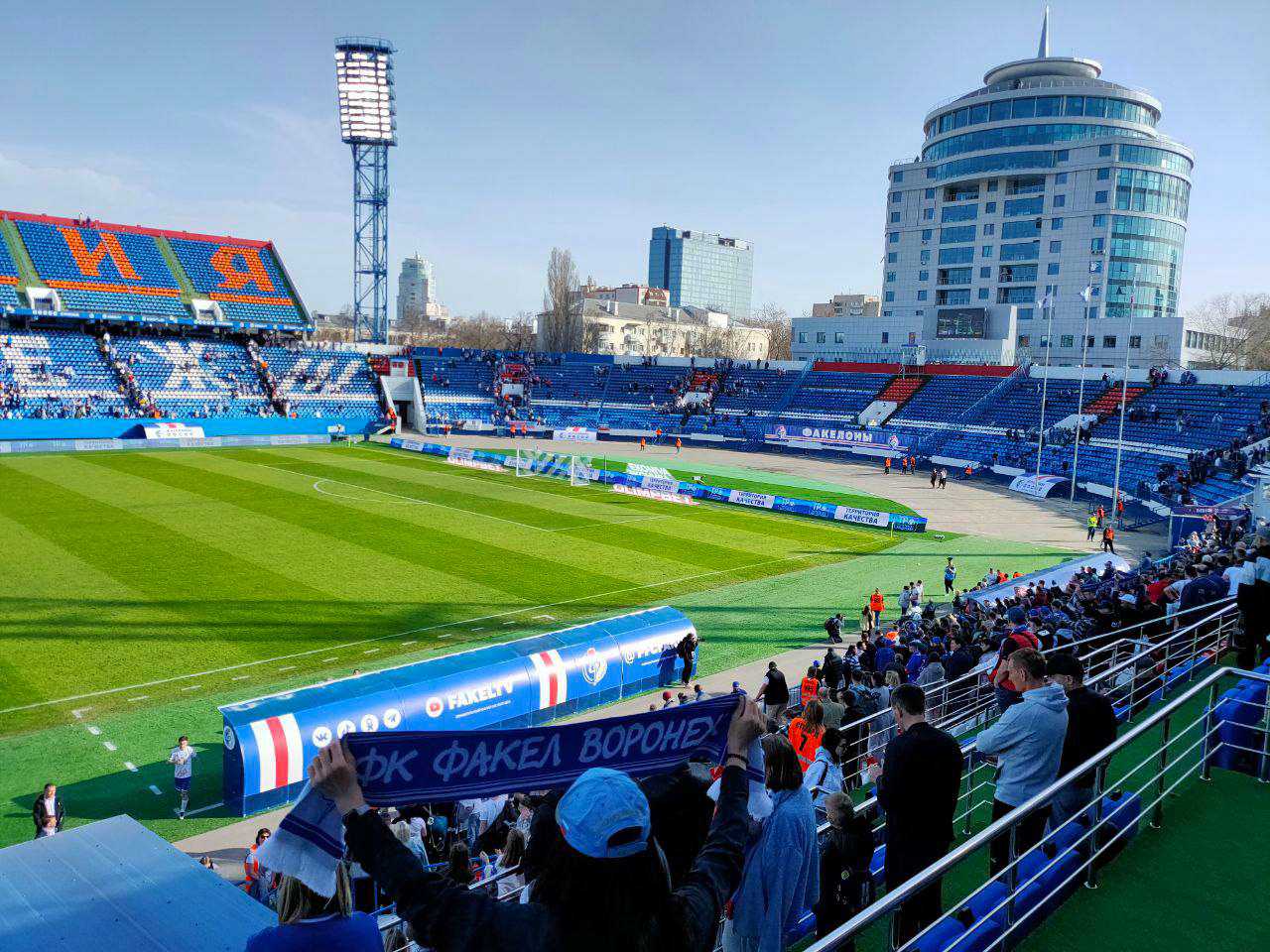
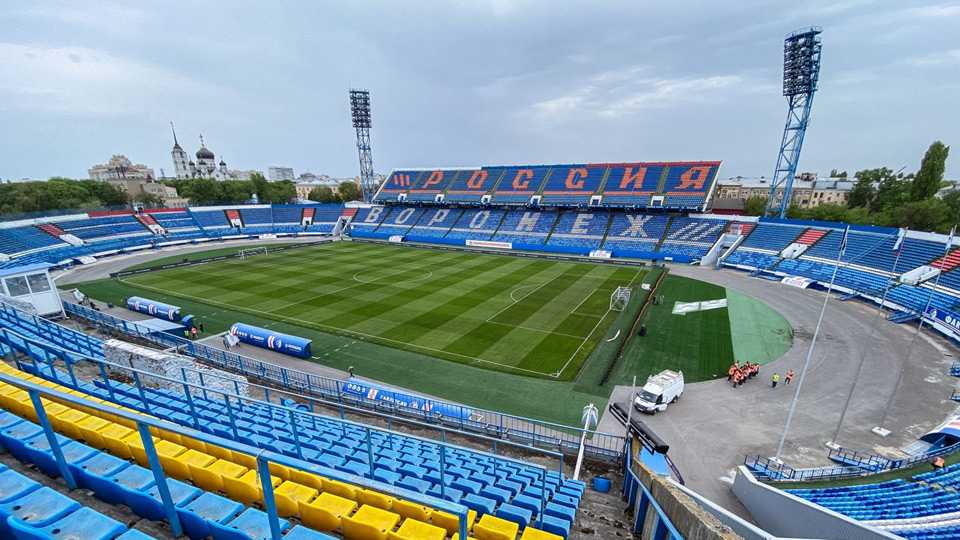
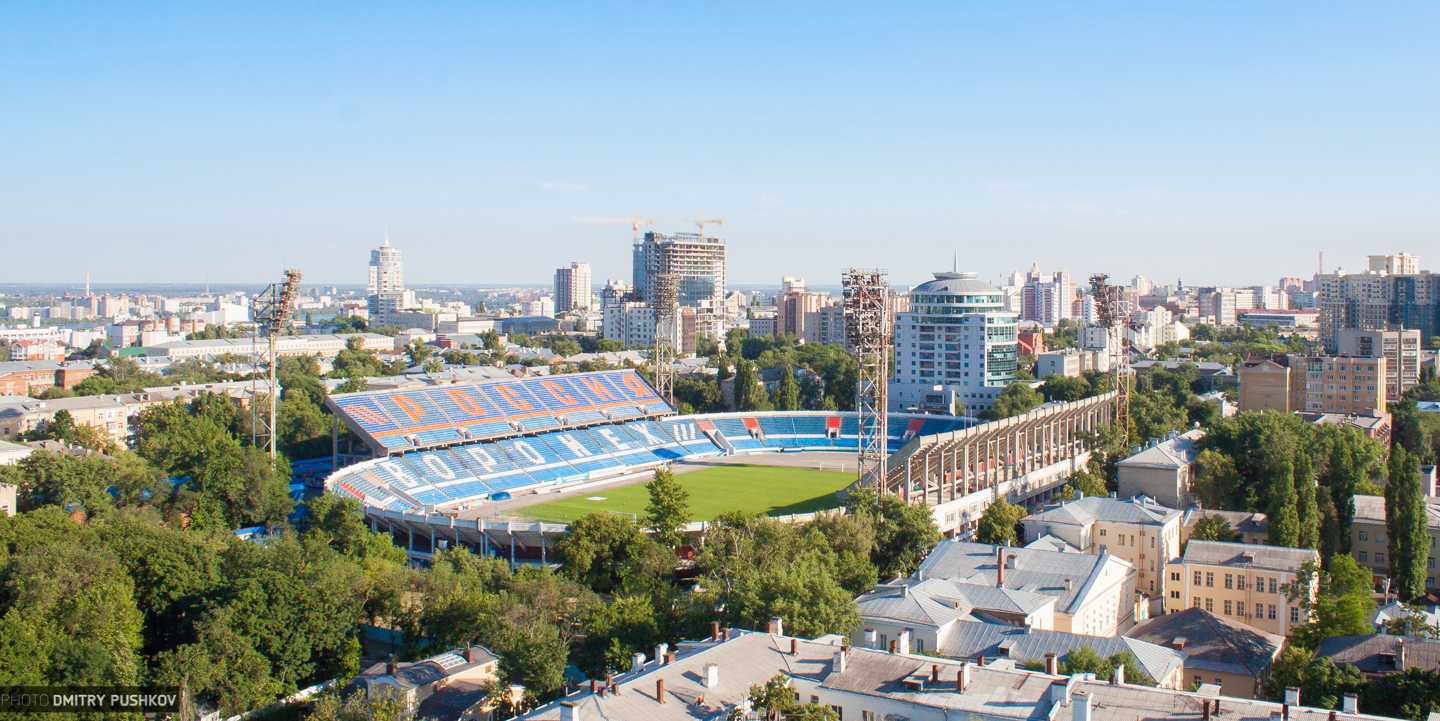
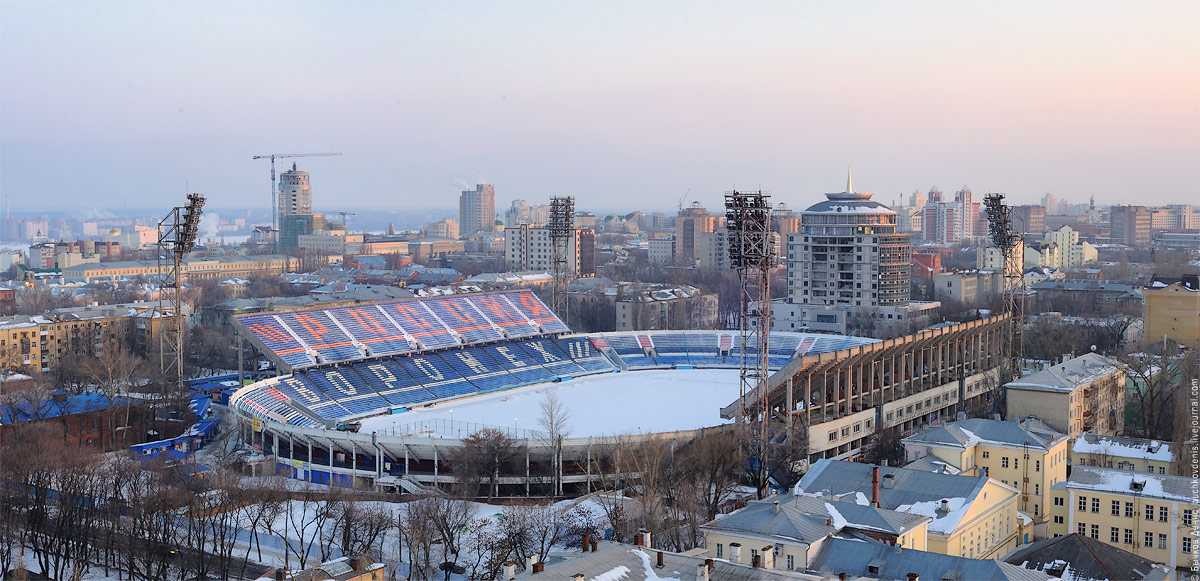
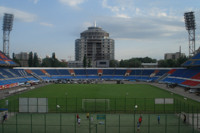
In the form achieved after the 1980s renovations – with a lower ring of stands around the track and a second tier along the sides of the pitch – the stadium survived until its demolition. Various maintenance works were still carried out in the 21st century, including the installation of plastic seating.
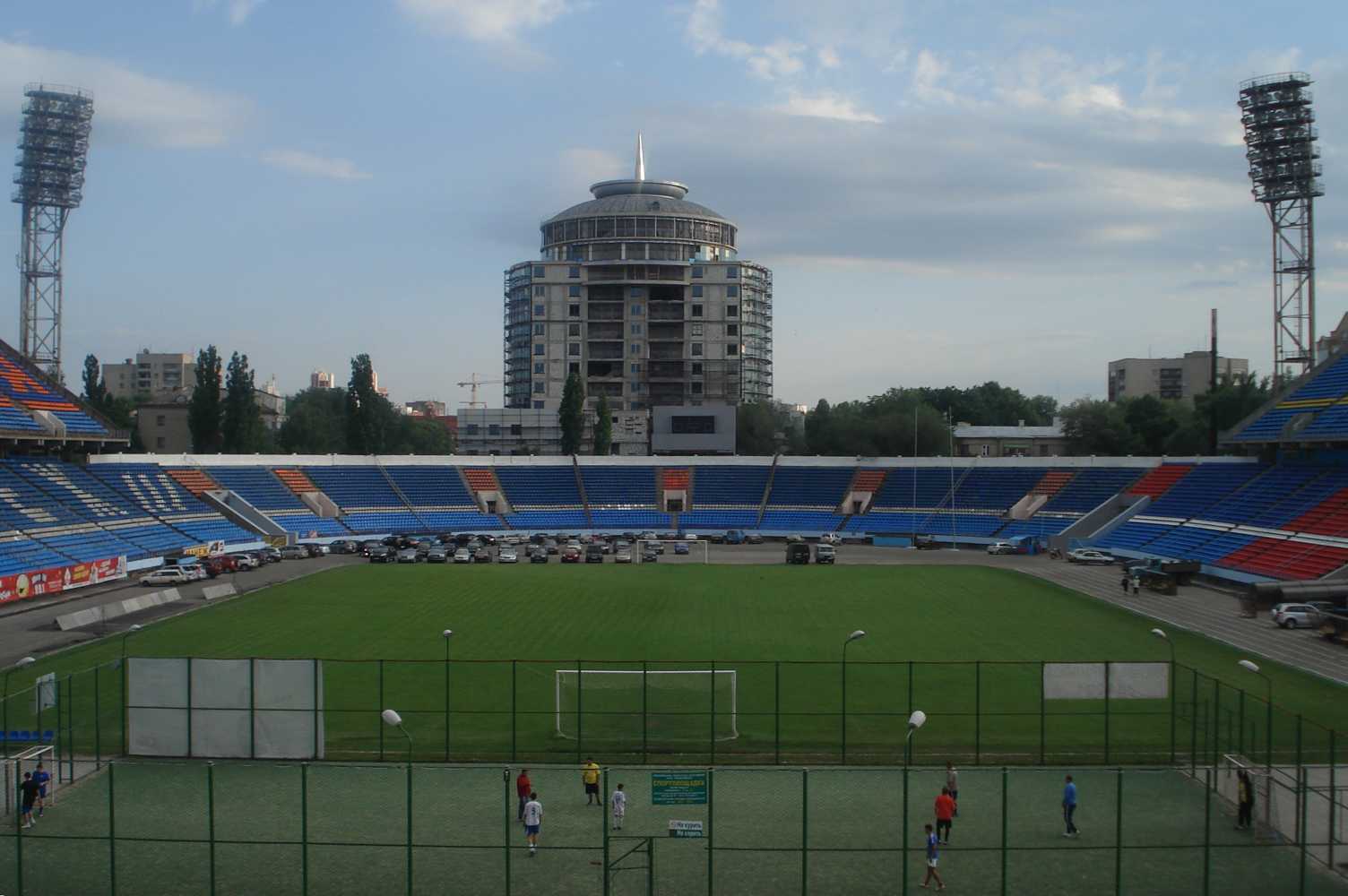
By the end, the stadium’s capacity was around 32,000 spectators. For technical reasons, the upper tier was often closed. Four 58-meter-high floodlight masts in the corners provided illumination of 1,300 lux. Since September 2002, a sports museum operated within the stadium.
Where was Tsentralnyi Stadion Profsoyuzov located?
The stadium was situated on Studencheskaya Street, next to Orlyonok Park, close to Voronezh’s main railway station and not far from the city center. Just behind the eastern stand was a sports hall, and behind the southern curve stood the distinctive building of the Business Center Premier, which opened in 2012.
What events took place at Tsentralnyi Stadion Profsoyuzov?
The main tenant of the stadium was Fakel Voronezh, a football club founded in 1947, which was an occasional participant in the top-tier leagues of the USSR and Russia. Until the end of the 20th century, Fakel’s matches attracted large crowds and the club regularly recorded high attendance figures.
The stadium also frequently hosted various events, festivals, and shows, including celebrations for Victory Day and City Day.
On 18 August 2001, during the halftime of a match between Fakel Voronezh and Spartak Moscow, a motorcycle show was taking place. One of the riders hit an uneven spot on the track, lost control, and crashed into a group of people, killing one person.
On 17 November 2010, the Russian national team played at the stadium for the only time in its history, in a friendly against Belgium. The match ended 2–0 to Belgium, with both goals scored by Romelu Lukaku, marking his first goals for the national team.
On 5 July 1963, an unofficial match was also played here by the Soviet Union national team, defeating Norwegian club Fredrikstad FK 1–0.
How was Tsentralnyi Stadion Profsoyuzov decommissioned?
The aging stadium had long required a comprehensive renovation. When Fakel was promoted to the Premier League in 2022, the regional authorities leased the stadium, and the following year purchased it from the regional trade unions council for 200 million rubles, with the aim of carrying out a thorough renovation.
Ultimately, instead of modernizing it, a decision was made to demolish Tsentralnyi Stadion Profsoyuzov and build a completely new, football-specific arena on the same site. The modern 25,000-seat stadium project was designed by the Arena Design Institute.
Before work on the old stadium began, a new Fakel Stadium was built in the southwest part of the city between 2021 and 2024. The venue has a capacity of 10,000 and meets all league standards, serving as the club's temporary base until the new Tsentralnyi Stadion is completed.
Demolition of the old stadium began on 1 December 2025, although preparatory work had already started in November. The dismantling is expected to last until spring 2026, after which construction of the new arena is scheduled to begin, with completion planned for the end of 2029.
Advertisement
Pictures
2024
25.05.2024 © Александр Гусев 
31.03.2024 © Александр Гусев 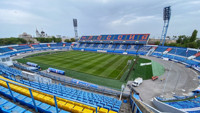
2024 © ПФК «Крылья Советов» Самара
2015
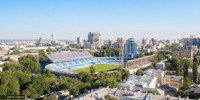
14.06.2015 © Dimkapushkov
2012
16.03.2012 © Bychkov Denis (CC BY-SA 3.0)
2009
03.06.2009 © Timur Mamedrzaev (CC BY-SA 3.0) 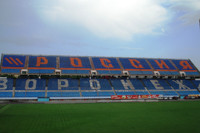
03.06.2009 © Timur Mamedrzaev (CC BY-SA 3.0)