 StadiumDB
American Express Stadium (Falmer Stadium)
| Capacity | 31 876 |
|---|---|
| Country | England |
| City | Brighton & Hove |
| Clubs | Brighton and Hove Albion |
| Other names | AmEx Stadium, The AmEx, American Express Community Stadium |
| Inauguration | 16/07/2011 (Brighton - Eastbourne Borough) |
| Construction | 04/2009 - 05/2011 |
| Renovations | 2012-2013 |
| Record attendance | 30,565 (B&H Albion - Everton, 15/10/2017) |
| Cost | £105 million |
| Design | KSS Design Group |
| Design time | 2007 |
| Contractor | Buckingham Group |
Advertisement
Amex Stadium – stadium description
Where does the American Express Stadium get its name from?
The American Express Stadium, also known as the Falmer Stadium, takes its name from a sponsorship agreement with the American Express company. This global financial institution has had its European headquarters in Brighton for many years, located just a few kilometres from the stadium. Thanks to this natural connection between the club and a major local employer, a strategic partnership was established that provided additional financial support for Brighton & Hove Albion. Even before the official opening of the venue in 2011, an agreement was signed under which the stadium was named after the well-known brand, and the club gained a reliable business partner.
The sponsorship deal covers not only the naming rights to the stadium but also a broad marketing collaboration and joint promotional initiatives in the city and region. American Express branding is visible throughout the stadium during Premier League matches, and the company also engages in community projects connected with the club and local society. As a result, the name American Express Stadium has become recognizable not only in England but around the world, where Brighton & Hove Albion has been gaining increasing popularity.
In everyday speech, fans and residents of Brighton more often use the shorter form Amex Stadium.
This expression has become common both in the media and among football supporters, turning into an almost equal synonym of the official name. The American Express Stadium in Brighton is therefore not only a venue for matches but also an example of a successful combination of sport and business, in which the sponsor’s local roots played a key role.
Where is the American Express Stadium located??
The American Express Stadium, also known as the Falmer Stadium, is located in southern England, in East Sussex. The venue sits on the north-eastern outskirts of Brighton, in the district of Falmer, which gave it its original name.
The stadium lies in the immediate vicinity of the campuses of the University of Sussex and the University of Brighton. Its address is Village Way, Falmer, Brighton (BN1 9BL). The closeness of the academic environment makes the stadium a distinctive feature of this part of the city, combining its sporting role with the surrounding educational and urban landscape.
What is the capacity of the American Express Stadium?
The American Express Stadium in Brighton, also known as the Falmer Stadium, currently has a capacity of 31,876 spectators. This makes it a medium-sized venue in Premier League terms, but for Brighton & Hove Albion it is a fully adequate stadium that meets the highest domestic and international standards. The number of seats has not always been the same — when it opened in 2011, the stadium offered around 22,374 seats, which at that time was sufficient for a club returning to the Championship. However, Brighton’s rapid growth soon made it necessary to expand the capacity to meet the increasing demand from fans.
When was the American Express Stadium opened?
The American Express Stadium was officially opened in July 2011, after several years of intense construction and even longer efforts to obtain approval for the investment. The ceremonial inauguration took place on 30 July 2011, when Brighton & Hove Albion played a friendly against Tottenham Hotspur. This match was the first opportunity for fans to sit in the new stands and symbolically marked the beginning of a new era in the club’s history. Earlier, on 16 July, a closed test match against Eastbourne Borough was held to trial the stadium’s facilities.
The opening was a breakthrough moment both for Brighton & Hove Albion and the local community. The club had long struggled without a permanent home — after selling the Goldstone Ground in 1997, the team played at rented venues in Gillingham and then at the temporary Withdean Stadium. The modern Falmer Stadium finally solved this problem, giving the team and supporters a long-awaited permanent ground. Thanks to its inauguration in 2011, Brighton gained a stadium matching its ambitions, which in the following years led the club to promotion and a stable position in the Premier League.
Who uses the American Express Stadium on a daily basis?
The main tenant of the American Express Stadium is Brighton & Hove Albion F.C., for whom the Falmer venue has been the home ground since 2011. This is where the Seagulls play their Premier League fixtures, as well as domestic and international cup matches. The move to the Amex ended a long period of instability, during which the team had to rely on borrowed grounds — first Priestfield Stadium in Gillingham, then the temporary Withdean Stadium. Today, the Falmer stadium is an inseparable symbol of the club and its modern identity.
The American Express Stadium is not limited to men’s football. It is also regularly used by Brighton & Hove Albion Women, who play their Women’s Super League matches here, especially those attracting larger audiences. In addition, the stadium hosts non-sporting events such as concerts, conferences, corporate functions, and community gatherings. Thanks to its conference facilities and modern infrastructure, the Amex serves as a multifunctional meeting centre, integrated into the life of the local community and the nearby universities.
What events have been held at the American Express Stadium?
Since its opening in 2011, the American Express Stadium in Brighton has hosted many important international sporting events. In 2015, the venue staged matches of the Rugby World Cup, under the name Brighton Community Stadium.
It was here that one of the tournament’s most sensational results occurred, when Japan defeated the heavily favoured South Africa 34–32. The stadium also hosted games during UEFA Women’s Euro 2022, and it is already set to stage further global competitions, including matches of the Women’s Rugby World Cup in 2025. Earlier, in 2013, the stadium also held a youth international friendly between England U-21 and Austria U-21.
The American Express Stadium also plays a significant cultural role. In its early years, the venue hosted large-scale concerts — in 2012 Fatboy Slim performed here, followed by Rod Stewart in June 2014. The stadium additionally offers extensive conference and event facilities, allowing it to regularly host business meetings, exhibitions, social gatherings, and private functions. With such a wide scope of use, the Amex functions not only as the home of Brighton & Hove Albion but also as a cultural and sporting hub for the whole region.
What does the architecture of the American Express Stadium look like?
The American Express Stadium in Brighton, designed by KSS Design Group, stands out with its modern yet harmoniously integrated architecture. Built in a suburban area surrounded by the green hills of the South Downs, it was crucial that the stadium should not overwhelm its surroundings but blend with the natural landscape. The architects opted for flowing, wave-like forms in the stands and roof, which visually echo the rolling terrain around Falmer. This makes the venue appear as a light structure with large glazed areas and a curved roof, rather than a heavy concrete block, giving it a distinctive silhouette.
The stands form a compact, enclosed bowl, ensuring excellent sightlines from every seat. The most impressive feature is the west stand, a four-tier structure housing VIP lounges, conference halls, and technical facilities. Another hallmark of the Amex’s architecture are the corners — originally left open but later filled with extra seating during expansions. The entire structure is topped by a sweeping roof made of lightweight materials supported by steel arches. This design not only fits into the surrounding landscape but also enhances acoustics, amplifying the matchday atmosphere.
The stadium is also distinguished by the elegant finish of its façades. The glazed surfaces and steel elements contrast with the white structural arches, lending the venue a dynamic appearance. From the outside, the Amex presents itself as a modern sports complex that combines functionality with aesthetics suited to its environment. Thanks to this architectural approach, the stadium is regarded as a successful project that reconciles contemporary infrastructure demands with respect for the local landscape.
What facilities and technological solutions does the American Express Stadium offer?
The American Express Stadium was conceived as a modern sports venue that combines fan comfort with functionality for event organisers. From its opening in 2011, the stadium offered spacious, covered stands with excellent sightlines, later enhanced further by expansions. The west stand is the most complex part of the venue, featuring four levels with numerous VIP boxes, conference rooms, corporate spaces, and restaurants. As a result, the stadium functions not only as a sports arena but also as a business and event centre, attracting companies and institutions that organise meetings outside of matchdays.
Technologically, the stadium is equipped with modern sound and lighting systems that meet UEFA and Premier League standards. The roof system, made of steel and lightweight materials, both shelters spectators and enhances acoustics, contributing to the unique matchday atmosphere. Eco-friendly features were integrated into the design, such as energy and water-saving systems, a requirement for building within the protected South Downs environment. The stadium’s interiors are fully accessible, with lifts, dedicated seating areas, and adapted sanitary facilities for people with disabilities.
A key feature is also its catering infrastructure — numerous kiosks and food outlets are distributed throughout the venue, with menus tailored to a wide range of supporters. Additionally, the stadium includes spacious fan zones and a modern club shop. Thanks to this combination, the American Express Stadium is not only a football ground but a multifunctional complex that unites sporting tradition with advanced technology and high standards of fan service.
How can you get to the American Express Stadium and what transport options are available?
The American Express Stadium is located in Falmer, right next to university campuses, and was designed from the outset to be easily accessible to fans. The main transport mode is the train, with Falmer railway station situated right next to the stadium. The journey from central Brighton takes about ten minutes, and on matchdays additional services are scheduled to handle the increased passenger numbers. Ticket holders for Brighton & Hove Albion matches often benefit from free travel on trains and buses within set zones, which makes attending games even more convenient.,/p>
Buses also play a major role. Routes 25, 28, and 29 serve the stadium, and on matchdays special football buses
are in operation, stopping close to the venue and Falmer station. These services connect different parts of Brighton and the surrounding area, and thanks to the agreement with the club, fans can usually ride them free of charge with a match ticket. This solution has become popular as it helps avoid parking issues around the stadium.
Travel by car is possible but requires planning. Parking spaces near the venue are limited and usually need to be booked in advance. As an alternative, a Park & Ride system is in place, allowing fans to leave their cars at designated locations such as Mill Road or Brighton Racecourse and continue to the stadium by shuttle buses. This reduces traffic congestion in the immediate vicinity of the stadium and improves logistics on matchdays.
For those preferring greener options, cycling facilities are also available. Bike racks and monitored storage areas are provided near the stadium, and the Amex is connected to the city via a network of cycle paths. This makes it a practical option for local residents and students from nearby universities who frequently use bikes as their main mode of transport. With this range of transport solutions, the stadium is accessible to all groups of supporters, regardless of how they choose to travel.
What sporting events are held at the American Express Stadium?
The American Express Stadium is first and foremost the home of Brighton & Hove Albion, who have played their league and cup fixtures here since 2011. Premier League matches make up the bulk of events at the venue, regularly drawing sell-out crowds, particularly when the Seagulls face England’s biggest clubs. The stadium also stages fixtures in domestic cup competitions such as the FA Cup and EFL Cup. With its modern infrastructure meeting UEFA requirements, the Amex is also fully equipped to host European matches, which Brighton experienced for the first time in the 2023/24 season, welcoming teams from across the continent.
The stadium has also staged international tournaments. In 2015, Falmer was selected as one of the host venues for the Rugby World Cup, a major honour for the region. It was here that one of the sport’s greatest shocks unfolded — Japan’s 34–32 victory over South Africa. Another major event was UEFA Women’s Euro 2022, for which the Amex hosted group games as well as a semi-final, proving itself a fitting venue for top-level football competitions. In the near future, the stadium will once again feature on the global stage as one of the arenas for the Women’s Rugby World Cup in 2025, confirming its international reputation and versatility.
Are concerts or other cultural events held at the American Express Stadium?
From its inception, the American Express Stadium was designed as a multifunctional venue, serving not only sport but also as a cultural and entertainment hub for Brighton and East Sussex. It boasts modern conference and event facilities, capable of hosting banquets, exhibitions, trade fairs, and corporate functions. The internal spaces, especially in the imposing west stand, are regularly hired by companies and institutions, which make use of the contemporary meeting rooms and banquet halls. This ensures that the stadium remains active year-round, not just on matchdays, and serves as an important focal point for community life.
The venue has also hosted major concerts and cultural events. In 2012, Brighton native Fatboy Slim became one of the first artists to perform at the stadium in front of a huge crowd. Two years later, in June 2014, the stadium welcomed Rod Stewart, drawing fans from across the region. In addition to large concerts, themed events such as a local Oktoberfest and smaller entertainment shows in the The Terrace
club space have also taken place. Altogether, these activities demonstrate that the American Express Stadium is not only the home of Brighton & Hove Albion but also a diverse cultural centre in southern England.
What attendance records have been set at the American Express Stadium?
From the very beginning, the American Express Stadium has enjoyed huge popularity among Brighton & Hove Albion supporters, with Premier League football only reinforcing its status as a ground that regularly sells out. Early attendance records were set shortly after its opening, when the club was still competing in the Championship. With the later expansion of the stands and the filling of the corners, capacity increased to nearly 32,000 seats, allowing for higher attendances and consistent sell-outs for top-flight fixtures.
The current record crowd at the Amex was set on 26 October 2024, when 31,840 fans attended the Premier League match against Wolverhampton Wanderers. Before that, the record had been established during a game against Chelsea on 29 October 2022, which drew 31,746 spectators. Nearly all of these record-breaking crowds have been associated with high-profile league fixtures, adding to the prestige of such occasions. For Brighton & Hove Albion, achieving such stable, high attendances is clear evidence of the deep loyalty of its fanbase and proof that building a new stadium was one of the pivotal steps in the club’s modern development.
Has the American Express Stadium undergone renovations or expansions?
The American Express Stadium (Falmer Stadium) has already undergone several important renovations and expansions aimed at increasing capacity and improving spectator comfort. Below is an overview of the work completed to date.
The original design provided for a capacity of around 22,500 seats — this was the number available when the venue opened in 2011. It soon became clear, however, that the club and its supporters required more space, as demand for tickets exceeded supply. In response, Brighton & Hove Albion and the architects planned expansions without the need for a complete rebuild.
The first phase of expansion took place during the 2012–2013 seasons, when an additional tier was added to the east stand and the corners of the stadium were filled in, significantly increasing capacity. The KSS Design Group had foreseen such extensions in the original design, ensuring the venue could be enlarged in the future. Thanks to this work, the stadium grew to about 30,500 seats.
In the years that followed, further smaller-scale upgrades were carried out, improving comfort, facilities, and internal infrastructure — especially in VIP zones, technical areas, and public spaces. More recently, additional work has been undertaken to enhance the spectator experience. There are also plans for a new fan zone: a two-storey building with catering and social spaces for up to 1,000 people, designed to operate on both matchdays and non-matchdays.
How Amex Stadium compares to other Premier League venues?
Advertisement
Pictures

30.09.2011 © University of Sussex 
05.08.2011 © Barbara van Cleve (cc: by-sa) 
06.06.2014 © Helen Haden 
22.04.2011 © Warren Chrismas (cc: by-nc) 
22.04.2011 © Dominic Alves (cc: by) 
09.04.2011 © Dominic Alves (cc: by) 
07.04.2011 © Dominic Alves (cc: by) 
01.02.2015 © purplezulu 
17.12.2011 © Stephan Hoogerwaard 
17.12.2011 © Stephan Hoogerwaard 
03.05.2014 © Peter Butchers 
03.05.2014 © Peter Butchers 
03.05.2014 © Peter Butchers 
16.05.2015 © Stuart Noel Fuller 
16.05.2015 © Stuart Noel Fuller 
17.03.2013 © Warren Chrismas (cc: by-nc) 
11.01.2014 © leeahinton95 
11.01.2014 © Darren Perrin (cc: by) 
09.08.2014 © paul 
30.07.2011 © James Boyes (cc: by) 
30.07.2011 © James Boyes (cc: by) 
30.07.2011 © James Boyes (cc: by) 
30.07.2011 © James Boyes (cc: by) 
17.12.2011 © Stephan Hoogerwaard 
17.12.2011 © Stephan Hoogerwaard 
17.12.2011 © Stephan Hoogerwaard 
16.05.2015 © Stuart Noel Fuller 
29.03.2014 © jennifur53 
30.09.2014 © paul 
07.02.2015 © Worthing Wanderer


Related news
2026
2025
-

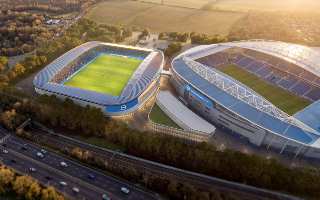
Great Britain: 2035 Women’s World Cup stadiums. New Trafford confirmed
Great Britain could host the 2035 FIFA Women’s World Cup, and today the list of stadiums that could welcome the world’s best players was revealed. England, Scotland, Wales and Northern Ireland have submitted a joint bid – the only one FIFA has received – which puts the project firmly in pole position.
-
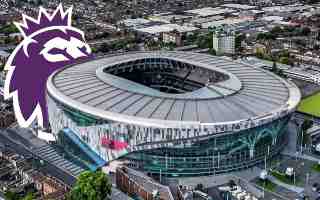
England: How the 21st century shaped the Premier League with 8 new stadiums
Although the Premier League is mainly associated with historic stadiums with over a century of tradition, the 21st century has also brought several modern venues. In this article, we will go through all the stadiums that have been built in the last 25 years.
-
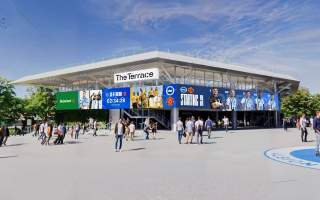
England: Seagulls set opening date of Premiership's biggest fan zone
"The biggest in the Premier League," boasts Brighton & Hove Albion, announcing the opening date of the Heineken Fan Zone. The zone will be able to accommodate 3,000 Seagulls fans and will crown the multi-million pound investment in the American Express Stadium.
-
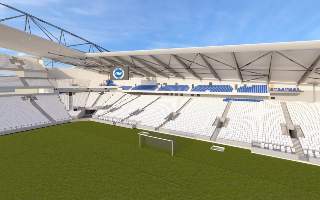
England: Brighton & Hove to expand Amex in a multi-million investment
Two years, three phases and tens of millions of pounds. Brighton & Hove Albion has unveiled ambitious plans to modernize Amex Stadium. Standing places or the largest fan zone in the Premier League are just some of the changes for the Seagulls’ home to undergo.
2024
-
England: Standing seats will return to Brighton & Hove
Brighton & Hove has not had standing seats in its stadiums since 1997, when the club sold Goldstone Ground to avoid bankruptcy. Restrictive regulations prevented the introduction of standing sectors for a long time, but they have been relaxed in recent years. Brighton & Hove Albion is yet another club to introduce safe-standing rails.
-
England: Will government introduce new rules on stadium sales?
The government is preparing to grant powers to an independent regulator that will prevent Premier League clubs from selling their stadiums to affiliated companies or third parties.
-

England: Stadium Events & Hospitality Awards presented. Who took top prize?
Brighton & Hove Albion secured the top prize during a successful evening at the prestigious Stadium Events & Hospitality Awards gala. The club outperformed 28 other venues from the Premier League and Championship to win the award in the "Best Overall Matchday Hospitality Experience" category for the Tunnel Club, which opened in August last year.
-

England: Attendance at Premier League stadiums in the 2023/24 season
Another season, another league title for Manchester City. The award for highest attendance also went to the city of Manchester as well, but to the Red Devils, despite the team's worst season in Premier League history. As many as six clubs surpassed one million spectators this season, with five stadiums filling up at an average of more than 99%. Amazing.
-

England: New fan zone to be created at Amex Stadium
A planning application has been submitted for the construction of a fan zone outside Brighton & Hove Albion's stadium. The proposed building would replace existing kiosks near the railway line. What are the exact plans for creating this new space for fans?
-

England: Record attendance expected?
World Rugby and the Rugby Football Union have announced the locations for the opening and final matches of the England 2025 Women's Rugby World Cup. The heads of both organizations anticipate record attendance at the tournament's most important match, which will run from August 22 to September 27, 2025.
-

England: Brighton residents urge club to "turn off that light"
Residents of Brighton and its surroundings have been complaining about the overly bright light illuminating the night sky above the Amex Stadium for quite some time. "Sometimes it's really bright – it lights up the sky all night and doesn't let us sleep," one resident lamented in a conversation with The Argus.
2023

2022
-

England: Stadium rises will affect Premier League clubs
The value of almost all 20 stadiums owned by teams playing in the Premier League has recently increased. As a result, clubs will face multi-million pound tax increases involving their infrastructure.
-

England: Special project during World Cup in Brighton
Brighton & Hove's home ground will be upgraded during the WC break. The last renovation took place nearly 10 years ago. The club's authorities intend to thank fans for that decade of successes with a unique, even by English standards, idea dedicated to their most loyal supporters.
-

England: Meet the 2022/23 Premier League stadiums!
Much to the delight of fans, the new English Premier League season will kick off on Friday, August 5. On this occasion, we would like to introduce you to the stadiums where the footballers of the world's best league will soon be playing. Get your English tea in hand and let's get started!
-

England: Controversy over women's EURO 2022 stadiums
The UEFA European Women's Championship will kick off in just over two months' time, with England hosting the tournament for the second time in its history. Despite the fact that the grand final will take place at Wembley, the stadiums approved for the tournament, according to many, are… too small.
2021
-

England: Safe standing trials in Premier League and Championship
There has been talk for some time about introducing safe standing in the two highest leagues in the country. In 2019, the government assured about the imminent change of the regulations, but these were not introduced until 2 years later.
-

England: Brighton given green light to expand
Hoping for full stands in the summer, Brighton and Hove Albion are moving forward with their desired expansion to 32,500. Already by August the Amex will reach 31,800 seats, a thousand more than previously.
