 StadiumDB
BMO Field
| Capacity | 45 000 |
|---|---|
| Country | Canada |
| City | Toronto |
| Clubs | Toronto FC, Toronto Argonauts |
| Inauguration | 28/04/2007 (Toronto FC – Kansas Wizards 0–1) |
| Construction | 2006–2007 |
| Renovations | 2010, 2014–2016, 2024–2026 |
| Cost | C$62.9 M ($56.3 M) |
| Design | Brisbin Brook Beynon Architects |
| Contractor | PCL Constructors Canada Inc. |
| Address | 170 Princes Boulevard, Toronto, Ontario M6K 3C3 |
Advertisement
BMO Field – stadium description
How can BMO Field be summarized?
The construction of a new stadium in Toronto was initiated by the Canadian Soccer Association. The venue was originally planned for the 2007 FIFA U-20 World Cup, and when Canada was awarded the tournament, the project received financial support at all levels – from the city of Toronto, the province of Ontario, and the federal government.
Initially planned as the National Soccer Stadium, it was intended primarily for the Canadian national team. However, before construction began, a new club became part of the project – Toronto FC. The team was the first from outside the USA to join Major League Soccer and became the permanent host of the stadium, inaugurated in spring 2007.
Between 2014 and 2016, the stadium underwent its first major expansion. A second tier was added to the east stand, and three sides of the seating area were covered by a roof supported by four corner pylons.
The configuration of the stands behind the goals was also modified so that, after removing the temporary sections, the field could accommodate Canadian football. As a result of these changes, the Toronto Argonauts – the team with the most Grey Cup wins in history – became the stadium’s second tenant in 2016.
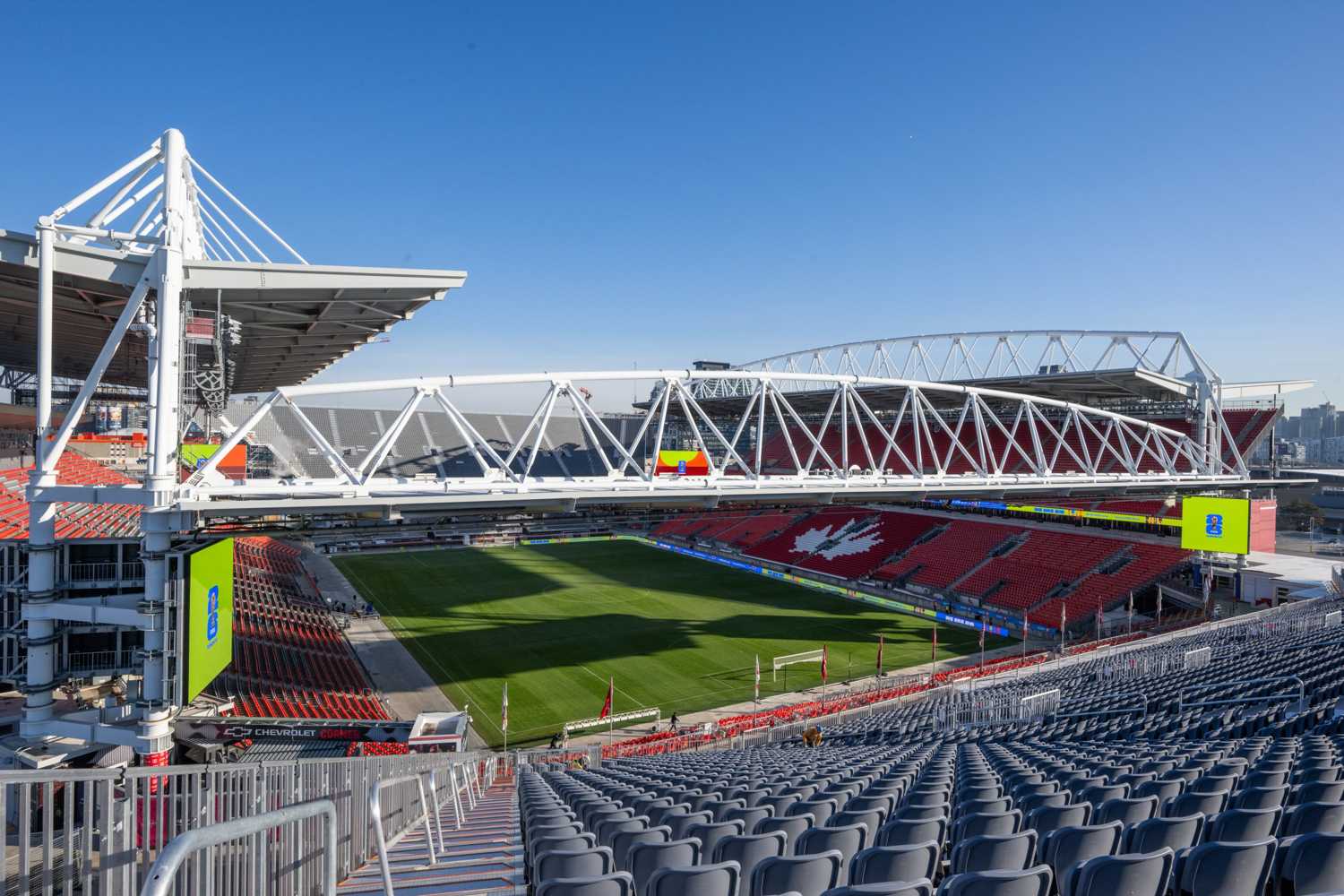
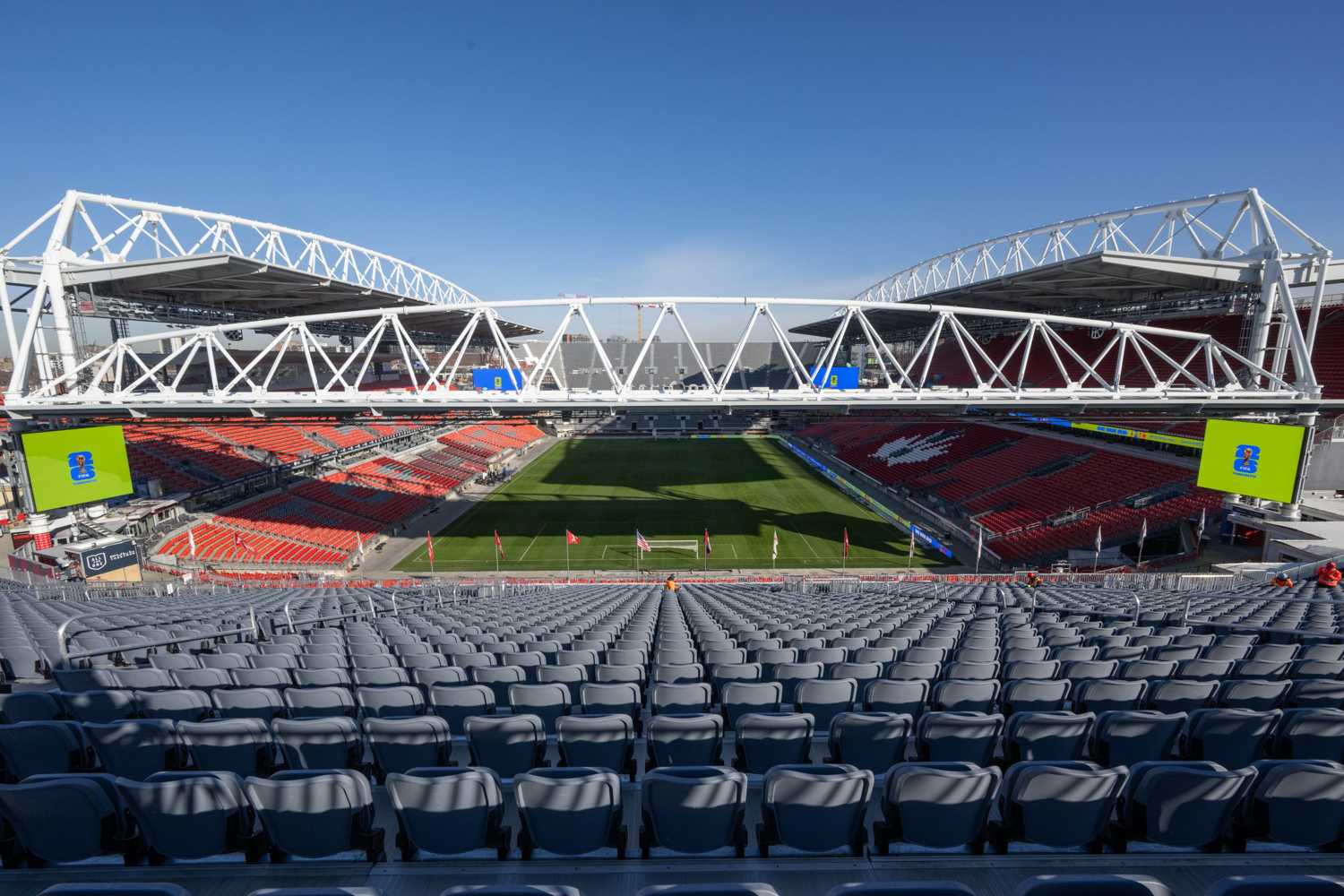
While its architecture is rather functional than flashy, the stadium has hosted numerous major sporting events. Its most important event, however, will be the 2026 FIFA World Cup, when it will be one of only two Canadian venues for the tournament. For the World Cup, temporary stands behind the goals will boost capacity to 45,000.
How was BMO Field created?
The idea to build a new soccer stadium in Toronto was sparked by the 2007 FIFA U-20 World Cup. The first plans for the venue were presented in July 2003 by the Canadian Soccer Association, at a time when Canada was still bidding to host the tournament.
The stadium was intended to serve as one of the tournament venues and later as a premier soccer facility in Canada, primarily for the national team – which is why the project was initially named the National Soccer Stadium.
In August 2004, FIFA awarded Canada the right to host the U-20 World Cup, so the decision was made to move forward with the stadium project. The plans received backing from all three levels of government – with the city of Toronto, the province of Ontario, and the federal government contributing funding.
Could the Toronto Argonauts have joined the BMO Field project?
The decorated Canadian football team, the Toronto Argonauts, also wanted to participate in the stadium project. In 2004, a preliminary agreement was reached with the Canadian Soccer Association, and the new stadium was planned to replace Varsity Stadium on the University of Toronto campus, rather than the site originally planned at Exhibition Place.
However, the agreement was ultimately abandoned. The Toronto Argonauts then announced plans to build a new stadium at York University, before finally deciding to extend their lease at Rogers Centre.
How did Toronto FC get involved in building BMO Field?
At the same time, the private entity Maple Leaf Sports & Entertainment (MLSE), which owns teams including the Toronto Maple Leafs (NHL) and Toronto Raptors (NBA), was interested in creating a new soccer club in Toronto to join the Major League Soccer (MLS) in the U.S.
The plan envisioned the team using the new stadium – as a result, Maple Leaf Sports & Entertainment also joined the project as one of the partners. Plans for building at Exhibition Place were revisited as well.
In October 2005, Major League Soccer granted the new Toronto team a license to join the league starting with the 2007 season. This led to the creation of Toronto FC, the first Canadian team in MLS – and from the very beginning, the new stadium had a permanent tenant.
Where was BMO Field built?
The new stadium was ultimately constructed at Exhibition Place – a sprawling trade and exhibition complex located on the shores of Lake Ontario, about 3 km west of downtown Toronto.
Exhibition Place is well known for hosting the annual Canadian National Exhibition, a major fair held since 1879 and one of the largest events of its kind in North America.
Exhibition Stadium
From the very beginning, Exhibition Place included a grandstand used for various shows and sporting events. Over the years, there were a total of four grandstands, each replacing an older structure, with the last one built in 1949.
In 1959, a second grandstand was added on the opposite (south) side, and the Canadian football team Toronto Argonauts moved in.
Between 1974 and 1976, the south stand was replaced with a new L-shaped structure adapted for a baseball field, allowing the new MLB team, the Toronto Blue Jays, to play there starting in 1977.
The venue was originally known as the CNE Grandstand or CNE Stadium, but after the new 1970s stand gave it a distinctive triangular shape, it became more commonly known as Exhibition Stadium.
In 1989, both the Argonauts and the Blue Jays relocated to the newly opened SkyDome (renamed Rogers Centre in 2005). After the SkyDome opened, Exhibition Stadium hosted fewer events and was eventually demolished in 1999.
Following the demolition, parking lots were built on the site. Plans for the area’s future development were also considered – and ultimately, the new soccer stadium was built (at least partly) in place of the former Exhibition Stadium.
How much did BMO Field cost?
The construction of the new stadium cost CAD 62.9 million. Funding came from the federal government (CAD 27 million), the province of Ontario (CAD 8 million), the city of Toronto (CAD 9.8 million), and Maple Leaf Sports & Entertainment, which covered the remaining costs.
Additionally, the city provided the land for the stadium free of charge – and became the owner of the facility. Maple Leaf Sports & Entertainment obtained the rights to manage the stadium and its naming rights.
Who became the naming sponsor of Toronto’s new soccer stadium?
The project was initially referred to as the National Soccer Stadium. Naming rights were held by Maple Leaf Sports & Entertainment and were purchased by the Bank of Montreal (BMO) – the agreement was announced in September 2006, a few months after construction began.
Under the agreement, the stadium was named BMO Field. The contract was initially set for 10 years and was renewed in 2016 for another decade.
During major sporting events, such as FIFA World Cup matches, the name BMO Field is sometimes replaced with a non-commercial designation: National Soccer Stadium, Exhibition Stadium, or Toronto Stadium.
When was BMO Field built?
The new stadium was designed by Brisbin Brook Beynon Architects, with PCL Constructors Canada Inc. serving as the main contractor. Construction began in March 2006 and lasted for more than a year.
At the start of construction, it was necessary to demolish the building of the Canada’s Sports Hall of Fame, which had occupied the site of the future north stand. (A new Canada’s Sports Hall of Fame was later built in Calgary and officially opened in July 2011.)
When was BMO Field inaugurated?
Toronto FC began their debut MLS season in 2007 with three away matches, and their first game at the new BMO Field took place on April 28, 2007, where the hosts lost 0–1 to the Kansas City Wizards. The winning goal was scored by Eddie Johnson in the 81st minute.
However, the official opening celebrations were held two weeks later, on May 11–12, 2007, during an “Inaugural Weekend.”
On Friday, May 11, 2007, the stadium hosted a match between Canada’s and Argentina’s (the reigning world champions at the time) U-20 national teams, preparing for the upcoming U-20 World Cup. Argentina won 2–1, scoring the decisive goal in the final minutes of the match.
The next day, May 12, 2007, Toronto FC played their second MLS home game against Chicago Fire FC. This time, the hosts won 3–1, marking Toronto FC’s first victory in MLS.
The first goal of the match was scored in the 24th minute by English striker Danny Dichio, the first goal in Toronto FC’s MLS history. Fans celebrated by throwing the seat cushions they had received onto the field.
It later became a tradition at Toronto FC matches to cheer for Dichio’s name in the 24th minute. Interestingly, in the same match, Danny Dichio also received Toronto FC’s first-ever red card.
How has BMO Field changed?
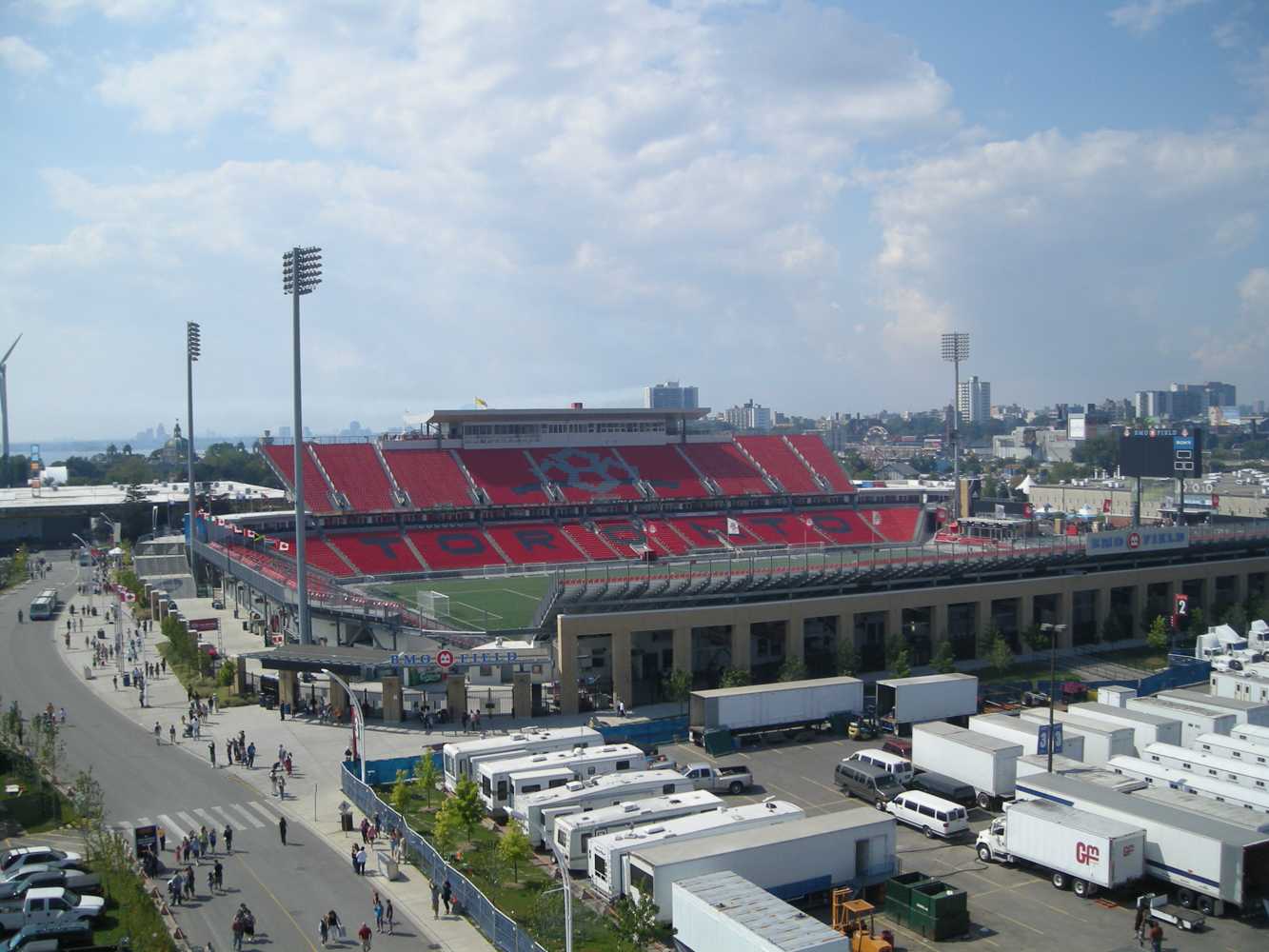
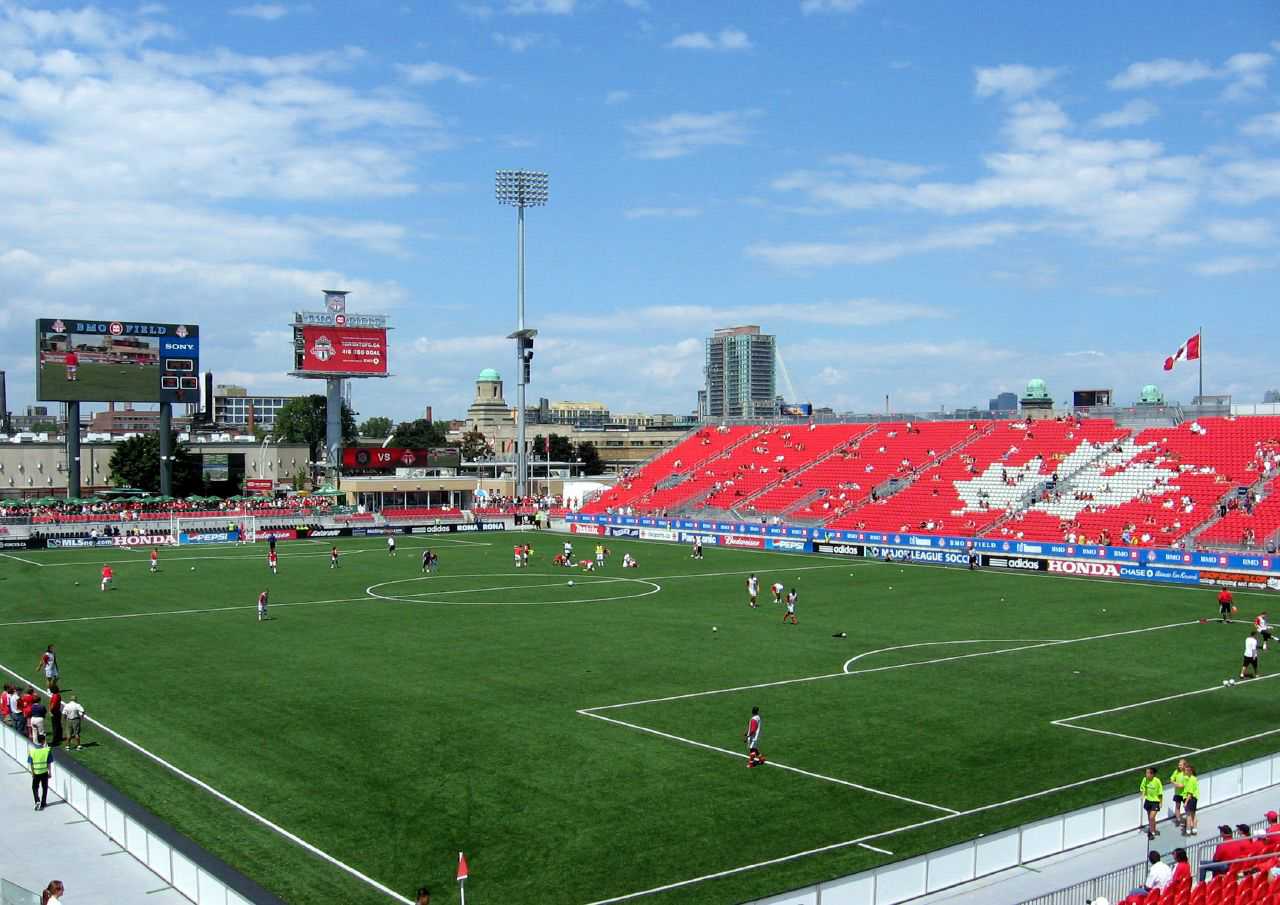
The stadium initially had a capacity of just over 20,000, with stands designed to fit the dimensions of a soccer field. The seating layout was asymmetrical – only the west stand had a second tier, while behind the north goal there were just a few rows of seats, along with a large video screen and the so-called “Carlsberg Patio.”
BMO Field originally featured a synthetic turf pitch. In 2010, it was replaced with natural grass, and since 2019 the stadium has had a hybrid playing surface.
What changes were made to BMO Field in 2010?
From February to April 2010, the lowest section of the north stand was expanded with an additional upper segment in the central part, adding space for 1,400 spectators.
How was BMO Field expanded between 2014 and 2016?
Between 2014 and 2016, the stadium underwent a second, much larger expansion, carried out in two phases. As a result, the east stand was raised with a second tier, the stands behind the goals were rebuilt to accommodate a Canadian football field, three stands were covered with a roof, and the overall capacity increased to around 30,000.
Phase I
The first phase began in September 2014 and was completed in May 2015. During this stage, the east stand was expanded with a second tier, adding 8,400 seats, bringing the total stadium capacity to approximately 30,000.
Phase II
Construction for the second phase started in November 2015 and lasted until May 2016. This phase included the installation of a roof over three stands (east, west, and south), supported by four corner pylons, as well as the reconstruction of the stands behind the goals.
The redesign of the stands behind the goals created additional space to fit a Canadian football field. As part of these changes, the existing north stand was removed (with temporary structures used there only for soccer matches), while on the south side the lower rows were converted into retractable, removable seating. This allowed the Toronto Argonauts to move in for the 2016 season after leaving Rogers Centre.
The design of the 2014–2016 BMO Field renovation and a construction report can be viewed on separate pages
What changes were made to BMO Field ahead of the 2026 World Cup?
Another modernization of BMO Field was closely linked to the 2026 FIFA World Cup. In 2018, Canada, the United States and Mexico were selected as hosts of the tournament, and in 2022 the host cities were announced.
Toronto was among them, with matches scheduled to be played at BMO Field. It was one of only two Canadian host cities (alongside Vancouver, where games will be held at BC Place).
BMO Field appeared to be the least prepared venue among all World Cup stadiums. It was clearly too small and had to be expanded to meet the requirements of a major international tournament.
The increase in capacity was achieved by adding temporary stands – something the stadium had already been designed for, with a similar solution previously used when hosting the Grey Cup and an NHL outdoor game in 2016–2017.
The modernization works also included a number of additional upgrades intended to benefit the stadium in the long term. The project was carried out in two phases: from December 2024 to August 2025, and from December 2025 to March 2026.
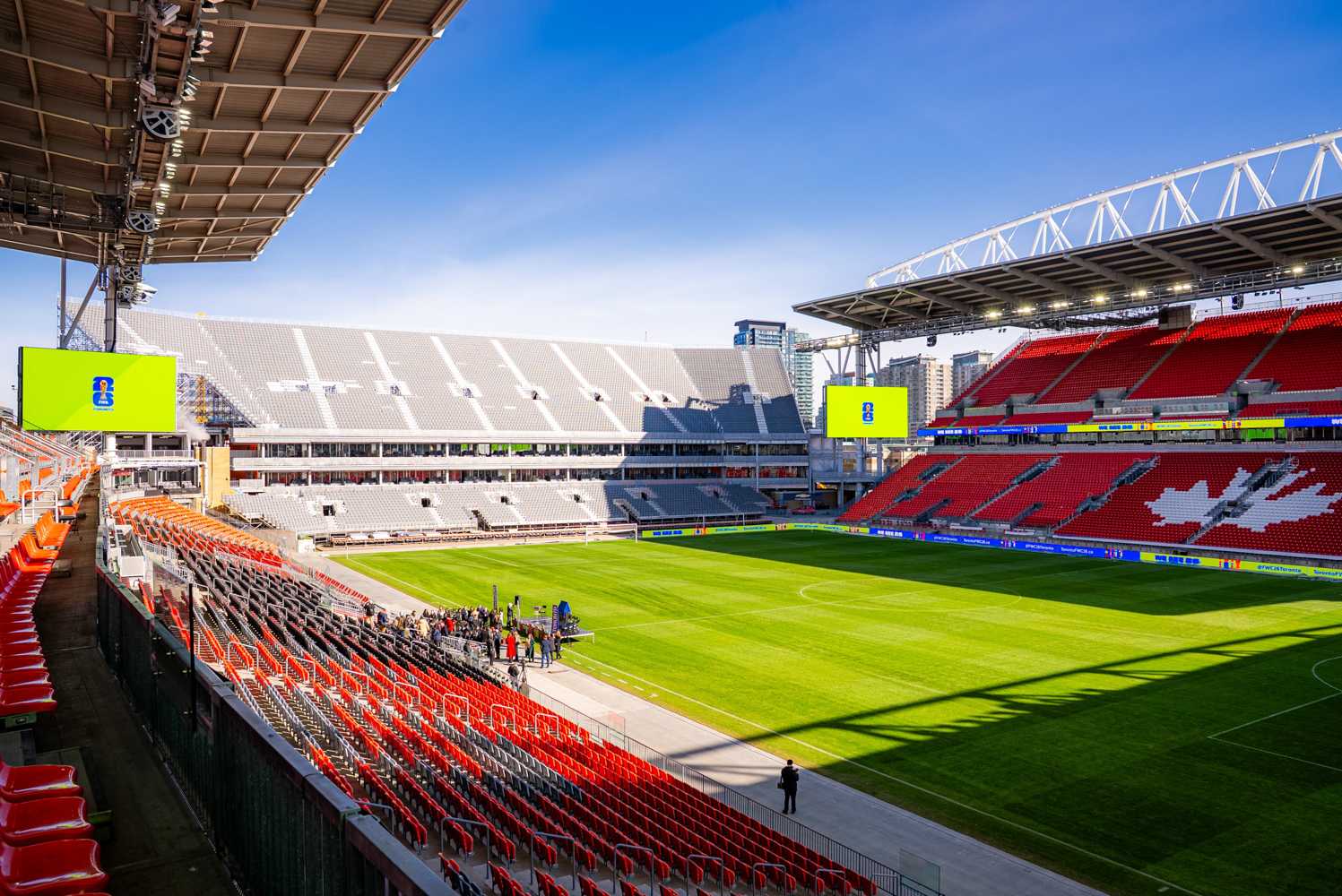
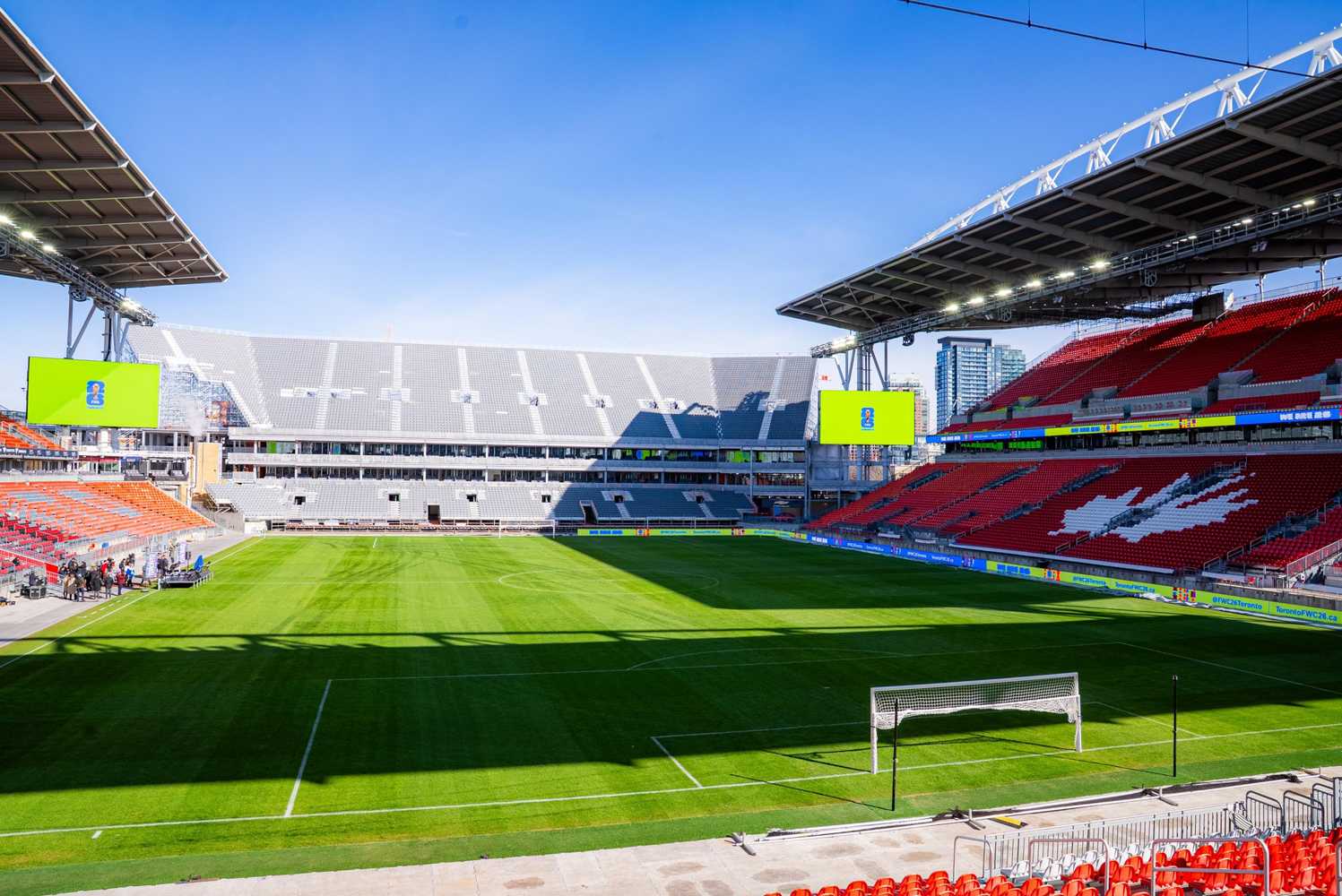
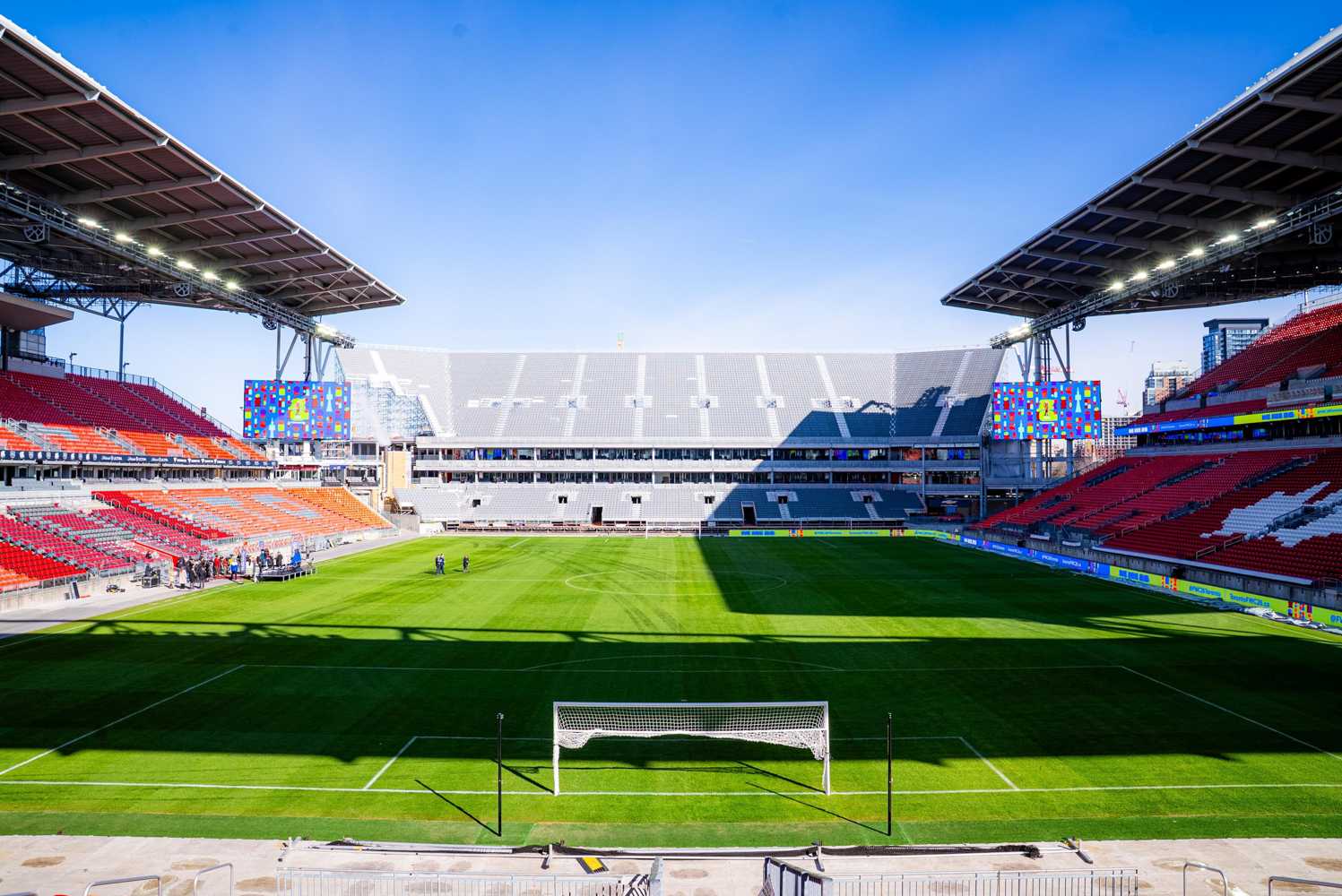
Temporary stands were installed behind the goals, increasing the stadium’s capacity to 45,000 for the World Cup (a total of 17,000 additional seats – 10,000 in the north and 7,000 in the south).
Among the permanent additions, the stadium gained a hospitality building with suites behind the north goal, four corner video boards replacing the previous north-end screen, as well as renovated locker rooms and other facilities, and upgraded technical infrastructure.
The design of the 2024–2026 BMO Field modernization can be viewed on a separate page
What does BMO Field look like?
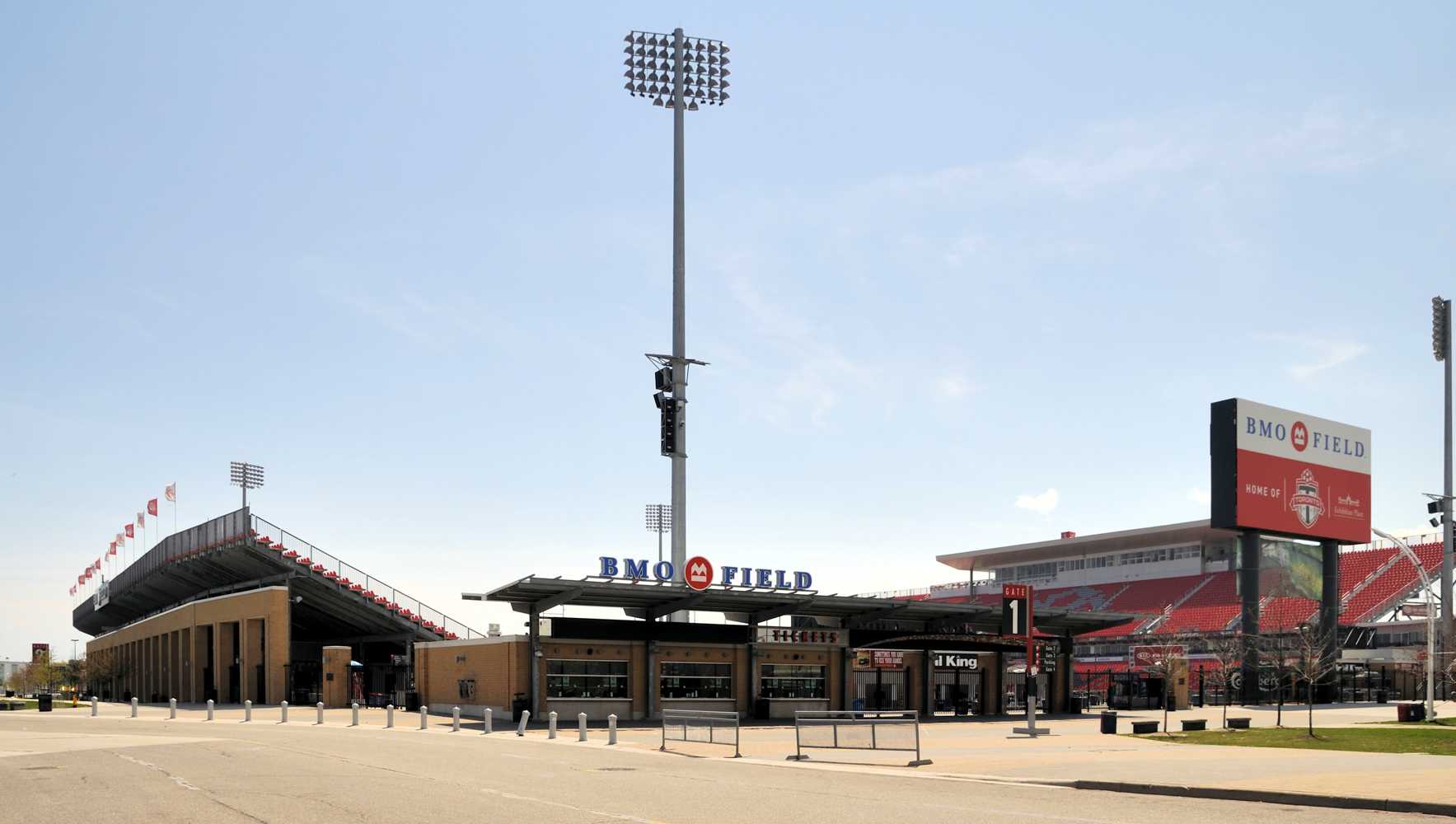
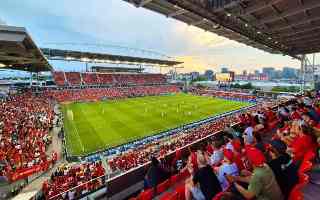
BMO Field is a stadium designed primarily for soccer, but thanks to the introduction of removable seating sections behind the goals, it has also been able to host Canadian football since 2016.
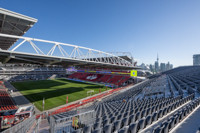
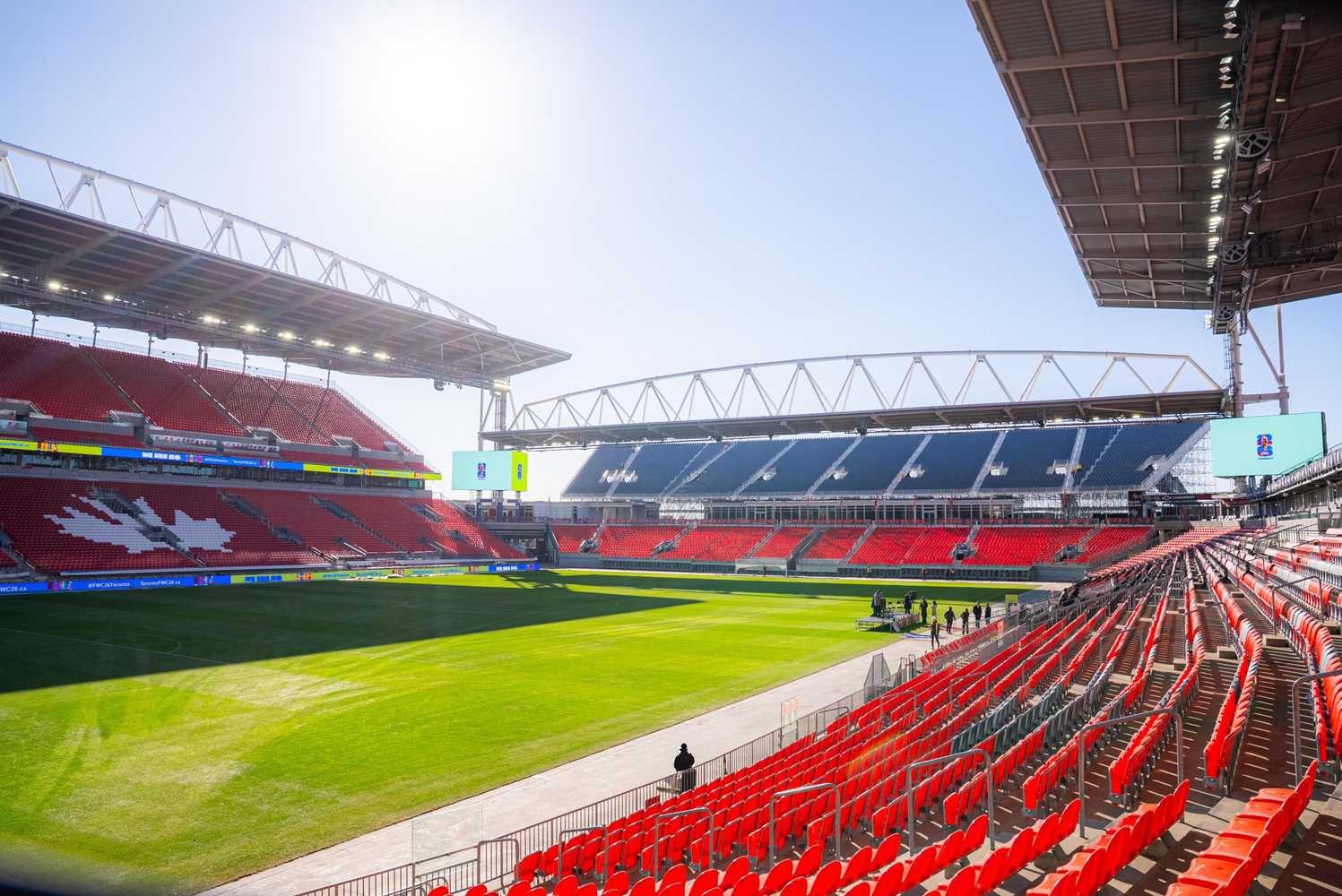
Along the sidelines, the stadium features tall, two-tier stands equipped with VIP suites. Behind the south goal there is a single-tier stand with retractable lower rows.
Behind the north end, fully mobile stands are used, which are removed for Canadian football games to extend the playing field. The north side also includes a two-level suite building.
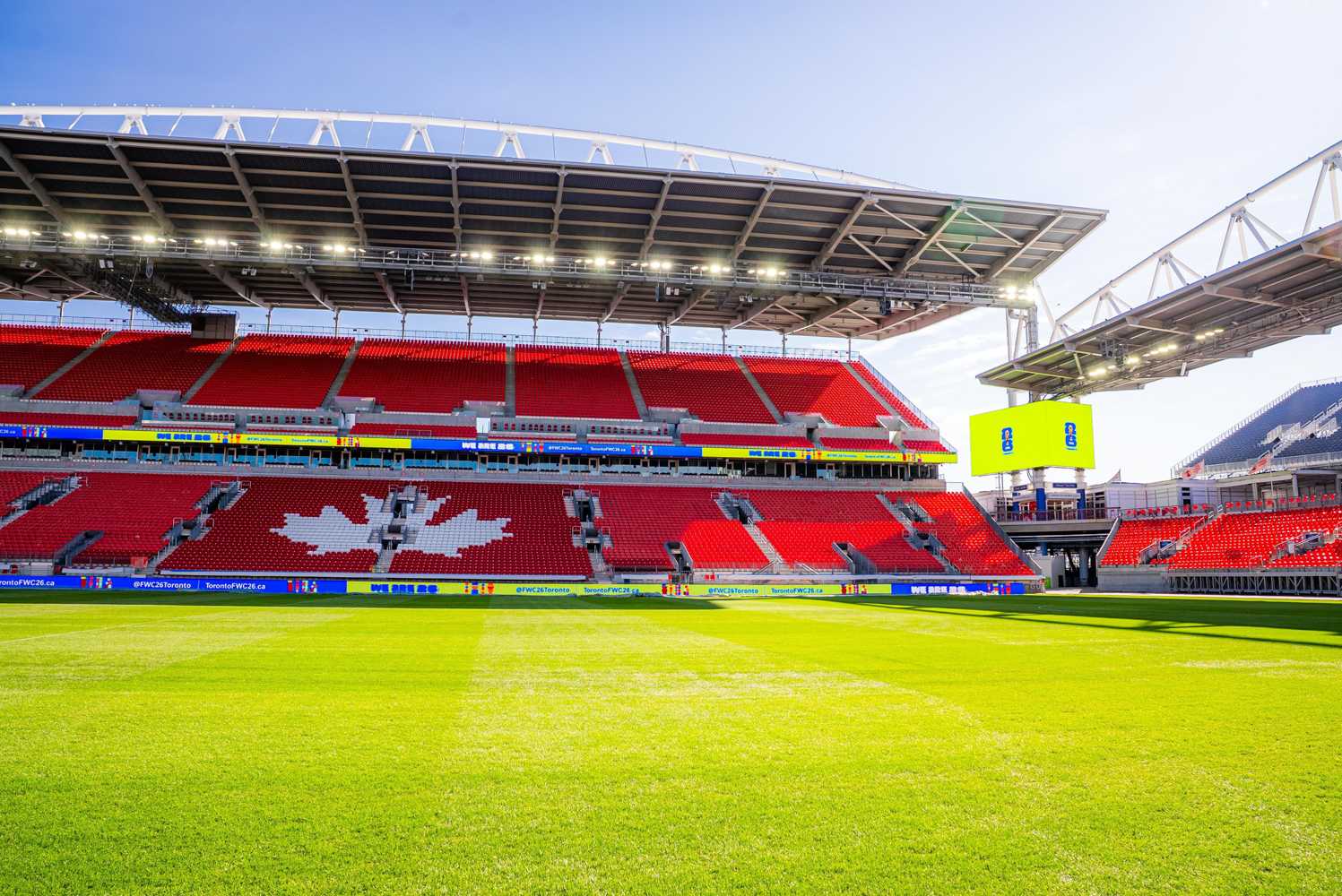
Red seats dominate the stands (with the exception of lettering and graphic patterns), and the stadium’s capacity without temporary structures is approximately 28,000. For the 2026 FIFA World Cup, large temporary structures have been erected behind the goals, increasing capacity to around 45,000.
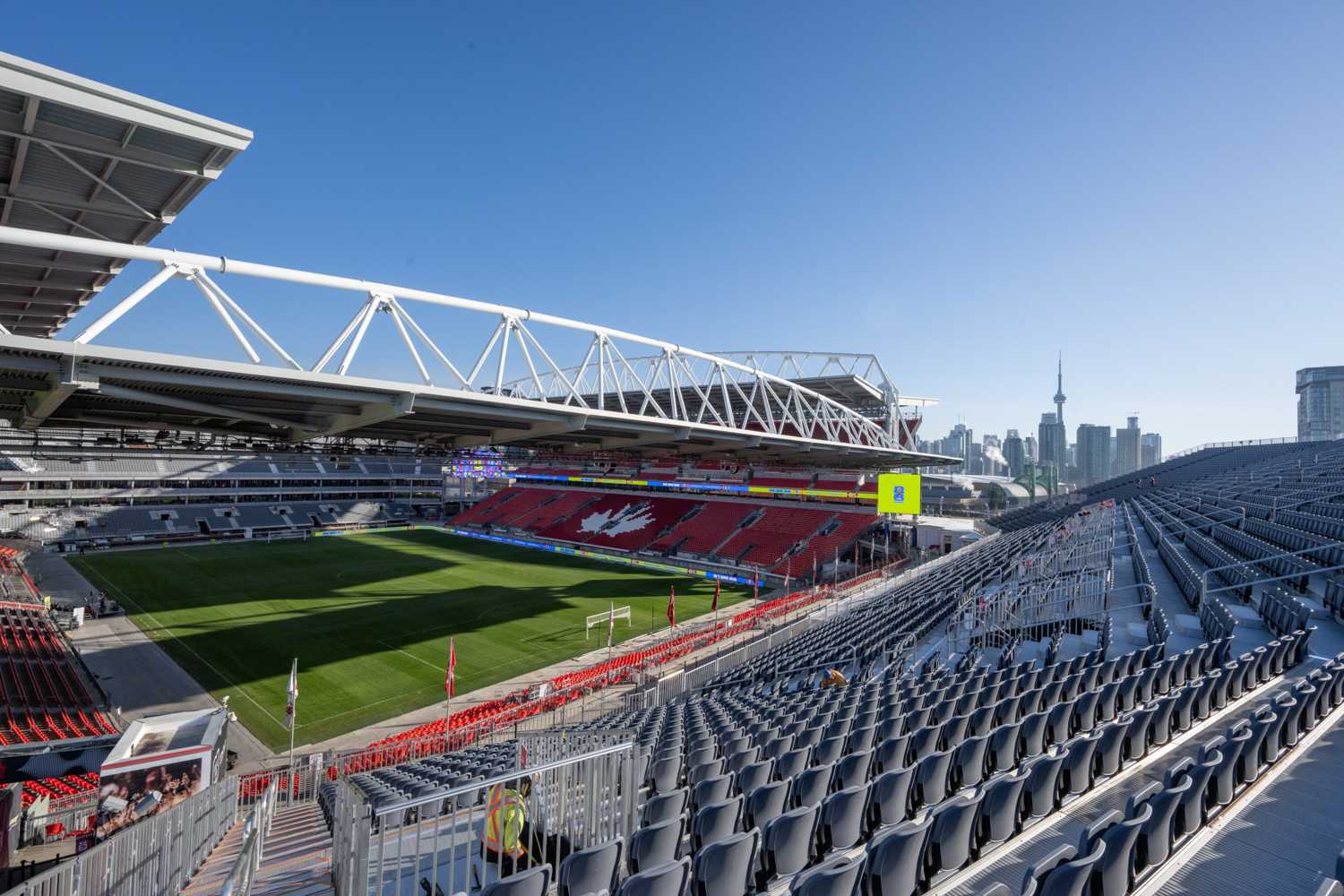
The east, west, and south stands are fully covered. The roof structure is largely supported by four corner pylons, which carry longitudinal trusses holding the roof covering. Four video boards are also mounted on these pylons.
The roof above the west and south stands is suspended relatively high, which makes it appear as a separate structure distinct from the rest of the stadium. However, the elevated roof on the south side allows for the installation of additional temporary seating without obstructing views of the field.
The structural frame of the stands remains largely exposed on the exterior. At ground level, the building is finished with light brick walls.
The stadium is located within Exhibition Place, near the shores of Lake Ontario, about 3 km west of downtown Toronto.
What events are held at BMO Field?
Which teams play at BMO Field?
Toronto FC
The primary tenant of BMO Field is Toronto FC, a soccer club competing in Major League Soccer (MLS). The team debuted in the 2007 season, alongside the opening of the stadium, and became the first MLS club from outside the United States.
Toronto FC’s greatest achievement is winning the MLS Cup in 2017. In 2018, the team also reached the CONCACAF Champions League final, where they lost on penalties to CD Guadalajara.
Toronto Argonauts
Since 2016, following their move from Rogers Centre, the Toronto Argonauts have been the stadium’s second tenant. The team competes in the Canadian Football League (CFL) and is the most successful franchise in the history of Canadian football.
Canada men’s national soccer team
The stadium was built at the initiative of the Canadian Soccer Association and was originally intended to serve as a national soccer stadium, primarily for the national team, before Toronto FC was secured as a permanent tenant.
It remains one of the main venues for Canada’s national team, hosting many important matches.
Other teams
In the 2009 season, BMO Field was home to the first Canadian team in Major League Lacrosse – the Toronto Nationals. The team moved to Lamport Stadium after just one season, relocated to Hamilton in 2011, and folded after the 2013 season.
In 2018, Toronto FC II, the reserve team of Toronto FC, also played at BMO Field while competing in the United Soccer League (USL).
The stadium has also hosted matches of the Canada national rugby union team.
What sporting events are held at BMO Field?
FIFA U-20 World Cup (2007)
The construction of the stadium was driven by Canada’s hosting of the FIFA U-20 World Cup. The venue was completed shortly before the tournament, which took place from July 1 to July 22, 2007, and marked the first major event held at BMO Field.
The stadium was one of six venues for the tournament. A total of 12 matches were played there, including the final, in which Argentina successfully defended their title by defeating the Czech Republic 2–1.
FIFA U-20 Women’s World Cup (2014)
Another major international event was the FIFA U-20 Women’s World Cup, held in Canada in August 2014. BMO Field was one of four venues and hosted seven matches, including one of the quarter-finals.
CONCACAF Gold Cup
The stadium has twice hosted matches in the CONCACAF Gold Cup – in 2015 (two group-stage matches) and in 2023 (one group-stage match).
Campeones Cup
Following their MLS Cup triumph in 2017, Toronto FC hosted the inaugural Campeones Cup on September 19, 2018 – a match between the champions of MLS and Liga MX. The game at BMO Field ended in a 3–1 victory for the visitors, Tigres UANL.
MLS Cup
BMO Field has hosted the MLS Cup – the championship match of Major League Soccer (MLS) – three times, in 2010, 2016, and 2017. In 2010, it became the first Canadian stadium selected to host the event.
The hosting of the MLS Cup in 2016 and 2017 was the result of Toronto FC reaching the final – since 2012, the league has followed the practice of awarding home-field advantage to the finalist with the better regular-season record.
List of MLS Cup matches held at BMO Field:
- November 21, 2010: Colorado Rapids – FC Dallas 2–1 (a.e.t.)
- December 10, 2016: Toronto FC – Seattle Sounders FC 0–0 (a.e.t., 4:5 on penalties)
- December 9, 2017: Toronto FC – Seattle Sounders FC 2–0
Grey Cup (Canadian football)
Following the 2014–2016 expansion, BMO Field gained the ability to host the Grey Cup – the championship game of the Canadian Football League (CFL).
The match took place on November 27, 2016, marking the 104th Grey Cup. In the game, the Ottawa Redblacks defeated the favored Calgary Stampeders 39–33 after overtime, winning their first championship in just their third season of existence.
For the event, the south stand was temporarily expanded, increasing the stadium’s capacity to approximately 34,000.
NHL Centennial Classic (ice hockey)
On New Year’s Day, January 1, 2017, BMO Field hosted a National Hockey League (NHL) regular-season game known as the NHL Centennial Classic, celebrating both the Toronto Maple Leafs’ 100th season in the NHL and the league’s own centennial year.
In the outdoor game, the Toronto Maple Leafs defeated the Detroit Red Wings 5–4 after overtime. With temporary seating added on the north and south sides, the match was attended by over 40,000 spectators.
The day before, BMO Field also hosted an alumni game featuring former players from the same teams. The Detroit side won 4–3.
2015 Pan American Games
During the 2015 Pan American Games, held in Toronto in July 2015, BMO Field hosted all rugby sevens matches in both the men’s and women’s tournaments.
2026 FIFA World Cup
BMO Field has been selected as a venue for the 2026 FIFA World Cup, which will be held in Canada, the United States, and Mexico. It will be one of 16 stadiums used for the tournament and one of only two in Canada (alongside BC Place in Vancouver).
The World Cup will be the largest event in BMO Field’s history. Ahead of the tournament, the stadium underwent modernization and was expanded with temporary stands behind the goals, increasing its capacity to 45,000.
During the tournament, BMO Field is set to host six matches – five in the group stage (including Canada’s first game) and one in the Round of 32.
Advertisement
Pictures
24.03.2026 © City of Toronto 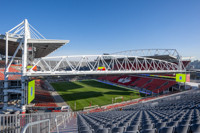
24.03.2026 © City of Toronto 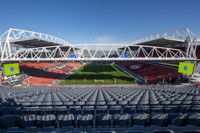
24.03.2026 © City of Toronto 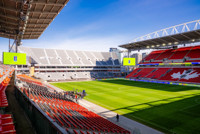
03.2026 © FIFA World Cup 26 Toronto 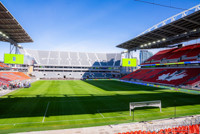
24.03.2026 © City of Toronto 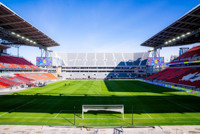
03.2026 © FIFA World Cup 26 Toronto 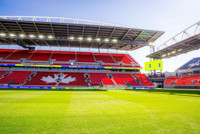
03.2026 © FIFA World Cup 26 Toronto 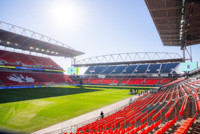
24.03.2026 © City of Toronto 
15.05.2019 © Frank Jasperneite 
15.05.2019 © Frank Jasperneite 
19.06.2024 © mosi - always on tour 
19.06.2024 © mosi - always on tour 
19.06.2024 © mosi - always on tour 
19.06.2024 © mosi - always on tour 
15.05.2019 © Frank Jasperneite 
15.05.2019 © Frank Jasperneite 
15.05.2019 © Frank Jasperneite 
15.05.2019 © Frank Jasperneite 
15.05.2019 © Frank Jasperneite 
15.05.2019 © Frank Jasperneite 
05.05.2016 © Amir Delic (cc: by-nc-sa) 
05.05.2016 © Amir Delic (cc: by-nc-sa) 
07.05.2016 © Jack Landau 
15.05.2019 © Frank Jasperneite 
15.05.2019 © Frank Jasperneite 
15.05.2019 © Frank Jasperneite 
30.04.2016 © drum118 
07.05.2016 © PCL Constructors 
07.05.2016 © PCL Constructors 
27.07.2011 © paul bica (CC BY 2.0) 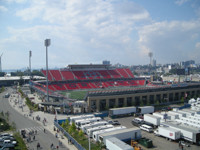
05.09.2009 © Neal Jennings (CC BY-SA 2.0) 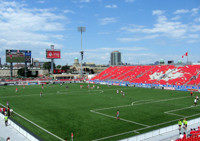
29.07.2007 © Oliver Mallich (CC BY-ND 2.0) 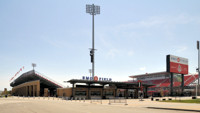
08.05.2009 © Wladyslaw (CC BY-SA 3.0)
2016–2024:


2010–2014:

2007–2010:
Related news
2026
-
WC 2026: “You can be small and compete.” Toronto’s underrated World Cup stadium
Does a World Cup really need 80,000- or 90,000-seat stadiums? Toronto suggests otherwise. The smallest venue of the 2026 World Cup has become a symbol of a more sustainable approach to hosting major tournaments, sparking debate over whether atmosphere and long-term usability matter more than record-breaking capacity.
-
WC 2026: Countdown to the World Cup in Canada. How were the stadiums prepared for the tournament?
Canada’s preparations for the 2026 FIFA World Cup involved extensive upgrades to its two tournament venues — BC Place in Vancouver and the stadium in Toronto. Both facilities underwent comprehensive renovations aimed at meeting FIFA requirements and raising technical, operational and commercial standards.
-
USA: Inside the billion-dollar machine behind World Cup 2026. Costs, controversy and complexity
Although the 2026 FIFA World Cup will be a joint effort of the United States, Canada and Mexico, it is the USA that bears the greatest organizational burden of the tournament. Most matches — including the final — will be played on American soil, which has required massive investment in stadiums, transport and security systems.
-
WC 2026: How US stadiums are preparing for the World Cup? Grass, construction, and criticism
Preparations for the 2026 FIFA World Cup involved extensive upgrades that transformed NFL venues into stadiums meeting FIFA requirements. The key changes included switching to natural grass surfaces, adjusting pitch geometry and expanding technical infrastructure and operational facilities.
-
USA: A revolution underfoot. Have scientists perfected the World Cup pitch?
For eight years, scientists have been working on a pitch designed to withstand the biggest World Cup in history. As BBC reports, the grass for the 2026 FIFA World Cup will not be just another part of the stadium, but the result of advanced research, testing and technological refinement of every detail.
-

WC 2026: Toronto Stadium renovation completed. Venue fully ready for the World Cup!
Toronto is completing its World Cup preparations, with its main stadium undergoing one of the most significant transformations in its history. The venue is set to meet global expectations and new standards. How has it changed ahead of the 2026 tournament?
-

World Cup 2026 – Ultimate Fan Guide
The 2026 World Cup sets a new scale in the history of the tournament. This guide will help you plan your trip and secure your match attendance without the risk of losing out in ticket lotteries, while also organizing the format, host cities, and stadiums for fans watching the tournament on TV.
2025
-

World Cup 2026: Key matches and stadiums for the biggest national teams
As the 2026 World Cup schedule takes shape, fans around the globe are eagerly planning the football journey of a lifetime. This could be the final chance to witness Messi and Ronaldo shine on the world’s biggest stage! Here’s where the top national teams will play, which stadiums will host their battles, and how to track ticket availability before it’s too late.
-
USA: World Cup 2026 under extreme heat as stadiums surpass safe limits
Ten of the 16 stadiums set to host the 2026 FIFA World Cup in the United States, Canada and Mexico currently exceed safe playing limits due to extreme temperatures, according to a report by Football for Future, Common Goal and Jupiter Intelligence.
-

North America: Stadiums ruled out of the 2026 World Cup host race
There’s less than a year left until the start of the 2026 World Cup. The USA, Canada and Mexico are preparing to host the tournament, but not all cities met FIFA’s expectations. We present 15 stadiums that were once in the running but were ultimately left out.
-

USA: One year to the 2026 World Cup! Did the Club World Cup test deliver?
A new format and a major dress rehearsal ahead of the 2026 World Cup. From political undertones and turbulent weather conditions to controversies over attendance and pitch quality – did the expanded edition of the Club World Cup live up to expectations?
-

WC 2026: Infantino shocked by… summer? Heatwave exposes FIFA unprepared
FIFA president Gianni Infantino announced that during the 2026 World Cup, to counter expected heat, matches scheduled for early hours will be played primarily in stadiums that are covered and air-conditioned.
-
Canada: How will BMO Field change for the 2026 World Cup?
The FIFA Men’s World Cup is fast approaching, and Toronto’s downtown stadium, which will host six tournament matches, is undergoing a nearly $150 million upgrade.
2024
-

Canada: Toronto to host first-ever FIFA World Cup match in the country
Toronto will host Canada's first-ever FIFA World Cup match at BMO Field in 2026. The tournament will kick off on 11 June and will be co-hosted by Mexico, Canada and the US.
-
World Cup 2026: Locations, stadiums and schedule
FIFA has already announced the details of the 2026 World Cup, which will be held in the USA, Mexico and Canada. As happens when a tournament of this size is co-hosted by several countries, there was no shortage of controversial decisions. So let's check what we already know about the 2026 World Cup.
-

2026 World Cup: Toronto divided on hosting tournament
Announcement of Toronto as the host city for the 2026 World Cup has sparked diverse opinions among fans, showcasing the city's potential for both grand celebrations and financial challenges.
-

World Cup 2026: We know location of tournament final!
On Sunday afternoon, the official announcement of the schedule for the 2026 World Cup took place. The tournament will be held in the United States, Mexico, and Canada. The stadium that will have the honor of hosting the final has also been revealed.
2023

2022
-

World Cup 2026: How is Canada Preparing for the World Cup in 2026?
The 2026 World Cup is edging ever closer, and preparations for the ultimate tournament are already underway. Canada is hosting the competition alongside the USA and Mexico. Toronto and Vancouver will represent the most northern of the three nations, with 11 USA cities and three Mexican ones also set to accommodate matches.
-

Canada: Toronto will spend $300 million to host the World Cup
The Toronto authorities have just announced that hosting the 2026 World Cup at BMO Field stadium will cost $300 million of public money. The cost of hosting the games in Toronto is now approaching the net amount the city expects to earn during the 2026 World Cup, which is $307 million.