 StadiumDB
USA: A revolution underfoot. Have scientists perfected the World Cup pitch?
source: BBC; author: Małgosia Kowalska
 For eight years, scientists have been working on a pitch designed to withstand the biggest World Cup in history. As BBC reports, the grass for the 2026 FIFA World Cup will not be just another part of the stadium, but the result of advanced research, testing and technological refinement of every detail.
Advertisement
The World Cup starts with grass
As BBC reports, preparing the pitches for the 2026 FIFA World Cup has become one of the largest and most precise technological projects connected with the tournament. Although fans usually see the pitch as the background to the game, at the World Cup in the USA, Canada and Mexico it is set to become one of the key elements of the entire infrastructure.
The scale of the challenge is exceptional, as the tournament will be held across 16 stadiums in three countries, in different climate zones and in venues with completely different designs. FIFA, however, requires the ball to roll and bounce in as similar a way as possible, regardless of whether the match is played under a roof, in an open stadium, in a cooler climate or in high temperatures.
That is why the federation brought in scientists from the University of Tennessee and Michigan State University, who have been working for several years on natural playing surfaces for World Cup stadiums and training pitches. The project covers not only the match venues, but also the training infrastructure, which will be hugely important for national teams during the tournament.
 © Grzegorz Kaliciak| AT&T Stadium
Natural grass in stadiums not always ready for it
The biggest problem is not simply growing the grass, but adapting it to stadiums that do not normally function like traditional football venues. Some NFL arenas use artificial turf, while others are roofed or enclosed, meaning natural grass has limited access to light.
The solution is to be specially prepared, reinforced natural grass. The pitches must have proper drainage, irrigation systems, soil ventilation and additional lighting to support grass growth. Methods of reinforcing the surface are also being tested so that it is more stable and resistant to intensive use.
Another important part of the work has been developing a pitch that can be transported and installed with almost no loss of quality. Instead of treating grass as a simple layer of turf, scientists are analysing its root system, soil structure and behaviour after being moved into a stadium. The goal is for the pitch to be ready for play quickly, while also retaining its properties.
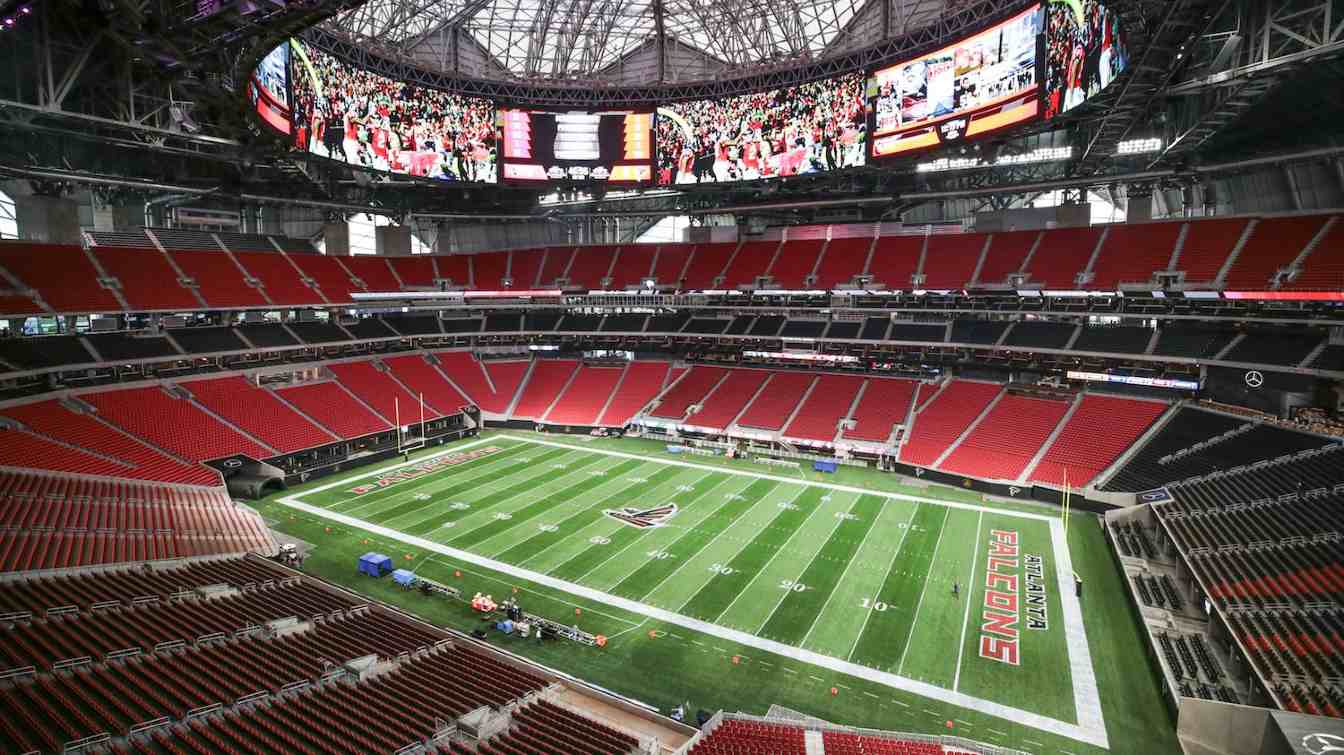 © Atlanta Falcons / Mercedes-Benz Stadium | Mercedes-Benz Stadium
Perfection or controlled risk?
The preparations for the World Cup are also a response to criticism of pitch quality during previous tournaments in the USA. In recent years, the condition of playing surfaces in North America has been a subject of discussion, especially when European clubs and national teams had to play in stadiums designed primarily for American football.
FIFA stresses that the goal is not only an attractive green pitch, but above all a predictable and safe playing surface. Researchers are testing, among other things, surface hardness, ball bounce, grip and how the grass reacts under load, so that players do not have to adapt their game to each stadium separately.
Has the World Cup pitch been perfected? On paper, the project looks like the most advanced pitch preparation programme in tournament history. The final test, however, will come only during the matches, when scientific assumptions meet temperature, enclosed stadiums, the match schedule and the pressure of the biggest football event in the world.
Advertisement