 StadiumDB
World Cup 2026 – Ultimate Fan Guide
source: StadiumDB.com ; author: StadiumDB.com
 The 2026 World Cup sets a new scale in the history of the tournament. This guide will help you plan your trip and secure your match attendance without the risk of losing out in ticket lotteries, while also organizing the format, host cities, and stadiums for fans watching the tournament on TV.
Last update: March 31, 2026
Table of contents
- Introduction
- World Cup 2026 in a nutshell
- Tournament format
- Key dates
- Host cities and regions (see 3 matches in 7 days)
- Stadium guide
- Buying tickets
- Transport between cities
- Accommodation & neighborhoods
- Travel safety
- Matchday planning
- FAQ
Introduction to 2026 World Cup Guide
What does 2026 World Cup guide cover?
World Cup 2026 is the biggest football tournament in history: three host countries, over a dozen time zones, scores of cities, and hundreds of possible travel combinations. This guide was created to distinguish realistic travel scenarios from those that only look good on paper.
If you are planning a trip, you will find everything here that actually impacts a fan’s decisions: distances between cities, travel times, matchday schedules, rest days, the consequences of the new format, and matchday logistics. We show you how the 2026 World Cup works in practice and how to navigate it effectively.
At the same time, this is a complete guide to the tournament itself, even for those not planning to travel. We discuss the competition format, calendar, regional divisions, the role of specific cities and stadiums, and how the expansion to 48 teams changes the flow of the championship. As a result, this guide allows you to understand the scale of the event, its structure, and dynamics — whether you are watching matches from the stands or following the tournament from home.
This is not a collection of loose facts or a tourist photo album. It is an organized compendium on the 2026 World Cup that presents the tournament as it truly will be — both from the perspective of a traveling fan and a keen observer of the year's biggest football event.
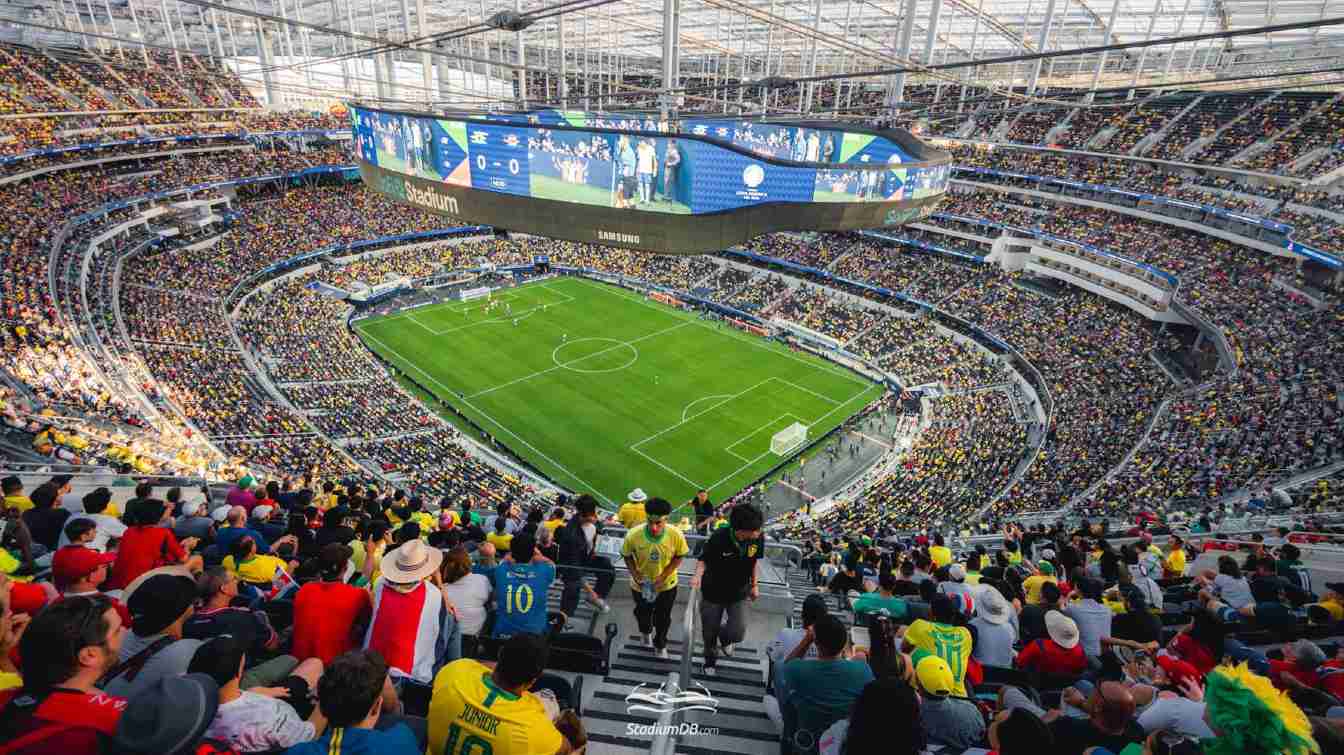 © Grzegorz Kaliciak | SoFi Stadium in Los Angeles will host the opening match of the host nation, with the United States facing Paraguay.
Who can practically benefit from this guide?
If you are planning for a single match at the World Cup, you will find the information needed to choose the right city, stadium, or transport to ensure your matchday doesn't turn into logistical chaos. No excess theory – just a focus on practice.
If you want to combine several cities during the tournament, the guide shows which routes make sense within the real timeframe of the event, and which require too many flights or overnight transfers. This is a tool for itinerary building, not an inspirational album.
If you are following a national team at the 2026 World Cup, scenarios are key: the group stage, potential qualification, city changes, and short breaks between games. This guide explains how to plan a trip given the uncertain progression of the tournament and where to leave yourself a safety margin.
How to use 2026 World Cup guide?
The structure of the guide is modular. You can read individual chapters independently and return to tables and checklists at different stages of your planning.
First, we discuss the framework of the tournament – the format, dates, and scale of the event. Then we move on to the regions, cities, and stadiums, always from the perspective of a fan on the ground. Subsequent sections cover transport, accommodation, safety, and matchday experience, concluding with ready-made travel itineraries and match tables.
How will this guide help you buy tickets for 2026 World Cup?
All links in this guide lead to a verified partner of StadiumDB.com, with whom we have already helped fans secure their tickets for the 2026 World Cup – in a transparent, safe, and proven way.
The principle of using the guide is simple and practical: when you choose a city, a specific day, or a team, you return to the relevant section and check real availability and current prices with a single click. This allows you to plan your trip and tickets in parallel – consciously, without guessing, and without leaving key decisions to the last minute.
Additionally, on our tournament page, you will find a complete list of all 2026 World Cup matches, gathered in one place and directly linked to tickets. If you want to quickly check the entire schedule, compare cities, or return to planning at any moment – everything is there at your fingertips.
World Cup 2026 in a nutshell
The 2026 World Cup will take place from June 11 to July 19, 2026. The hosts will be the United States, Canada, and Mexico – marking the first time the World Cup will be played simultaneously across three countries. It will be the largest edition in tournament history: featuring 48 national teams, 104 matches scheduled over 39 days, with the top two teams playing up to eight games each.
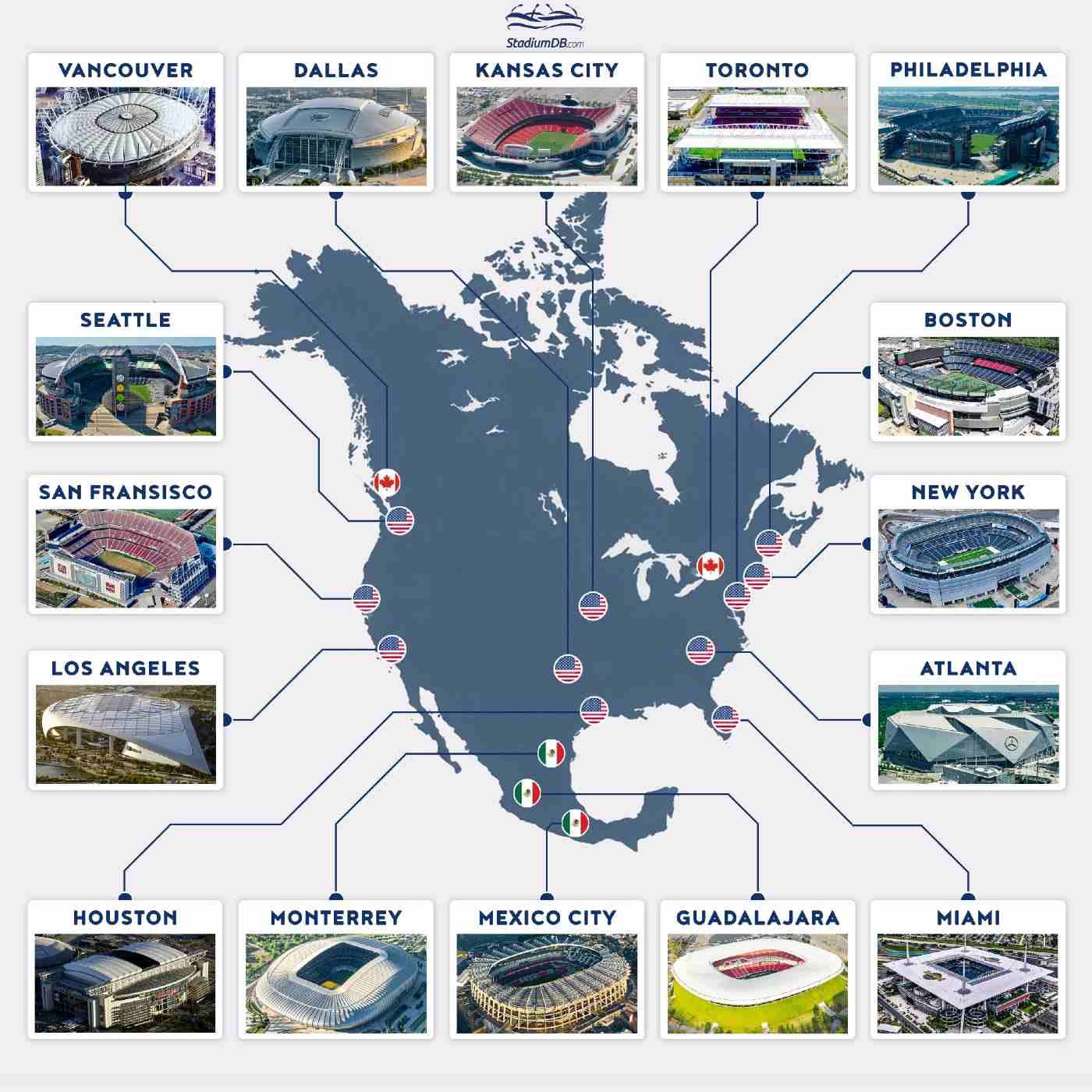
The tournament will take place without the construction of new stadiums. All matches will be played at existing NFL and MLS venues, as well as top stadiums in Mexico, across 16 host cities – from Vancouver to Guadalajara. Mexico will make history as the first nation to host the World Cup for a third time, following the 1970 and 1986 editions. In contrast to the compact Qatar 2022, where all arenas were within close proximity, World Cup 2026 will be an event of continental scale, requiring travel across multiple time zones.
Initially, FIFA considered a format of 16 groups of three teams but ultimately decided on classic four-team groups. This format is recognized as fairer and more sportingly attractive, while also limiting the risk of collusion and ambiguous outcomes in the final stages of the group phase.
How is the 2026 World Cup format structured?
The 48 national teams have been drawn into 12 groups of four teams. Each team will play three matches, resulting in a total of 72 group-stage games spread over approximately two weeks of competition. 32 teams will advance to the knockout stage: the top two teams from each group, plus the eight best third-placed teams, determined by points, goal difference, and comparisons across groups.
The knockout stage will begin on June 28 with the Round of 32. In this round, 16 matches will be played in a short timeframe at stadiums located across North America. The tournament will then proceed into the classic bracket known from previous World Cups: the Round of 16, Quarter-finals in four cities, Semi-finals scheduled for Dallas and Atlanta, and the final on July 19 at MetLife Stadium in the New York area.
For fans, this means far more options than during the World Cup in Qatar, but also more logistical challenges. Watching two matches in a single day will be practically impossible, but there will be room to explore the host cities. A solid travel plan will become crucial: the group stage allows you to anchor yourself to specific stadiums and locations, whereas the Round of 32 requires significant flexibility and quick flights between countries.
Key dates and important moments of World Cup 2026
When to realistically plan your leave for World Cup 2026
The 2026 World Cup will run from June 11 to July 19, but for a fan planning a trip, specific time windows matter more than the entire tournament duration.
The Group Stage will be played from June 11–27, and this part of the World Cup is the most logistically predictable. The group schedule is known in advance, cities and stadiums are assigned to specific matches, and the breaks between games allow for realistic planning of flights and accommodation. For most fans, this is the best time to schedule leave – especially if the goal is to see one or a few matches without the risk of sudden location changes.
The Knockout Stage will begin on June 29 and last until the final on July 19. From this point on, trip planning requires greater flexibility – both in terms of time and budget – because the locations of subsequent matches depend on sporting results.
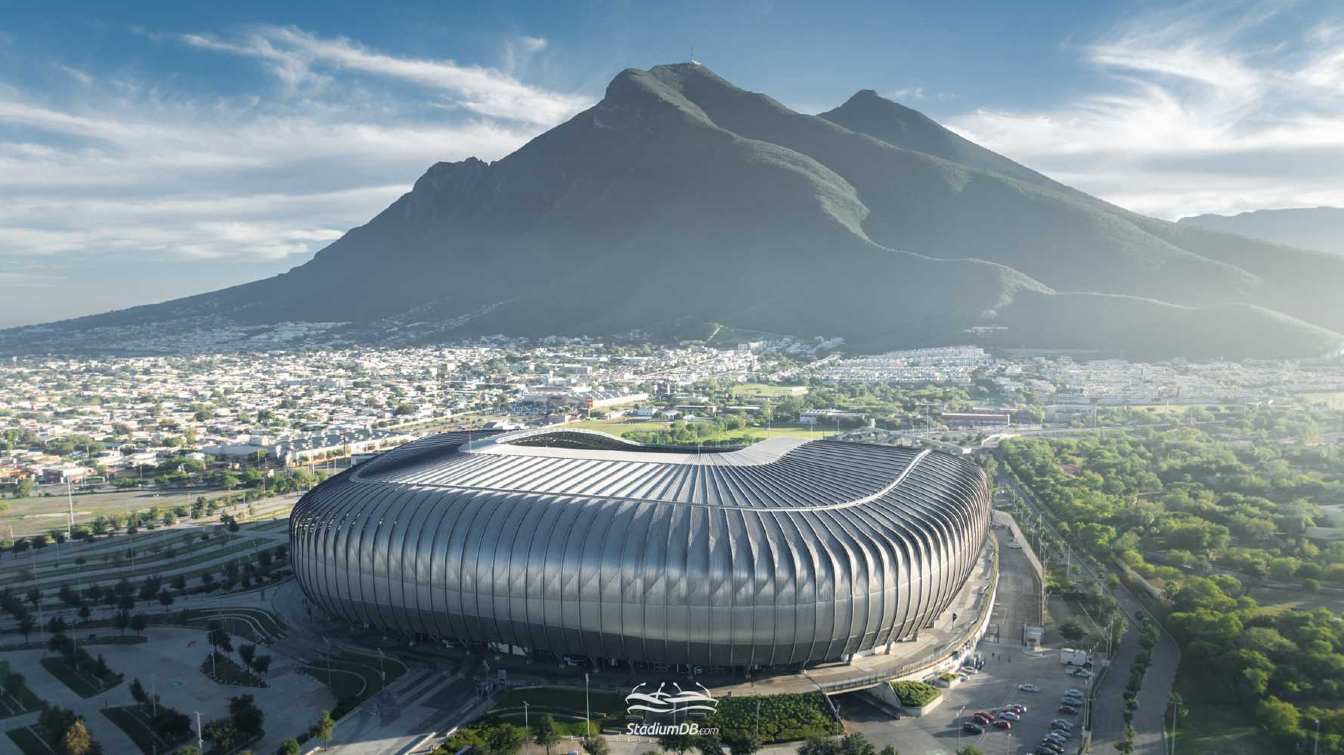 © Grzegorz Kaliciak | The World Cup 2026 stadium in Monterrey, Estadio BBVA, is widely regarded as one of the most beautifully located stadiums in the world.
How to read the schedule: matchdays, breaks, and flights
The new format of World Cup 2026 means that every national team in the group stage will play three matches, typically at intervals of 4–6 days. In practice, this means there are usually 3–4 non-match days between a team's group games. These breaks are crucial from a logistical perspective. Given the distances characteristic of the USA, Canada, and Mexico, it is difficult to treat host cities as neighboring locations. A flight between Seattle and Miami, or Vancouver and Mexico City, is a full-scale air journey requiring a separate day in your itinerary.
An additional factor is time zones. Matches are played from UTC–7 to UTC–4, which affects not only kick-off times but also your daily rhythm, recovery, and the feasibility of quick flights between regions.
Tournament Mini-Timeline: From Group Stage to Final
- June 11–27 – Group Stage (12 groups, matches in 16 cities)
- June 28 – July 3 – Round of 32
- July 4–7 – Round of 16
- July 9–11 – Quarter-finals
- July 14–15 – Semi-finals
- July 18 – Third Place Match
- July 19 – Final
It is worth noting that all matches from the Quarter-finals onwards will take place in the USA, which significantly simplifies logistics in the second half of the tournament – especially for fans planning a longer stay.
What advancing from the group stage changes
Advancing to the knockout stage does not mean continuing the tournament in the same region. In the new format, sudden changes of cities and time zones are possible, often with very short breaks between matches.
Therefore, a key decision is whether your travel plan covers only the group stage or also potential qualification. In the latter case, it is necessary to leave a safety margin:
- extra days,
- flexible accommodation,
- the ability to book a quick flight to another city.
This guide helps you understand which qualification scenarios are logistically sensible and which, in practice, require very large time compromises.
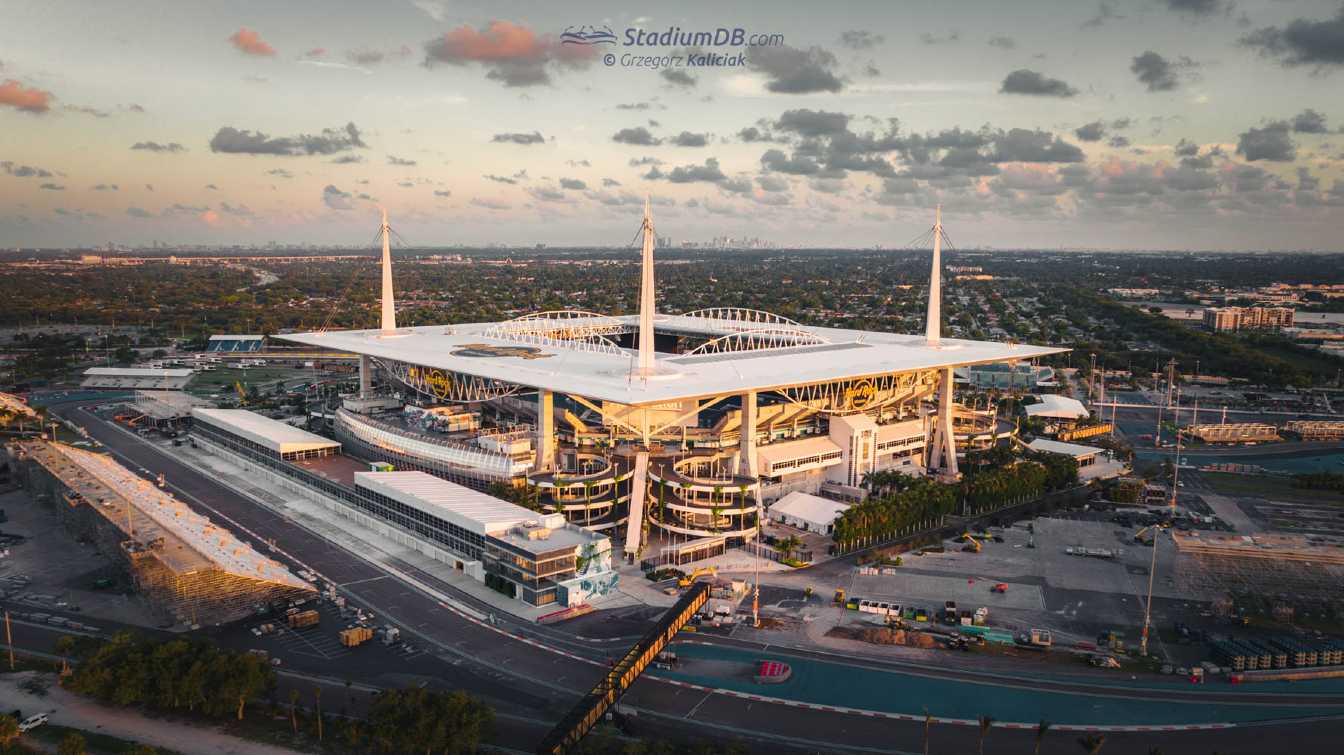 © Grzegorz Kaliciak | Miami will be one of the hottest host cities during the World Cup tournament.
Host cities and regions: choose the "map" before you choose the matches
In 2026, the easiest way to lose is not against ticket prices, but against geography. The World Cup is spread across three countries and several time zones, so the first decision that truly organizes your plan is: which region do you want to move within?
Only then should you choose cities, stadiums, and matches — so that your trip doesn't turn into a chain of flights and invisible
costs (time, fatigue, layovers, stadium commutes).
Region 1: Canada (Toronto, Vancouver)
Canada consists of just two cities, but on two opposite sides of the country.
- Toronto naturally connects with the
belt
in the eastern USA: the areas of New York, Boston, and Philadelphia. If you want to build amatch + short transfer + next match
plan, Toronto is a great piece of the puzzle. - Vancouver, on the other hand, is on the side of the western corridor: Seattle / San Francisco Bay Area / Los Angeles. This is a good choice if you want to stick to a single time zone.
Who Canada is suitable for: if you want to watch the Canadian national team or if this country is the most convenient location for you, buy tickets for matches in Toronto or experience the World Cup in Vancouver.
Region 2: Mexico (Mexico City, Guadalajara, Monterrey)
Mexico has three cities and three distinct advantages:
- Mexico City is the venue for the opening match and other group games.
- Guadalajara will host one Mexico group match and the blockbuster Spain vs Uruguay clash.
- Monterrey offers one match from the
Mexican
group and fantastic stadium views.
Who Mexico is suitable for: don't want to miss the grand opening match at Estadio Azteca? Mexico is for you. Attend Mexico national team matches played in an incredible home atmosphere.
Region 3: USA (remaining cities)
The USA is the largest part of the tournament. USA
as a single location doesn't exist — in practice, it's several travel corridors that make sense mainly if you stick to one area or travel to follow a specific team.
How to think about the United States?
- East / Northeast: New York, Boston, Philadelphia + Atlanta/Miami as a separate, southern
sub-region.
- Central: Dallas, Houston, Kansas City (here you can often build a plan with fewer flights because many matches
rotate
between these points). - West: Los Angeles, Seattle, San Francisco.
Who is the USA suitable for: want to be at the center of the World Cup? The biggest stadiums, the brightest stars, and a huge selection of matches sound tempting. Although many great national teams will play in the USA, a unique atmosphere will accompany the host nation's games. Buy tickets for USA matches at the 2026 World Cup!
If you want to see 3 matches in 7 days – the most rational itineraries
The following variants have been developed based on the actual group stage schedule, stadium locations, and time intervals between matches. Each layout:
- fits within an approximately one-week window,
- limits the number of flights to a minimum,
- is based on a logical regional layout,
- includes matches featuring recognizable national teams.
Option A: Texas hub & last dance for Messi (USA – Central)
| Date | Match | City / Stadium | Tickets |
|---|---|---|---|
| 14 June | Netherlands vs Japan | Dallas Stadium | See Prices |
| 17 June | England vs Croatia | Dallas Stadium | See Prices |
| 22 June | Argentina vs Austria | Dallas Stadium | See Prices |
This variant is based on a single accommodation base and one stadium. No need to change cities simplifies logistics and allows you to focus solely on matchdays. The main advantage is the chance to see an Argentina match for the last time with Lionel Messi in the squad without the need to travel between cities.
Option B: Canada–US East (Toronto–Boston)
| Date | Match | City / Stadium | Tickets |
|---|---|---|---|
| 20 June | Germany vs Ivory Coast | Toronto Stadium | See Prices |
| 22 June | Norway vs France | New York New Jersey Stadium | See Prices |
| 23 June | England vs Ghana | Boston Stadium | See Prices |
An itinerary based on two cities in the same time zone. The transfer between Toronto and Boston can be planned during the break between matches, and the last two games take place in one location, stabilizing the travel plan. Favorable logistics aren't everything; the great asset of this layout is the opportunity to see top teams like Germany or England and cap the trip with a duel between Kylian Mbappé and Erling Haaland.
Option C: Brazil-focused week (USA – East)
| Date | Match | City / Stadium | Tickets |
|---|---|---|---|
| 19 June | Brazil vs Haiti | Philadelphia Stadium | See Prices |
| 24 June | Scotland vs Brazil | Miami Stadium | See Prices |
| 25 June | Ecuador vs Germany | New York New Jersey Stadium | See Prices |
This variant focuses on two Brazil matches played in different East Coast cities. A third match featuring Germany completes the week both sportingly and geographically.
Option D: England group-stage route
| Date | Match | City / Stadium | Tickets |
|---|---|---|---|
| 17 June | England vs Croatia | Dallas Stadium | See Prices |
| 23 June | England vs Ghana | Boston Stadium | See Prices |
| 27 June | Panama vs England | New York New Jersey Stadium | See Prices |
A variant for fans who want to follow one national team throughout the entire group stage. The dates of England's matches allow for calm travel between cities and planning the trip in stages.
Option E: Miami & Cristiano Ronaldo
| Date | Match | Stadium | Tickets |
|---|---|---|---|
| 21 June | Uruguay – Cape Verde | Miami Stadium | See Prices |
| 24 June | Scotland – Brazil | Miami Stadium | See Prices |
| 27 June | Colombia – Portugal | Miami Stadium | See Prices |
This layout was prepared with fans in mind who want to see Portugal and Cristiano Ronaldo in the group stage, and also plan to be in the Miami area for a week. Exotic Cape Verde or a star-studded Brazil make this path even more sensible.
How to use these proposals or create your own
Each of the above variants should be treated as a framework plan that can be adapted to available time and budget. It would also be beneficial to use these layouts as a template to create your own. In that case, it is good to:
- identify one key match,
- select a second as a high priority,
- treat the third as a supplement dependent on availability and prices.
This approach allows you to plan your trip in an organized way, without the need to completely overhaul the concept later. Didn't find a scenario for yourself? Plan your own World Cup route thanks to our tournament page, where you will find links to all 2026 World Cup matches.
Stadiums of WC 2026: stadium guide
Toronto Stadium
Toronto Stadium – location and brief history
Toronto Stadium is a modern, open-air football stadium located within the Exhibition Place complex on the shores of Lake Ontario, just a few kilometers west of downtown Toronto — Canada’s largest city and the capital of Ontario. The venue was built in 2007 on the site of the former Exhibition Stadium, which fell into disrepair and was demolished in 1999 after the Toronto Blue Jays and Toronto Argonauts moved to the SkyDome (now Rogers Centre). Owned by the City of Toronto, the stadium is managed by Maple Leaf Sports & Entertainment — the company that controls Toronto FC in MLS and the Toronto Argonauts in the CFL, giving the arena a multi-purpose character.
From the start, it was designed as a football-specific venue, prepared for the 2007 U-20 World Cup and Toronto FC’s debut season in Major League Soccer. The pitch meets FIFA standards, and the stands rise close to the turf, creating a compact, football atmosphere. Over time, the stadium also became the home of the Argonauts, hosted rugby tournaments (including the 2015 Pan American Games), as well as numerous concerts and commercial events. In preparation for the 2026 World Cup, expansion works are underway to increase capacity to 45,000 seats and introduce modern hospitality facilities, TV studios, and advanced multimedia infrastructure.
Toronto Stadium – capacity and layout
Originally, Toronto Stadium offered about 20,000–25,000 seats, with a dominant west stand, a lower east stand, and open ends behind the goals. The steel prefabricated structure was finished with light brick and designed for easy expansion.
Renovations between 2014 and 2016 added an upper tier to the east stand with a distinctive red maple leaf pattern, densified the sectors behind the goals, lengthened the field for CFL needs, and roofed most seats, increasing the permanent capacity to about 30,000 for soccer matches, with the possibility of temporary expansion to 40,000.
The layout retained its classic football character: a 105 × 68 meter pitch, no running track, steep sectors close to the touchlines, and compact, English-style stands. The lower west stand features the inscription TORONTO,
and the south end displays BMO,
highlighting local identity. The stadium was also adapted for Canadian football thanks to movable sectors in the end zones, partially artificial turf in the runoff areas, and a hybrid pitch with heating and grow lights, allowing quick adaptation for MLS, CFL, rugby, and commercial events.
Before the 2026 World Cup, 17,000 modular seats are planned to be installed on the north and south stands (to be dismantled after the tournament), increasing capacity to 45,500. Additionally, new seats will appear on the east and west stands, along with dugouts, FIFA-standard LED lighting, an improved pitch, elevators, staircases, and TV studios. The first phase of modernization, completed in September 2025, included the installation of LED screens, Wi-Fi, the Coinbase lounge, and broadcast infrastructure at a total cost of C$146 million.
Matchday at Toronto Stadium
Toronto Stadium comes alive primarily during Toronto FC MLS matches, which in 2016–2017 drew full crowds, generating a loud, European atmosphere thanks to ultras in the standing sections. The stadium hosted MLS Cup finals in 2010, 2016, and 2017 (including TFC’s historic treble), the 2007 U-20 World Cup (Argentina–Czech Republic final), international matches, rugby competitions, and the Grey Cup.
Beyond soccer, the venue serves as the home of the Argonauts in the CFL and hosts rugby sevens tournaments and the 2015 Pan American Games. Its location within Exhibition Place means matchday naturally blends with city life — fans can walk along Lake Ontario with a view of the Toronto skyline, passing CNE colors, concerts, and festivals, creating a unique atmosphere that spills over into the surroundings. During the 2026 World Cup, the stadium will host six matches: five group games and one Round of 32 fixture.
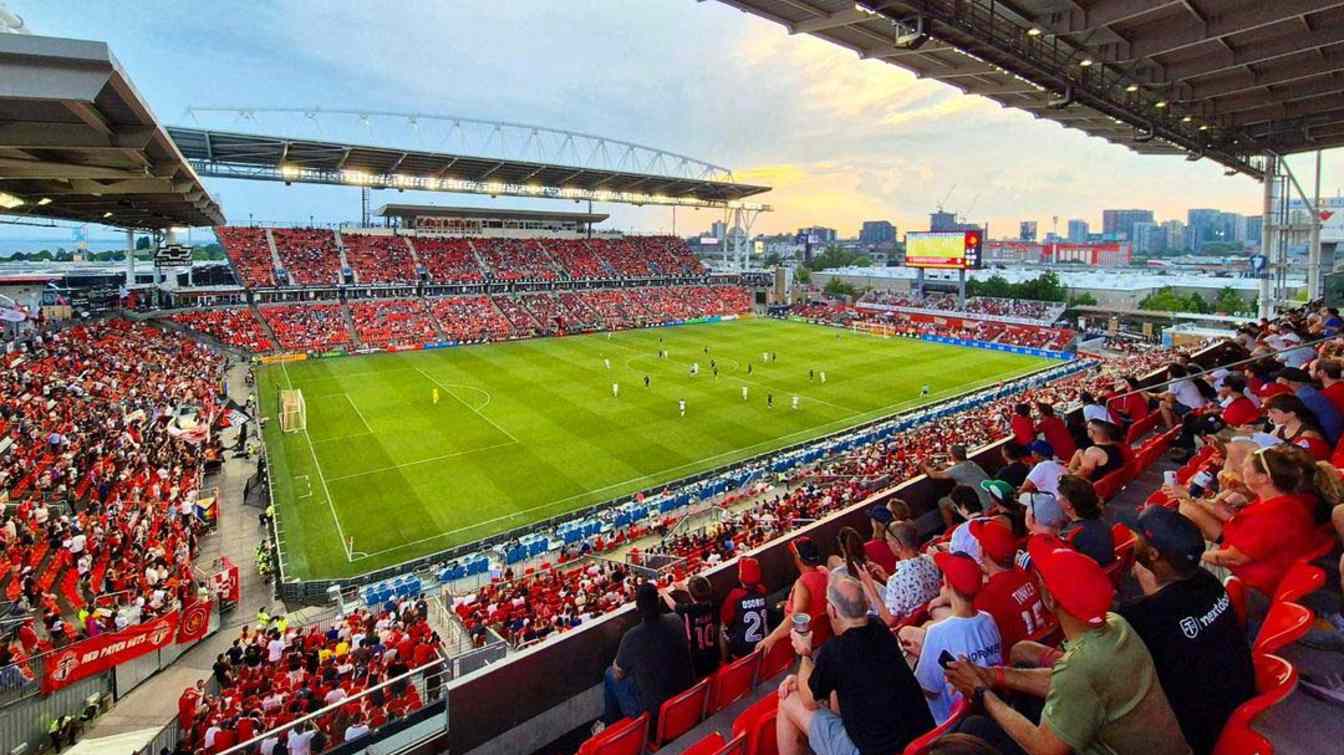 © mosi - always on tour | Toronto Stadium
How to get to Toronto Stadium during WC 2026 – transport guide
The stadium is located a few kilometers west of downtown Toronto, south of the Gardiner Expressway, right on the shore of Lake Ontario in the heart of Exhibition Place — a district known for trade shows, IndyCar races, and CNE festivals. The location favors large events thanks to wide avenues, dedicated parking, and excellent connections via TTC public transport and GO Transit commuter trains.
During the FIFA World Cup, special lines and transport zones will be launched. The simplest options include GO trains and TTC streetcar lines 509/511 from Union Station or downtown directly to Exhibition Place, getting off at Princes’ Gates or Dufferin Gate (5–10 minutes on foot). Walking or cycling from downtown takes about 45 minutes along the lake promenade or the Gardiner Expressway, passing the Toronto Music Garden and Humber Bay Park. Drivers can exit the Gardiner Expressway or highways I-427 and QEW directly to Exhibition Place, where parking for 10,000 cars and drop-off zones are provided; FIFA shuttle buses will also be available. Pearson Airport (YYZ) is a 30–45 minute drive from the stadium, and Billy Bishop (YTZ) is 20 minutes away.
Don’t wait for the final whistle – buy tickets for WC matches at Toronto Stadium and secure your place in the heart of the World Cup in Canada!
BC Place
BC Place – location and brief history
BC Place is located in the heart of Vancouver, on the north shore of False Creek, in British Columbia. The stadium opened on June 19, 1983, as the world’s largest air-supported domed stadium, built for Expo 86 and the first matches of the Vancouver Whitecaps and BC Lions. In 2007, the roof collapsed under the weight of snow, forcing its controlled deflation. After the 2010 Winter Olympics, the stadium underwent a major revitalization worth C$514 million.
The most significant change was replacing the inflatable roof with the world’s largest retractable cable-supported roof system (100 × 85 meters), which closes in 15 minutes. Owned by the province (PavCo), the venue has served for years as the home of the BC Lions in the CFL, Vancouver Whitecaps FC in MLS, and the Canada Sevens rugby tournament. In 2015, it hosted the Women’s World Cup final with a record attendance of 54,000, and in 2024, a Taylor Swift concert took place here. Before the 2026 World Cup, further modernizations are planned, including VIP suites, catering, and adapting the stadium to FIFA standards.
BC Place – capacity and layout
Following the 2011 renovation, the stadium offers 54,500 seats, including 50 VIP suites and 1,300 club seats. The stands form two tiers surrounding a 107 × 69 meter pitch with a Polytan LigaTurf surface holding a FIFA 2-star certificate. Above the field hangs the second-largest center-hung HD videoboard in North America and a 670-meter ribbon board.
The retractable roof protects against frequent rain, and the interior features 1,140 HDTV screens distributed in every row. The modernization also introduced wider concourses with 140 food and beverage points, modern sound systems, and sports lighting. Before the 2026 World Cup, the installation of a temporary natural grass pitch and FIFA tests regarding the surface, safety, and technology are planned. The tournament capacity of the stadium will be 54,000 seats.
Matchday at BC Place
BC Place buzzes with life mainly during BC Lions CFL games and Vancouver Whitecaps FC MLS matches, which regularly draw 25,000–30,000 fans, reaching a record 53,900 spectators during the 2025 playoffs against LAFC. The stadium hosted the 2015 Women’s World Cup final, the 10th Grey Cup won by the Lions, and the NHL Heritage Classic. The close proximity of the stands and the roof improve acoustics, creating a compact, intense atmosphere.
Its location on False Creek means matchday connects with city life — fans walk along the Yaletown promenades, pass Science World, and reach restaurants in the city center. Concerts by artists like Ed Sheeran or Taylor Swift fill the stadium to the brim. During the 2026 World Cup, BC Place will host seven matches: five group stage games (including two Canada matches on June 18 and 24), a Round of 32 match, and a Round of 16 match.
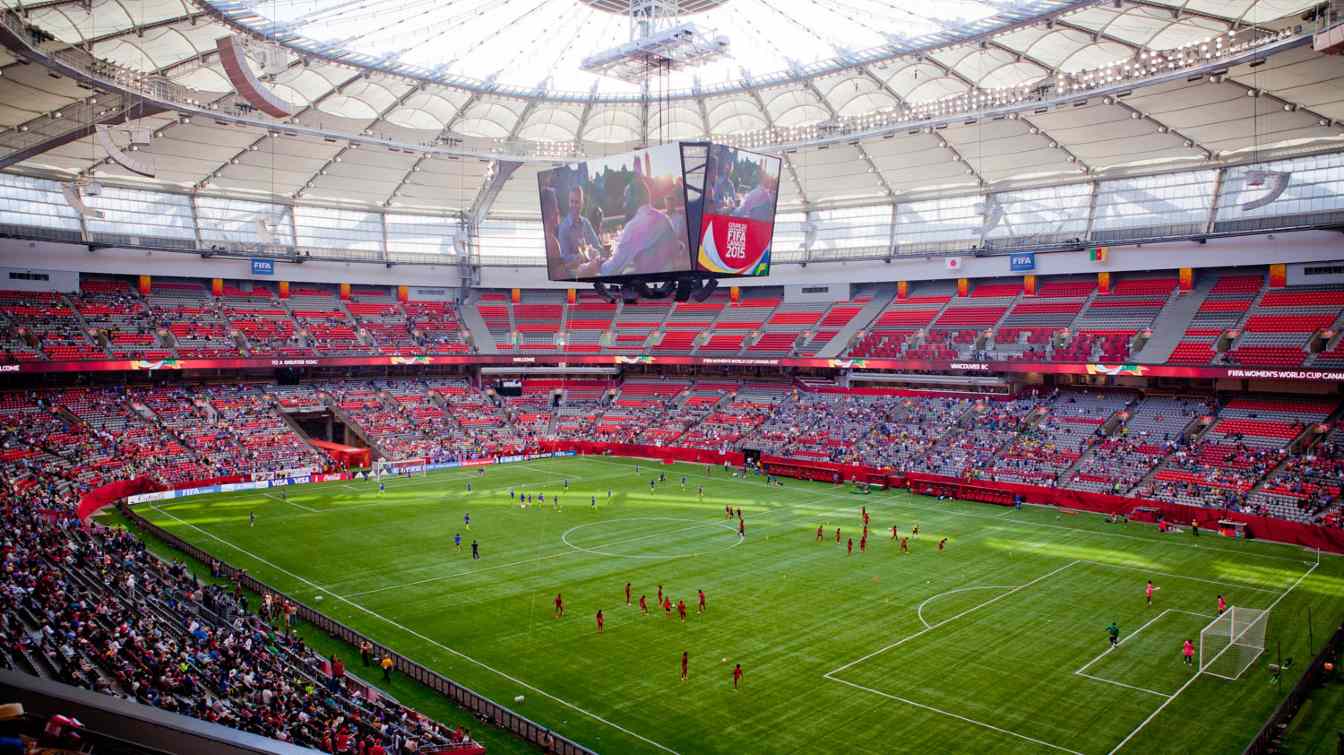 © GoToVan (CC BY 2.0) | BC Place Vancouver
How to get to BC Place during WC 2026 – transport guide
The stadium is located at 777 Pacific Boulevard in downtown Vancouver, with excellent access to the SkyTrain on the Expo and Canada Lines. The Stadium–Chinatown and Yaletown–Roundhouse stations are a few minutes’ walk away, as are TransLink stops and False Creek Ferries.
During the FIFA World Cup, dedicated shuttles from YVR airport and the city center will be launched. The fastest connection is the SkyTrain from YVR (20–30 minutes) or a walk from Gastown (15 minutes along the bay promenade). Drivers can use the Cambie and Granville bridges, though parking will be limited in favor of public transport and Uber drop-off zones.
Vancouver is calling! Plan your route, but don’t delay the most important part – buy tickets for WC matches at BC Place and see the best football against a backdrop of mountains and ocean!
Boston Stadium
Boston Stadium – location and brief history
Boston Stadium is located in Foxborough, Massachusetts, about 35 km southwest of downtown Boston and 29 km northeast of Providence, in the heart of the Greater Boston region. The stadium opened in 2002 as the successor to Foxboro Stadium. From the beginning, it has served as the home of the New England Patriots in the NFL and the New England Revolution in MLS, privately funded entirely by owner Robert Kraft. The stadium bears the sponsorship name Gillette (contract until 2031), but during the 2026 FIFA World Cup, the neutral name Boston Stadium will apply.
The stadium’s design was inspired by M&T Bank Stadium in Baltimore and features a distinctive entrance with a lighthouse and a bridge modeled on Boston’s Longfellow Bridge. The venue was designed by Populous after more than 200 variations. It has hosted seven AFC Championship Games, the 2016 NHL Winter Classic, concerts (Taylor Swift record – 174,000 spectators over three days in 2018), and NCAA lacrosse tournaments. A $225 million renovation completed in 2023 included a new observation lighthouse and the largest curved outdoor video board in the USA.
Boston Stadium – capacity and layout
During the 2026 World Cup, the stadium’s capacity will be 70,000 seats. The stands are divided into upper and lower tiers, surrounding a field without a running track, with central HD videoboards and the curved board added after the 2023 renovation. The lack of a roof is compensated for by a 66-meter lighthouse with a 360° observation deck, connecting hospitality levels with 75,000 sq ft of new spaces.
The 2023 renovation introduced a covered entrance from the north, a footbridge facilitating movement from east to west, more restrooms, permanent bars, and a memorial garden dedicated to the victims of the September 11 attacks. Before the World Cup, the stadium will undergo FIFA tests checking the hybrid surface, security systems, and technology.
The stands feature a classic, open bowl configuration
with three levels: lower (Main Concourse), middle (Club/Mezzanine), and upper (Upper Deck). The lower sectors offer excellent proximity to the pitch and great sightlines, while the upper tiers — despite their height and steepness — provide an impressive panoramic view of the entire field, although the wind can be strong there.
The stadium’s architecture is defined by the lack of a roof, making it an arena of the elements
— sun, wind, or rain are an integral part of the spectacle here, building a raw, Yankee
atmosphere typical of New England. The venue’s acoustics are specific — the open structure allows sound to escape upwards, but thanks to the new screens and the closure of the north side with a video wall,
the cheering reverberates better than before, creating a loud cauldron, especially in the lower sectors.
Matchday at Boston Stadium
Boston Stadium buzzes with life during matches of the New England Patriots, who have had a streak of over 231 sold-out games since 1994, and the New England Revolution, who set an MLS record of 65,600 spectators in 2024 against Inter Miami with Messi. The stadium has hosted seven AFC Championships, the 2002 MLS Cup, the 2003 Women’s World Cup, the Copa América, and concerts by One Direction (148,000 spectators over three days). The atmosphere is enhanced by Patriot Place, with outlets and bars right in front of the stadium. During the 2026 World Cup, the stadium will host seven matches: five group games, a Round of 32 match, and a Quarter-final.
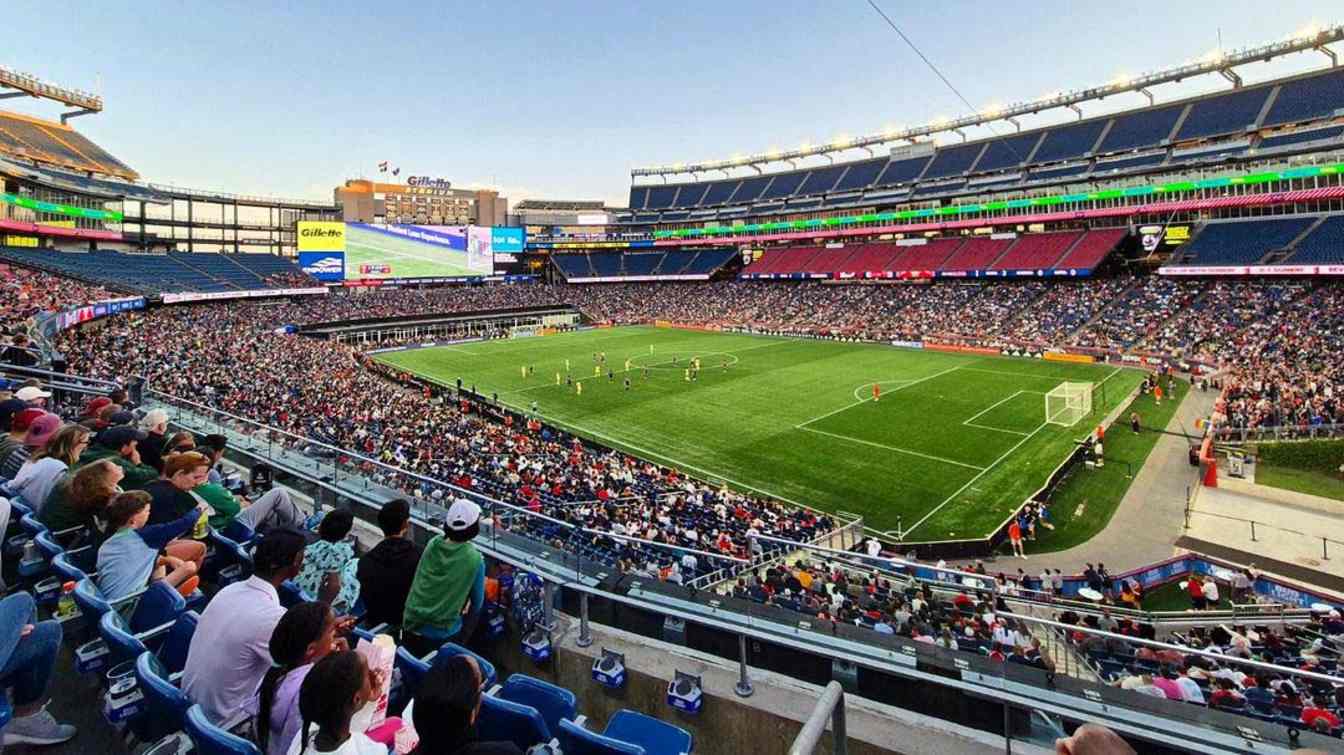 © mosi - always on tour | Boston Stadium
How to get to Boston Stadium during WC 2026 – transport guide
The stadium is located in Foxborough, 35 km southwest of Boston, with a dedicated MBTA Commuter Rail line on the Franklin/Foxboro Line from Boston and Providence. You get off at Foxboro Station, from where shuttles take fans to the stadium. The location is convenient thanks to Route 1 and new access roads.
During the World Cup, shuttles will run from Logan Airport in Boston (45 minutes) and from Providence (30 minutes). The MBTA train from South Station in Boston takes about an hour with transfers to shuttles. Walking or cycling from Patriot Place takes 5–10 minutes. Drivers can use Route 1 and I-95; the parking lot holds 20,000 cars with reservation via FIFA, and an Uber ride costs about $60. Although the parking is extensive, public transport is recommended due to expected congestion on Route 1 and I-95 on matchdays.
Watching on TV isn’t the same. Buy tickets for WC matches at Boston Stadium and see what it’s like to cheer along with 70,000 fans!
Miami Stadium
Miami Stadium – location and brief history
Miami Stadium is located in Miami Gardens, a suburb of Miami, Florida, at 347 Don Shula Drive, near I-95 and Florida’s Turnpike. The stadium opened in 1987 as the first multipurpose venue in the USA privately funded by Joe Robbie, replacing the Orange Bowl. It served as the home of the Miami Dolphins in the NFL, the Miami Marlins in MLB (until 2011), and since 2008, the Hurricanes in the NCAA. Since 2016, it has borne the name Hard Rock Stadium with rights until 2034, but during the 2026 World Cup, it will operate under the neutral name Miami Stadium.
The stadium design featured a rectangular field wider than in the NFL, facilitating conversion for baseball and soccer. The first rows of seats are 27 meters from the sidelines, ensuring visibility in all configurations. The venue has hosted six Super Bowls, the 2024 Copa América final, the Orange Bowl, the Miami Open, and since 2022, the F1 Miami GP on the track around the stadium. A renovation in 2015 worth $350 million added corner videoboards, 216 suites, 10,000 club seats, and an open canopy roof over the stands with an opening above the field.
Miami Stadium – capacity and layout
Following the 2015 renovation, the stadium’s permanent capacity is 64,767 seats, including 10,000 club seats and 216 suites. During the 2026 World Cup, capacity will increase to 67,518 seats. The stands are divided into a lower tier with 27,397 seats and an upper tier with 34,736 seats, plus 300 seats for people with disabilities and 193 suites. The canopy-style roof covers 92% of the seats, protecting against rain and sun, although the lower rows near the pitch and the north stand (usually occupied by visiting fans) can be sun-drenched. Living room
style VIP pods offer NFL RedZone broadcasts, among other amenities.
The 2015 renovation expanded food and beverage areas, added the SkyView gondola with views of Miami, and the Baptist Health Training Complex — the Dolphins’ training base, which will be used during the World Cup. Before WC 2026, FIFA will conduct tests of the hybrid turf, technology, and security systems. The 140-acre parking lot holds 24,000 cars.
Matchday at Miami Stadium
The stadium comes alive during Dolphins matches (a 5–3 record in home playoffs, Miracle in Miami
2018), Hurricanes games (five NCAA titles), and concerts by stars like Beyoncé or Bad Bunny with record attendance. The venue has hosted six Super Bowls, four BCS National Championships, and WrestleMania XXVIII (78,000 spectators). The tropical climate provides shade for the Dolphins’ stands and sun for the visitors in the remaining sectors. Additionally, the nearby Miami Open creates a tennis atmosphere in the area.
During the 2026 World Cup, the stadium will host seven matches: four group games, a Round of 32 match, a Quarter-final, and the Third Place Match.
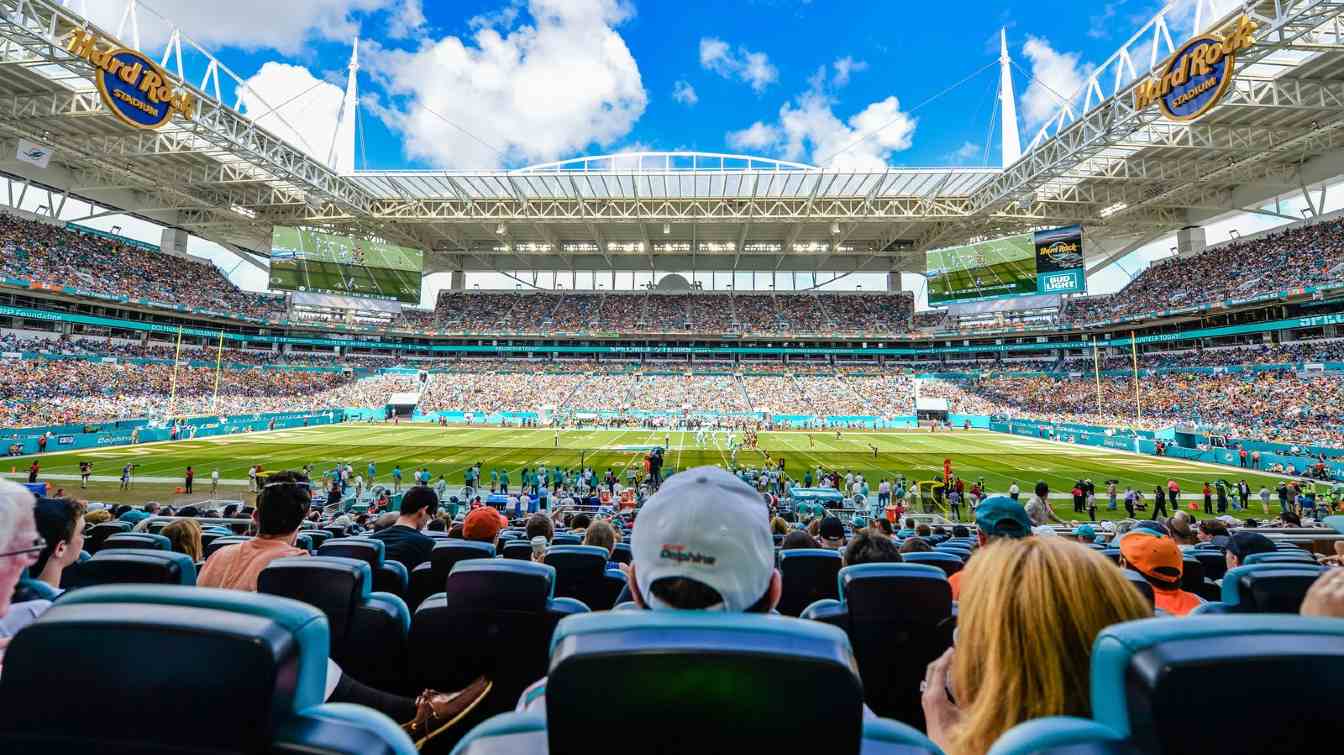 © Miami Dolphins | Miami Stadium
How to get to Miami Stadium during WC 2026 – transport guide
The stadium is located at 347 Don Shula Drive in Miami Gardens, close to I-95 and Florida’s Turnpike, allowing easy access from downtown Miami in 20–30 minutes. During the World Cup, FIFA will launch dedicated shuttles from Miami International Airport (MIA, 20 minutes) and the Brightline train from the city center.
The Brightline from Miami Central to Aventura Station takes 25 minutes, from where shuttles take fans to the stadium. Metrobus lines 836/837 run from MIA. Walking or cycling from parking lots and the F1 track takes a few minutes. Drivers can use the exit from I-95 onto NW 199 Street; parking holds 24,000 cars (reservation required). An Uber ride from MIA takes 20 minutes and costs about $30–40. Despite the massive parking lot, exiting after a match can be time-consuming. The Brightline + Shuttle option is recommended to avoid the worst congestion.
Sun, Florida, and top-tier football – sounds like the perfect plan? Buy tickets for WC matches at Miami Stadium and combine your vacation with cheering!
Philadelphia Stadium
Philadelphia Stadium – location and brief history
Philadelphia Stadium is located in South Philadelphia on Pattison Avenue, between 11th and South Darien Streets, along I-95, within the South Philadelphia Sports Complex. The stadium opened on August 3, 2003, replacing Veterans Stadium, and has served as the home of the Philadelphia Eagles (NFL) and Temple Owls (NCAA) ever since. The total investment amounted to $512 million, with $188 million coming from public funds. The venue bore the name Lincoln Financial Field until 2023 ($139.6 million deal), but during the 2026 FIFA World Cup, it will operate under the neutral name Philadelphia Stadium.
The design references the eagle symbol — wings over the east and west stands, the Eagle’s Nest balcony behind the north zone, and a brick façade nodding to Philadelphia’s history. The stadium has hosted five NFC Championship Games, including in 2025 (Eagles–Commanders 55–23), the Army–Navy Game, the 2015 CONCACAF Gold Cup final, and WrestleMania XL in 2024. A renovation in 2013 worth $125 million introduced Wi-Fi for 45,000 users, HD videoboards, and bridges connecting stadium levels.
Philadelphia Stadium – capacity and layout
The stadium’s permanent capacity is 67,594 seats, including 10,828 club seats and 172 suites. During the FIFA tournament, it will increase to 69,328 seats. The stands are divided into lower and upper tiers, with three open corners revealing the Philadelphia skyline. Green seats form the eagle logo, and 190 meters of LED ribbon boards add a modern touch. Two clubs — the Hyundai Club and Tork Club — each offer 3,700 m² of bars and hospitality areas.
The 2013 renovation also introduced 11,000 solar panels and 14 wind turbines, covering 30% of the stadium’s energy needs, making it one of the greenest NFL venues. Before the 2026 World Cup, FIFA will conduct tests of the pitch (a Kentucky bluegrass mix meeting strict requirements), security systems, and logistics, with a special focus on transport and fan safety.
Matchday at Philadelphia Stadium
Philadelphia Stadium buzzes with life during Eagles matches (setting an attendance record of 69,280 at the Temple–Notre Dame game in 2015) and Temple Owls games since 2003. The venue has hosted famous sporting events, including the Miracle at 4th and 26
in the 2004 playoffs, the 2019 NHL Stadium Series (Flyers–Penguins, 69,620 spectators), and the Liverpool–Arsenal match in 2024 (69,879 spectators).
The open corners of the stands provide a spectacular view of the city, and tailgating in the parking lots creates a unique atmosphere. Proximity to I-95 and the sports complex allows easy connection to the Phillies and Sixers venues. The NovaCare Complex opposite the stadium serves as a training base.
During the 2026 World Cup, the stadium will host six matches: five group games and a Round of 32 match.
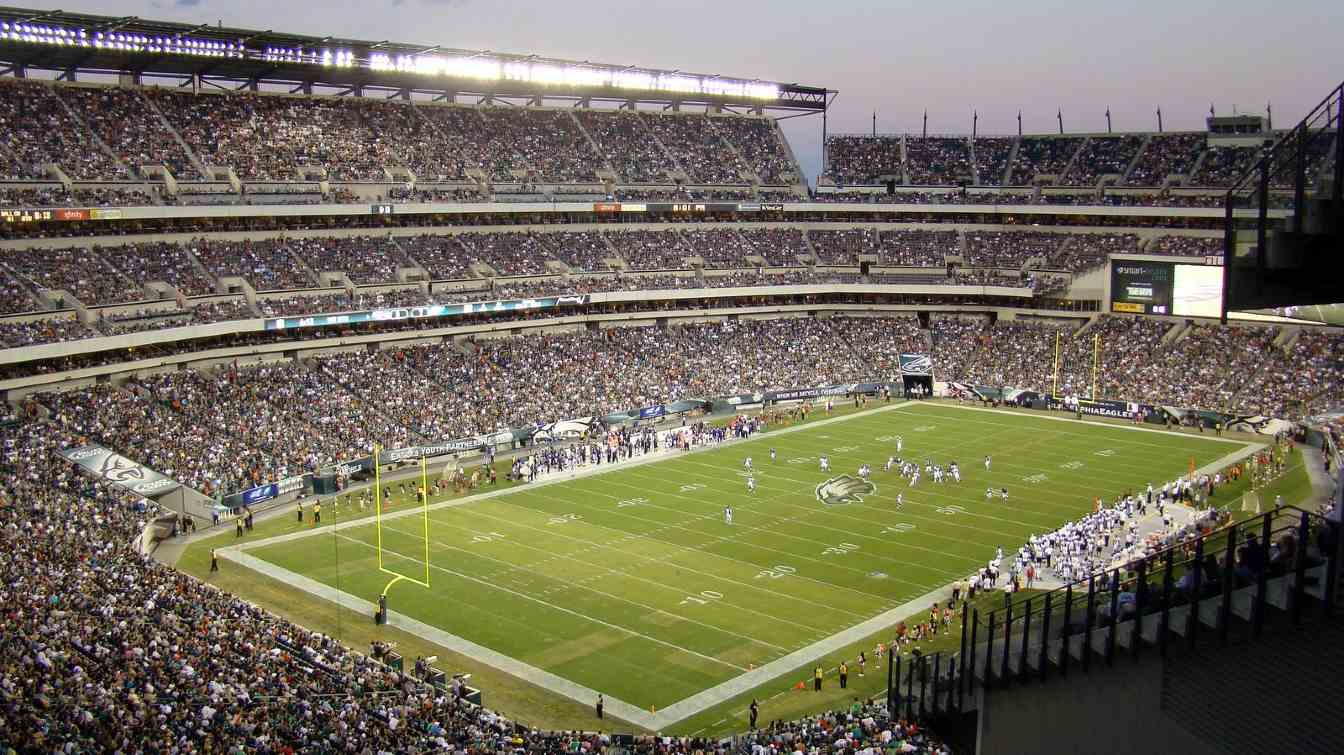 © houtexusa | Philadelphia Stadium
How to get to Philadelphia Stadium during WC 2026 – transport guide
The stadium is located on Pattison Avenue in South Philadelphia, near I-95. Parking for cars costs $45, for RVs – $90, with tailgating allowed.
During the World Cup, FIFA will launch shuttles from PHL Airport (20–30 minutes) and SEPTA public transport from downtown. The NRG subway station (end of the Broad Street Line) is a 5-minute walk from the stadium gates; the trip from 69th Street Terminal takes 30 minutes. Walking or cycling along the sports complex paths from the parking lots takes a few minutes. Drivers can exit I-95 (Exit 16); parking is available for thousands of cars with a reservation. An Uber ride from downtown Philadelphia takes 15–20 minutes and costs $20–30; on matchdays, this time can extend to 45–60 minutes.
Ready to visit Philly? Buy tickets for WC matches at Philadelphia Stadium and experience the spectacle at this grand venue!
Seattle Stadium
Seattle Stadium – location and brief history
Seattle Stadium is located in the SoDo district of Seattle, Washington, just 1.6 km from the city center. The stadium offers a view of the Seattle skyline from its open north end. Built between 2000 and 2002 for $430 million on the site of the Kingdome, it has served the Seattle Seahawks (NFL) from the start, and since 2009, also Sounders FC (MLS) and Reign FC (NWSL). Currently named Lumen Field (since 2020, formerly Qwest and CenturyLink), during the 2026 FIFA World Cup it will operate under the neutral name Seattle Stadium.
The stadium design is open, with roofs covering about 70% of seats, developed by Ellerbe Becket and LMN Architects with Paul Allen’s emphasis on an intimate atmosphere reminiscent of Husky Stadium. The stadium twice broke the Guinness World Record for crowd noise (Seahawks fans) – reaching 137.6 dB in 2014. The venue hosted the MLS Cup in 2009 and 2019 (attendance record 69,274), CONCACAF Gold Cup finals, and the Apple Cup. Subsequent modernizations introduced the Toyota Fan Deck in 2015, the Tunnel Club in 2023, and regular turf replacement every four years.
Seattle Stadium – capacity and layout
The permanent capacity is 68,740 seats for the NFL, expandable to 72,000 for other events. For the 2026 World Cup, FIFA has planned for 69,000 seats. The facility features 111 suites and the Hawk’s Nest with 3,000 seats.
The U-shaped stand layout features an open north end, a 13-story tower with a vertical scoreboard, and horizontal suite levels behind the end zone. The 19,000 m² roof, equipped with seismic dampers, protects fans from Puget Sound rain while leaving the field exposed. A 2022 renovation added a food court under the Hawk’s Nest and larger videoboards.
Before the 2026 World Cup, FIFA is preparing a temporary hybrid turf from Moses Lake, the removal of 800 seats in the stadium corners, and lighting upgrades – costing about $1.27 million per day. The venue retains an eco-friendly character thanks to wide concourses, 500 TV screens, and public art, such as Earth Dialogue.
Matchday at Seattle Stadium
Seattle Stadium is famous for the intense noise of Seahawks fans, which often causes false starts for opponents. Sounders FC draw record crowds for the MLS Cup, and the XFL Sea Dragons also use the arena. The stadium hosted the US Open Cup finals, the 2022 CONCACAF Champions League, and the 2025 Club World Cup, drawing over 210,000 spectators for six matches.
The atmosphere is intimate thanks to steep stands and views of Mt. Rainier from the south end. The complex, along with the Event Center, parking, and plaza, integrates with nearby T-Mobile Park. Converting the field from NFL to soccer takes about 14 hours.
During the 2026 World Cup, the stadium will host six matches: four group games, a Round of 32 match, and a Round of 16 match.
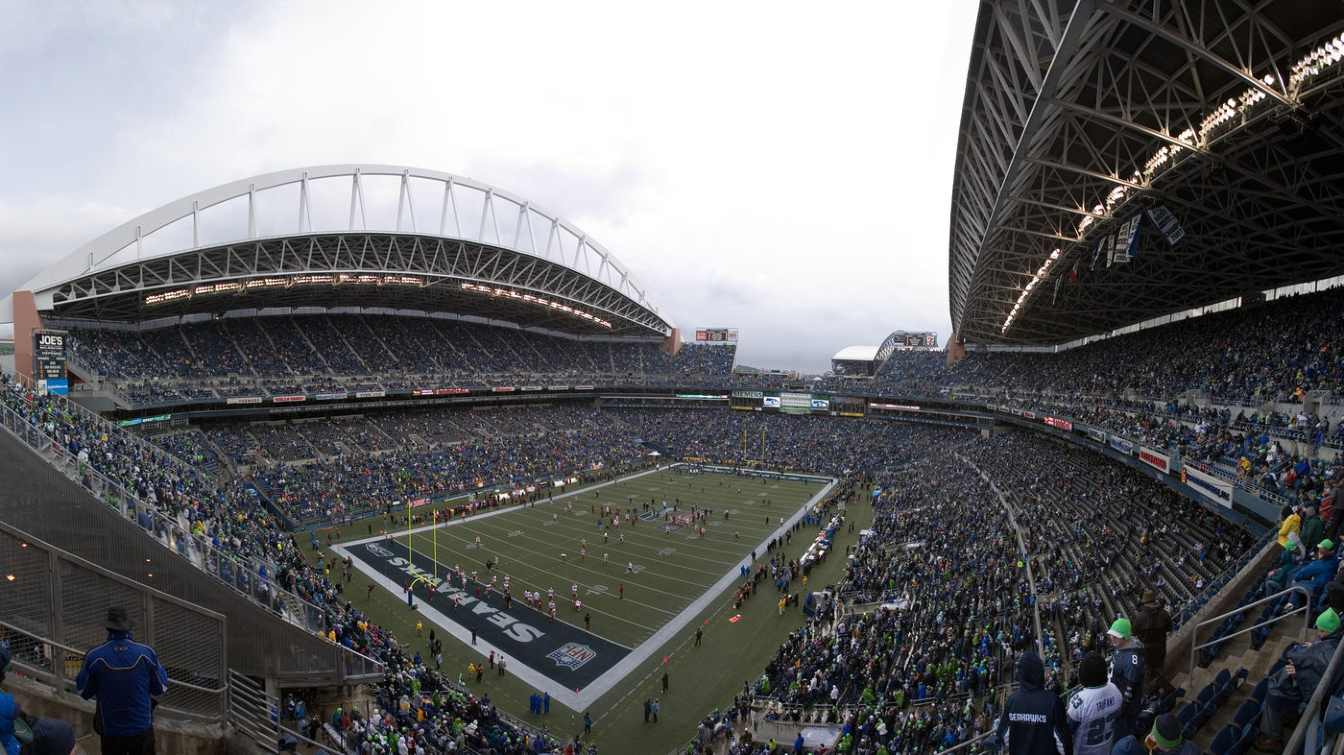 © Cacophony (cc: by) | Seattle Stadium
How to get to Seattle Stadium during WC 2026 – transport guide
The stadium is located in SoDo, 1.6 km from downtown Seattle, with convenient access from I-5 and I-90 highways and the Link Light Rail to Stadium Station (2 minutes on foot).
During the World Cup, FIFA shuttles from Seattle–Tacoma Airport (20–30 minutes) and Sound Transit public transport from downtown will be available. The Link Light Rail from SeaTac Airport takes 35 minutes, from the University of Washington – 20 minutes. The King Street Amtrak Station is a 10-minute walk away. Walking or cycling along SoDo paths is quick and convenient.
Drivers can use I-5 Exit 164; a parking garage is available with a reservation through FIFA. An Uber ride from downtown takes about 10 minutes and costs $15–25.
This venue is famous for incredible acoustics. Buy tickets for WC matches at Seattle Stadium and hear that legendary roar with your own ears!
Los Angeles Stadium
Los Angeles Stadium – location and brief history
Los Angeles Stadium is located in Inglewood, near Los Angeles, California, on the site of the former Hollywood Park Racetrack, right next to the Kia Forum and Intuit Dome, just 4 km from LAX airport. The stadium opened in September 2020 at a record cost of $5.5 billion, making it the most expensive stadium in the world. From the beginning, it has served the Los Angeles Rams and Chargers of the NFL. Currently named SoFi Stadium (since 2019, rights until 2039), during the 2026 FIFA World Cup it will operate under the neutral name Los Angeles Stadium.
The HKS design is distinguished by a semi-translucent ETFE canopy covering 93,000 m² with 46 movable panels and 27,000 LED pucks visible from the air above LAX. The stadium has hosted, among others, Super Bowl LVI in 2022, the 2023 CFP National Championship, WrestleMania 39, and the 2023 Gold Cup Final featuring Mexico. The complex is complemented by the 6,000-seat YouTube Theater and American Airlines Plaza, creating the Hollywood Park space.
Los Angeles Stadium – capacity and layout
The permanent capacity of the stadium is 70,240 seats, expandable to over 100,000 for other events. For the 2026 World Cup, FIFA has planned for 70,240 seats. The stands are angled close to the field, which is covered by artificial turf (the first in California shared by two NFL teams). Open sides and the Samsung Infinity Screen (80 million pixels) ensure spectacular visual effects. The canopy filters light and regulates the stadium’s microclimate. The venue won the ASCE Outstanding Architectural Engineering Project 2021 award and the Stadium of the Year title in the jury vote.
In preparation for the 2026 World Cup, seats in the corners were removed to accommodate a FIFA-sized pitch, the turf was replaced with a hybrid surface in two phases, and new food and beverage zones and security systems were added. The Hollywood Park complex includes 298,000 m² of retail space, a hotel, and 10 hectares of parks.
Matchday at Los Angeles Stadium
The stadium teems with life during Rams and Chargers games. In 2022, it hosted the Rams’ first home Super Bowl (a 23–20 win over the Bengals) in front of 70,240 spectators. The venue is famous for concerts — for example, BTS grossed $33.3 million over four nights. The complex also hosts the LA Bowl (college football), Monster Jam, and events like Vax Live.
Modern LED shows, views of the lake park, and the open design give the stadium a unique atmosphere. The YouTube Theater allows for additional concerts, while the retail zone and NFL Media integrate events within Hollywood Park.
During the 2026 World Cup, the stadium will open the tournament with the USA vs Paraguay match on June 12 and will host eight games: five group stage matches (including two USA games), two Round of 32 matches, and a Quarter-final.
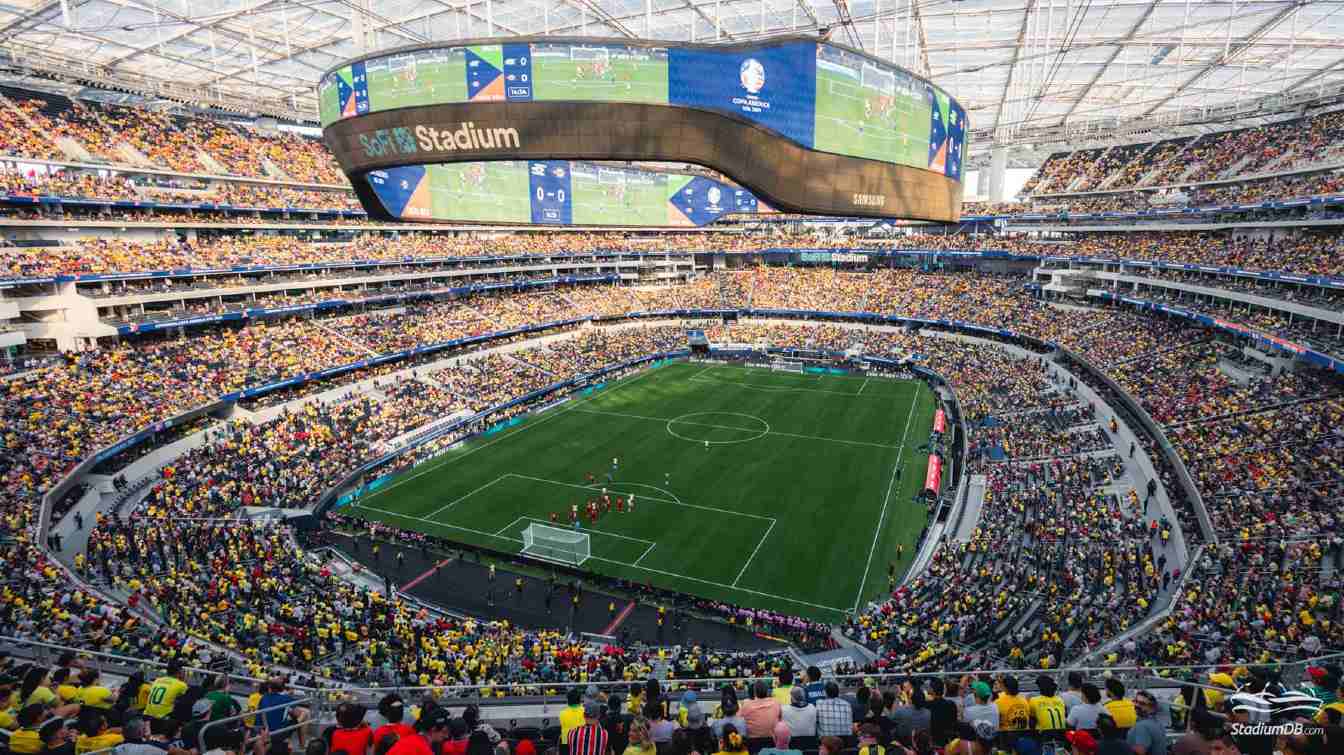 © Grzegorz Kaliciak | Los Angeles Stadium
How to get to Los Angeles Stadium during WC 2026 – transport guide
The stadium is located 5 km from LAX airport, with access from the I-405 and I-105 freeways. During the World Cup, FIFA will launch shuttles from LAX (10–15 minutes) and the Metro C Line to Hawthorne/Lennox station with a further shuttle transfer. The Metro Rail C Line from downtown LA takes about 40 minutes to the Aviation/LAX Transit Center, where shuttles are available. The FlyAway Bus from LAX takes 20 minutes. Walking or cycling along Hollywood Park paths provides convenient pedestrian access. The Inglewood People Mover project (an automated train connecting the metro to the stadium) has been delayed and will not be ready for the 2026 World Cup.
Drivers can use I-405 Exit 1A; parking is available by prior reservation. An Uber from LAX takes about 10 minutes and costs $20–30.
A Hollywood script on the pitch? It’s only possible here. Buy tickets for WC matches at Los Angeles Stadium and see football stars in the City of Angels!
San Francisco Bay Area Stadium
San Francisco Bay Area Stadium – capacity and layout
The permanent capacity of San Francisco Bay Area Stadium is 68,500 seats, with 70,909 seats provided for the 2026 World Cup. Two-thirds of fans sit in the lower bowl, close to the pitch, ensuring a unique atmosphere. The stands have three levels, over 800 concession points, and an app for in-seat food delivery. The field is covered with natural grass, though there have been maintenance issues in the past.
Eco-friendly solutions include: 75% waste recycling, rainwater harvesting systems, and no CFC use in construction. A $120 million investment before the 2026 World Cup will improve premium seating, videoboards, and infrastructure in line with FIFA standards. The stadium has no roof, and its specific orientation to the sun means the east stand (usually sections 100–200 on the visitor side) is exposed to extreme sun and heat during afternoon games. It’s worth bringing a hat and sunglasses, or aiming for seats on the west side (in the shade of the suite tower).
Matchday at San Francisco Bay Area Stadium
The stadium comes alive during 49ers games (record attendance 83,000), concerts (Grateful Dead 2015 – 80,000; Ed Sheeran 2023 – 80,000), and Earthquakes MLS matches (opening 48,000 spectators). It has also hosted the CONCACAF Gold Cup and motocross events. Critics point to a corporate atmosphere and less intimacy compared to the old Candlestick Park, but views of the Bay Area from the upper rows and tailgating in the parking lots compensate for these impressions.
Located next to California’s Great America and the convention center, as well as having access to the San Tomas Aquino Trail for cyclists, matchday is an integral part of regional life.
During the 2026 World Cup, the stadium will host six matches: five group games and one Round of 32 match.
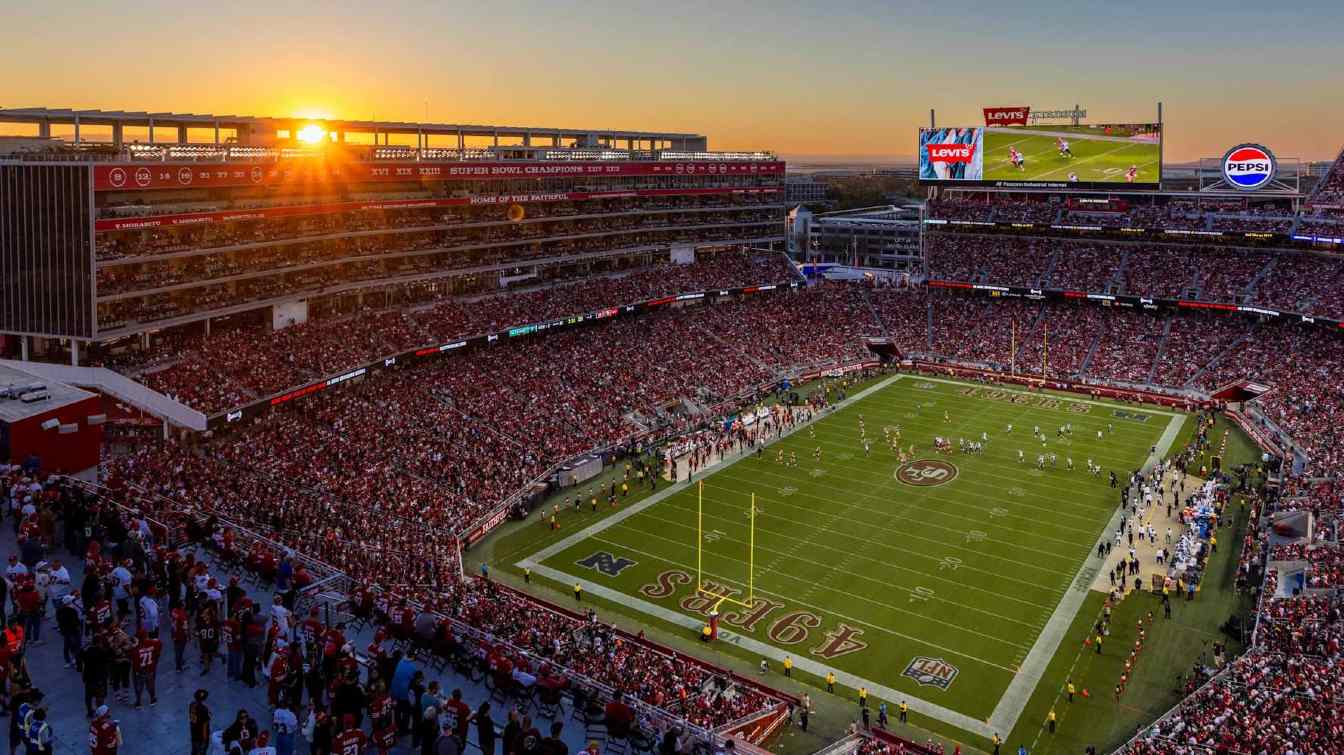 © Tyler Caisse, San Francisco 49ers | San Francisco Bay Area Stadium
How to get to San Francisco Bay Area Stadium during WC 2026 – transport guide
The stadium is located on Tasman Drive in Santa Clara, a five-minute walk from the VTA Light Rail Great America station and near the Santa Clara ACE/Amtrak station. During the World Cup, FIFA will launch shuttles from SJC (15 minutes) and SFO (45 minutes) airports. VTA Light Rail from downtown San Jose takes about 20 minutes, while from Caltrain (Mountain View) a shuttle is necessary. Shuttles to the stadium will run from the Warm Springs BART station. Walking or cycling along the San Tomas Aquino Trail and sports complex paths offers a comfortable alternative to public transport. Drivers can exit I-880/I-101 onto Tasman Drive; parking is available by prior reservation. An Uber ride from downtown San Jose takes about 20 minutes and costs around $25.
Football in the heart of Silicon Valley? You have to see it. Buy tickets for WC matches at Bay Area Stadium and join the game at the highest level!
Houston Stadium
Houston Stadium – location and brief history
Houston Stadium is located in Houston, Texas, within the NRG Park complex, next to the Astrodome — the first NFL stadium with a retractable fabric roof. Opened in August 2002 at a cost of $352 million after 30 months of construction, it has served the Houston Texans (NFL) and the Houston Livestock Show and Rodeo from the very beginning. It has borne the name NRG Stadium since 2014 (rights bought by NRG Energy until 2032), but during the 2026 FIFA World Cup, it will change to the neutral Houston Stadium.
The Populous design utilizes kinetic architecture, extensive glass for an open feel, and a two-panel roof that opens in just 7 minutes. The stadium hosted two Super Bowls — XXXVIII and LI, the 2024 CFP National Championship (Michigan vs. Washington), WrestleMania 25, and rodeos featuring Xtreme Bulls. Damage from Hurricane Ike in 2008 was quickly repaired.
Houston Stadium – capacity and layout
The capacity is 72,220 seats, including 7,000 club seats and 186 suites, with the ability to configure 11,600 m² for events and concerts. The stands feature the Bull Pen behind the north end zone dedicated to standing fans, and the 14,549 sq ft end zone screens are the second largest in sports. The fabric roof with a 206-meter super-truss closes instantly; the UBU Speed or Matrix Helix turf is replaced annually.
Upgrades after Super Bowl LI added office and team facilities, and before WC 2026, FIFA tests of the turf and security were conducted. The stadium is equipped with a 260-speaker audio system and configurable event spaces.
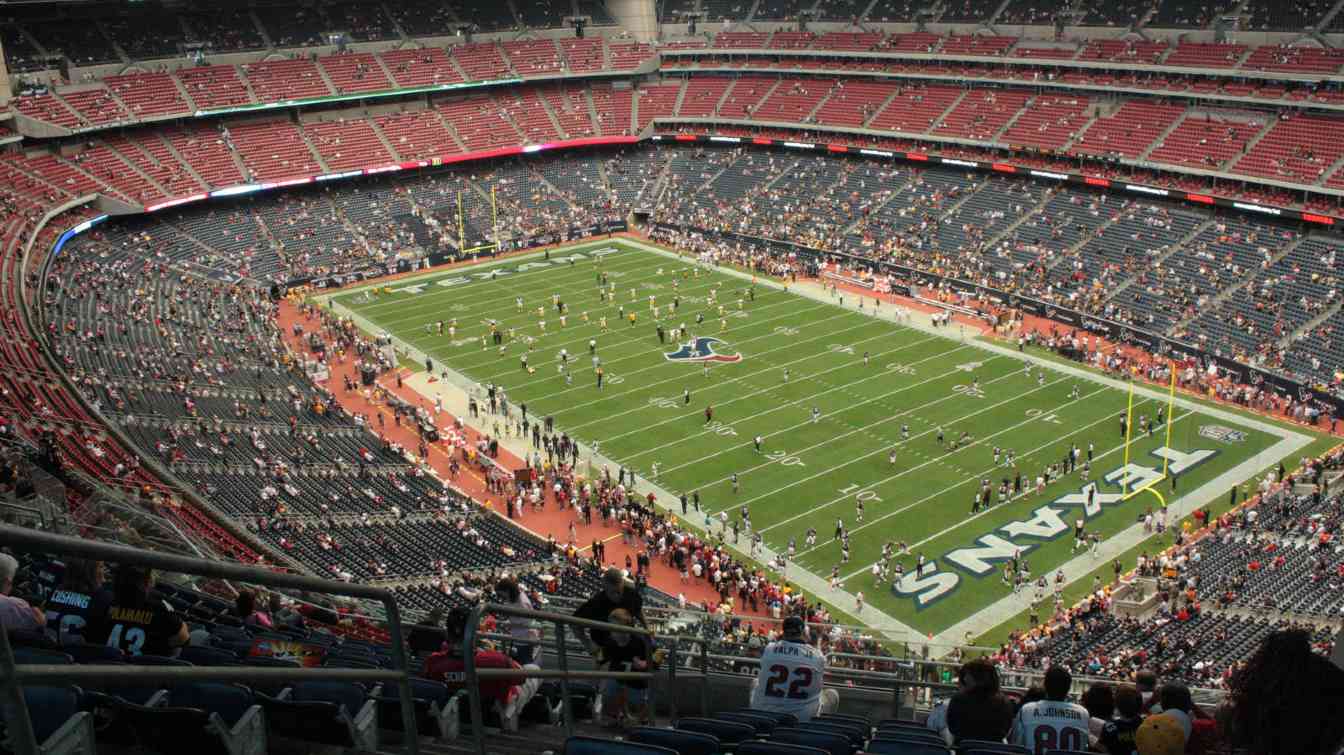 © Drew Allen (cc: by-nc-nd) | Houston Stadium
Matchday at Houston Stadium
The stadium bustles with life during Texans games — for example, in the first Monday Night Football game won 30–17 against the Jaguars in front of 70,809 spectators — and during RodeoHouston with concerts on a hydraulic stage. It hosted the 2010 MLS All-Star Game (Manchester United 5–2), the Copa América Centenario (Argentina 4–0 USA), and the Gold Cup with record Mexico attendance. The atmosphere is created by Bull Pen chants and open concourses with field views.
During the 2026 World Cup, the stadium will host 7 matches: 5 group games, a Round of 32 match, and a Round of 16 match.
Transport and access to Houston Stadium during WC 2026
Houston Stadium is located in NRG Park off Kirby Drive and is easily accessible by both car and public transport. Drivers can use exits from I-610 and US-59, with thousands of parking spaces available (worth booking in advance).
Shuttle buses run from George Bush Intercontinental (IAH) and William P. Hobby (HOU) airports, transporting fans in 30–45 minutes. From downtown Houston, you can conveniently take the METRORail Red Line to NRG Station, from where the stadium is just a five-minute walk away.
Shuttle buses are also available from the Greenway Plaza Park & Ride, and walkers or cyclists can move around the Astrodome complex. An Uber from downtown takes fans about 15 minutes for around $20.
Everything is bigger in Texas — the excitement too! Buy tickets for WC matches at Houston Stadium and experience it firsthand!
Kansas City Stadium
Kansas City Stadium – location and brief history
Kansas City Stadium is located in Kansas City, Missouri, on the border with Kansas, in the Truman Sports Complex next to Kauffman Stadium — the third oldest NFL stadium. Opened in 1972 after construction began in 1968 for $102 million funded by bonds, it replaced Municipal Stadium and served the Chiefs (AFL/NFL) and the Wizards (MLS) until 2007. It has been named GEHA Field at Arrowhead Stadium since 2021 (rights until 2031), but during the 2026 FIFA World Cup, it will operate under the neutral name Kansas City Stadium.
The elliptical bowl design with red three-tier stands and cutouts for oval screens was developed by Kivett & Myers, and the steep upper rows helped the stadium break the Guinness World Record for crowd noise at 142.2 dB during a Chiefs vs. Patriots game in 2014. It hosted Big 12 Championships and the Border War, and a 2010 renovation costing $375 million added horizon suites and the Chiefs Hall of Honor.
Kansas City Stadium – capacity and layout
The capacity is 76,416 seats, making it the fourth largest NFL stadium and the largest in Missouri, expandable to 76,640 for the 2026 World Cup. The stands are angled close to the pitch, and the Bull Pen behind the north end zone allows fans to stand, amplifying the atmosphere.
The stadium is open-air, without a roof, with lighting over the longer stands; the turf has been NorthBridge Bermudagrass since 2013. Before WC 2026, the end zone corners were reduced, and ventilation was modernized for $50 million.
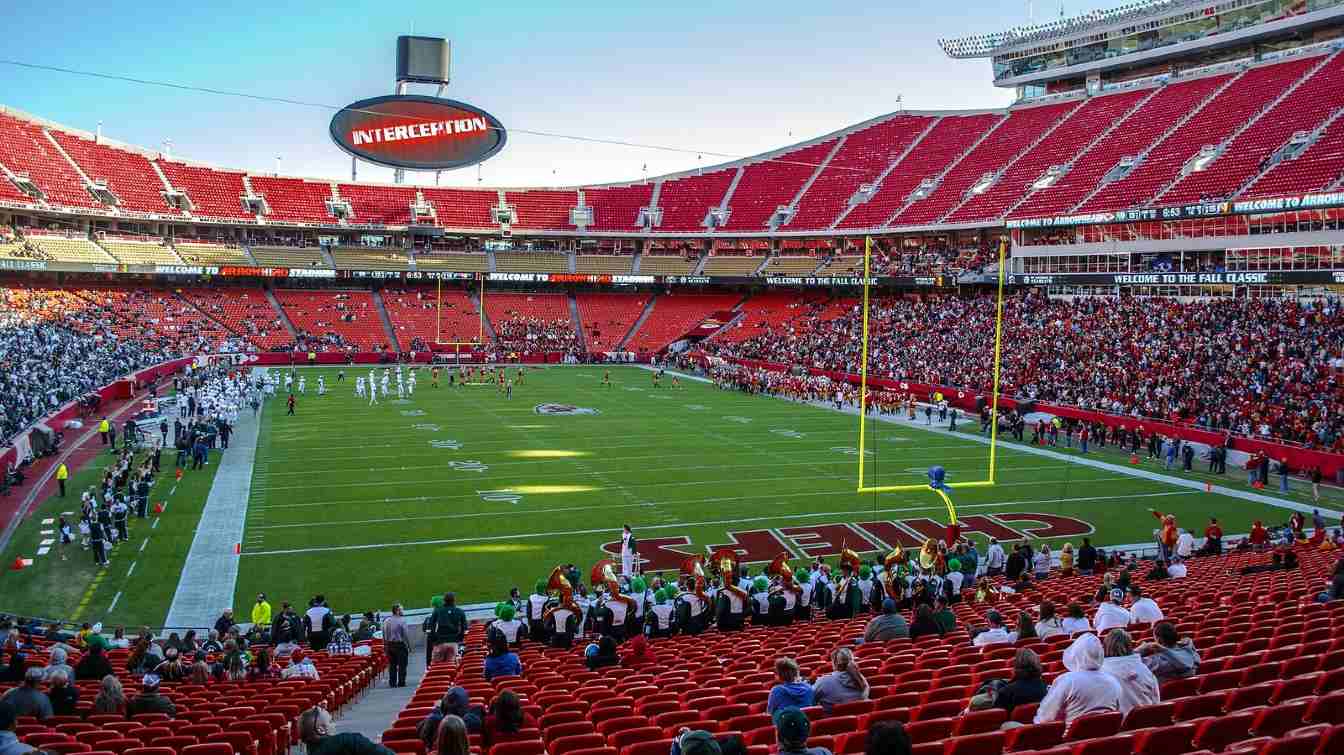 © Matt Meier | Kansas City Stadium
Matchday at Kansas City Stadium
The stadium is famous for Chiefs attendance records (e.g., 82,094 spectators against the Raiders in 1972) and concerts such as the Swift Eras Tour and Beyoncé Renaissance. It hosted Armageddon at Arrowhead
(KU vs. MU) with 80,537 fans and Farmageddon
(ISU vs. KSU). The atmosphere is created by the TD Pack Band and Bull Pen chants, though after the renovation, the stadium is sometimes criticized for a more corporate feel.
During the 2026 World Cup, the stadium will host a total of 6 matches: 4 group games, a Round of 32 match, and a Quarter-final.
Transport and access to Kansas City Stadium during WC 2026
Kansas City Stadium in the Truman Sports Complex is easily accessible by both car and public transport. Shuttle buses run from MCI airport, transporting fans in about 30 minutes, and from the city center, you can take the free KC Streetcar to the transfer hub at Union Station, where buses to the stadium depart.
KCATA lines 47 and 47L from Union Station allow quick access to stadium parking lots in 25 minutes, and additional shuttle buses run from River Market. Fans can also walk or cycle along the complex paths.
Although the stadium is famous for its huge parking lots, during the World Cup most spaces are reserved for VIP and Hospitality zones. For fans, the main means of transport are dedicated 'Stadium Direct' buses running from Union Station and regional Park & Ride hubs.
The center of the USA, the center of excitement. Buy tickets for WC matches at Kansas City Stadium and be where the heart of football beats!
Atlanta Stadium
Atlanta Stadium – location and brief history
Atlanta Stadium is located in downtown Atlanta, Georgia, next to the Georgia World Congress Center and Centennial Olympic Park, replacing the Georgia Dome, which was demolished in 2017. Opened on August 26, 2017, after delays and at a cost of $1.6 billion, it serves the Falcons (NFL) and Atlanta United (MLS), breaking attendance records. It has borne the name Mercedes-Benz Stadium since 2015 (rights bought until 2042), but during the 2026 FIFA World Cup, it will be called neutrally Atlanta Stadium.
The Populous design features a pinwheel retractable roof with eight panels opening in 8–12 minutes, inspired by the Roman Pantheon. The stadium hosted Super Bowl LIII, the 2018 CFP National Championship (Alabama vs. Georgia), the 2025 Ohio State vs. Notre Dame game, and the 2018 MLS Cup. Initial issues with the roof and turf were resolved after the debut.
Atlanta Stadium – capacity and layout
The capacity is 71,000 seats, including 7,500 club seats and 180 suites, expandable to 75,000 for the 2026 World Cup. The stands are two-tiered with premium balconies and retractable seats for soccer; the 5,793 m² Halo Board is the largest LED ring in the world.
The stadium offers an open view of the Atlanta skyline, and for WC 2026, natural grass will be laid over the turf prepared according to FIFA standards. Upgrades by 2026 include the FIFA pitch, accessibility, and security, and a pedestrian bridge from the Vine City MARTA station cost $33 million.
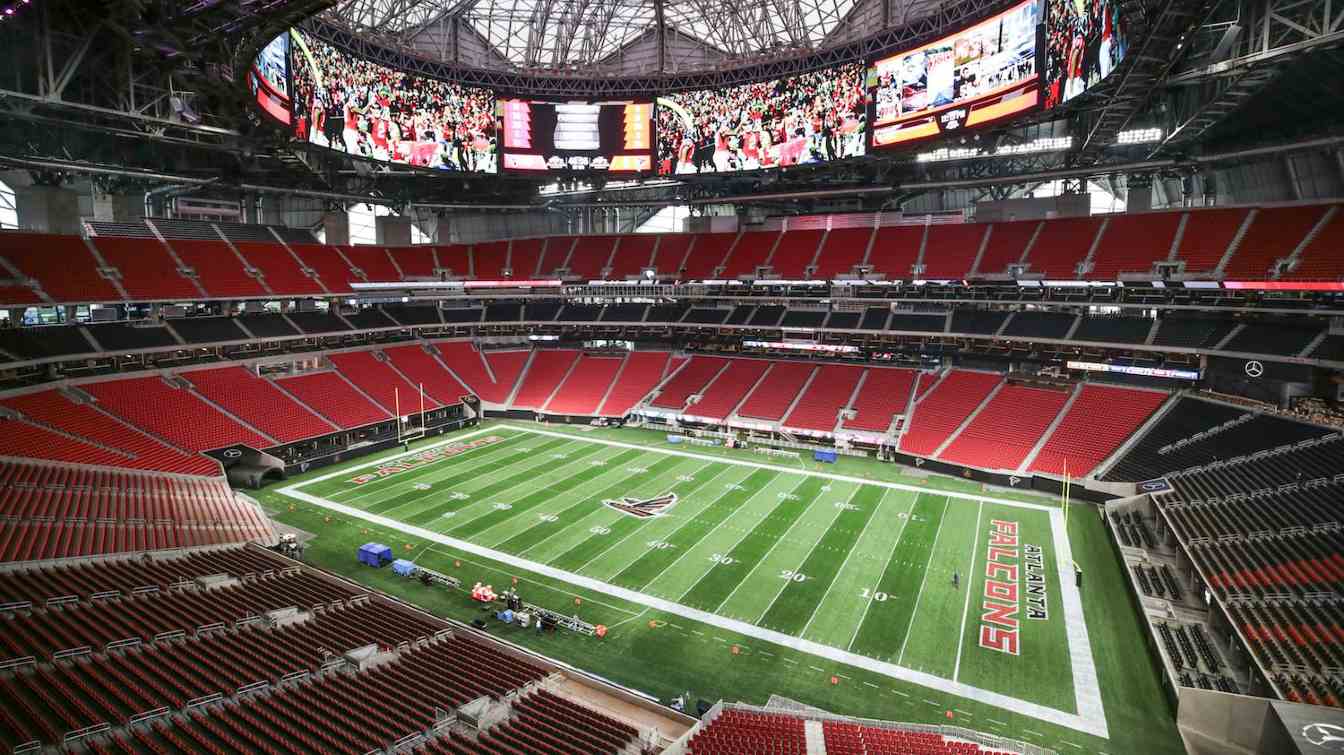 © Atlanta Falcons / Mercedes-Benz Stadium | Atlanta Stadium
Matchday at Atlanta Stadium
The stadium teems with life during Falcons games (featuring the distinctive horn after touchdowns) and Atlanta United matches — e.g., a record 73,019 spectators for the MLS Cup. It hosts the SEC Championship until 2027, the Peach Bowl, and concerts by Swift and Beyoncé, breaking attendance records. The atmosphere is created by the 100 Yard Club, AT&T Perch, and Budweiser Biergarten, while the Home Depot Backyard offers 11 acres of tailgating space. The stadium is famous for its revolutionary Fan First Menu
program, offering the lowest food prices in American sports (e.g., a hot dog for $2, a drink with unlimited refills for $2). This encourages fans to arrive earlier and stay longer.
During the 2026 World Cup, the stadium will host as many as 8 matches: 5 group games, a Round of 32 match, a Round of 16 match, and a Semi-final – one of the most important games of the tournament!
Transport and access to Atlanta Stadium during WC 2026
Atlanta Stadium on Northside Drive is connected by a pedestrian bridge to the Vine City MARTA Blue/Green Line station, from where it is about a 10-minute walk to the stadium. Shuttle buses run from ATL Airport, taking 20–30 minutes, and the MARTA network is accessible from Five Points downtown.
Additionally, the streetcar from Centennial Olympic Park transports fans in 5 minutes, and the Georgia Tech Park & Ride provides a shuttle. Walking and cycling are options via downtown paths. Drivers use exits from I-75/85 with thousands of parking spaces (worth booking), and an Uber from downtown takes fans about 10 minutes for $15.
The stadium of the future is waiting for you! Buy tickets for WC matches at Atlanta Stadium and see football under the world’s most spectacular roof!
New York New Jersey Stadium
New York New Jersey Stadium – location and brief history
New York New Jersey Stadium is located in East Rutherford, New Jersey, 13 km west of Manhattan, within the Meadowlands Sports Complex, replacing Giants Stadium. Opened in 2010 for a record $1.6 billion, it serves the Giants and Jets (NFL) with a neutral design following a dispute over the West Side Stadium project. It has been named MetLife Stadium since 2011 (rights bought until 2036), but during the 2026 FIFA World Cup, it will be called neutrally New York New Jersey Stadium.
The design, featuring aluminum louvers illuminated in blue or green and inspired by Allianz Arena, makes it the largest NFL stadium without a roof. It hosted Super Bowl XLVIII (Seahawks vs. Broncos), WrestleMania 29 and 35, and the Copa América Centenario final (Chile vs. Argentina). Renovations in 2024–25 for the FIFA pitch cost over $50 million.
New York New Jersey Stadium – capacity and layout
The capacity is 82,500 seats, including 10,005 club seats and 218 suites, expandable to 87,157 for the 2026 World Cup by adding seats in the end zone corners. The stands are three-tiered, with the front row 14 meters from the sideline and no overhangs; the turf has been FieldTurf Core since 2023. The stadium is open-air, with 50 km of louvers, 16×6 m LED pylons, and a 350 kW BIPV Solar Ring.
Despite its gigantic size, the stadium is praised for excellent sightlines — even from the highest nosebleed
seats (300 level), the entire pitch is visible. The lack of a roof and the open construction mean that wind from the Meadowlands wetlands can be a factor in the game, adding drama to the matches.
The venue's architecture is a triumph of functionality — it is the only NFL stadium shared by two teams that does not have permanent club colors. Thanks to the lighting system and interchangeable panels, the stadium can change its identity from green to blue... or to a neutral 'FIFA' look during the World Cup in a matter of hours.
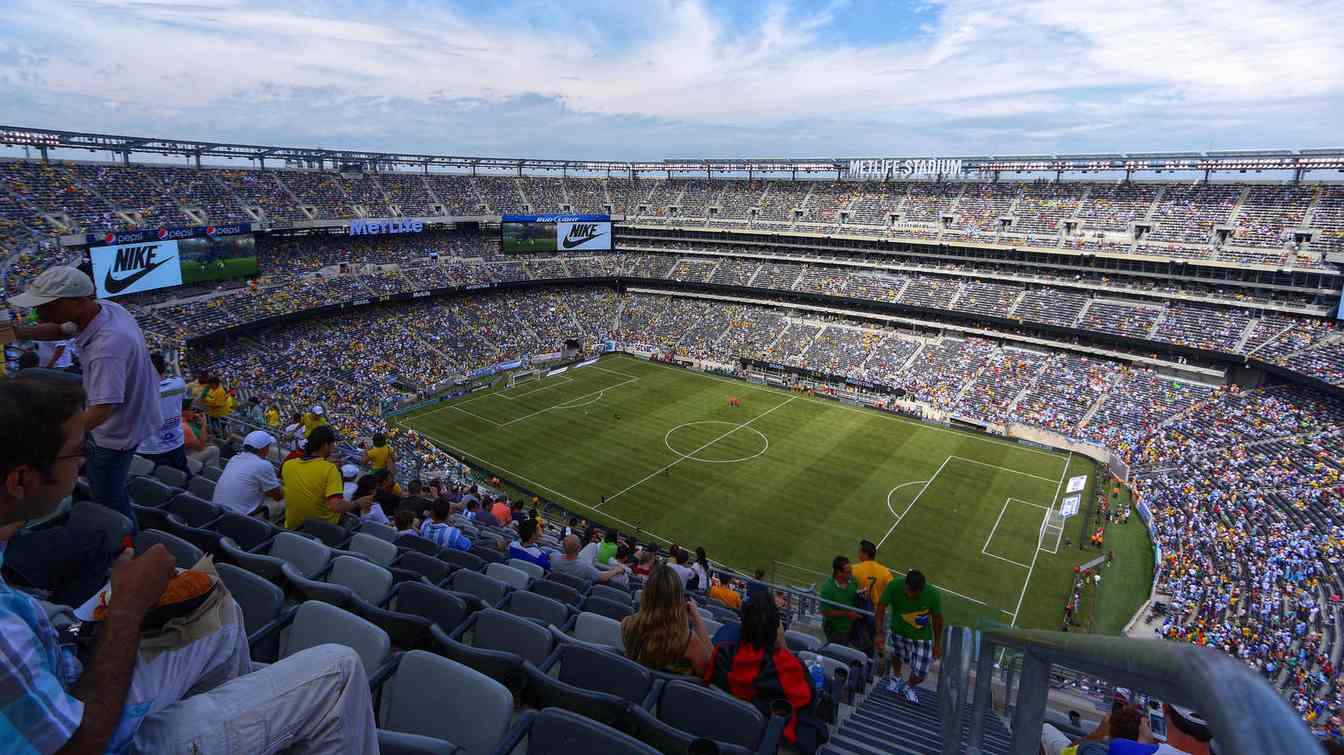 © Hari Menon (cc: by-nc-sa) | New York New Jersey Stadium
Matchday at New York New Jersey Stadium
The stadium comes alive during Giants and Jets games — e.g., the Miracle at the New Meadowlands
and Beckham’s famous catch. The soccer attendance record is 82,262 fans for the Manchester United vs. Arsenal match in 2023. It hosts the Gold Cup, the ICC (featuring Messi’s hat-trick in Argentina vs. Brazil), and the 2025 Club World Cup final. The atmosphere is created by color-changing façades and a clear bag policy, and the stadium offers four locker rooms.
During the 2026 World Cup, the stadium will host as many as 8 matches, including the most important one: 5 group games, a Round of 32 match, a Round of 16 match, and THE WORLD CUP FINAL.
Transport and access to New York New Jersey Stadium during WC 2026
The stadium at NJ Turnpike Exit 16W/I-95 is well connected by public transport and car. The Meadowlands Rail Line from Hoboken or Secaucus transports fans in 5 minutes. Shuttle buses run from JFK, EWR, and LGA airports in 45–60 minutes, and NJ Transit line 351 runs from the Port Authority. Additionally, Coach USA 353 brings fans from Secaucus Junction, and the Harmon Meadow Park & Ride offers a shuttle.
Walking or cycling is convenient within the complex, and drivers use exits from Route 3/120 with 20,000 parking spaces (booking recommended). An Uber from Manhattan takes fans about 30 minutes for $40.
Don’t let the biggest matches happen without you. Buy tickets for WC matches at New York New Jersey Stadium and be at the center of the world’s most important football events!
Dallas Stadium
Dallas Stadium – location and brief history
Dallas Stadium is located in Arlington, within the Dallas-Fort Worth metroplex in Texas, next to Globe Life Field, replacing Texas Stadium as the home of the NFL's Cowboys. Opened on May 27, 2009, after construction began in 2006 for $1.15 billion, the stadium broke the attendance record with 105,121 spectators during a game against the Panthers. Since 2013, it has been named AT&T Stadium, but for the 2026 World Cup, it will operate as the neutral Dallas Stadium.
The HKS design features 91-meter retractable roof arches and the world’s largest Mitsubishi HDTV board. The SoftTop turf is replaceable, and the stadium has hosted Super Bowl XLV (Packers vs. Steelers), the 2015 CFP National Championship (OSU vs. Oregon), and WrestleMania 32 and 38. Funding came from Arlington taxes and loans from Jones/NFL.
Dallas Stadium – capacity and layout
The base capacity is 80,000 seats, but thanks to the unique Party Pass system (standing zones on platforms), it can increase to over 100,000, making it the largest venue in the NFL. For the 2026 World Cup, the stadium will undergo an unprecedented engineering operation: the field level will be raised by 4.5 meters on a special platform to widen the playing surface at the expense of the lower seating rows, ensuring a tournament capacity of 92,967 spectators.
Above the pitch (for the WC: hybrid grass on a natural base) hangs the stadium icon — a 600-ton Mitsubishi video screen, 55 meters long (spanning from 20-yard line to 20-yard line), providing 4K quality to every fan. Another characteristic element is the giant sliding glass doors in the end zones, which open the interior to the outdoor plazas. The stadium offers luxury on an unprecedented scale: 3,000 LCD screens in the concourses, 218 VIP suites, and exclusive field-level clubs through which players walk onto the pitch.
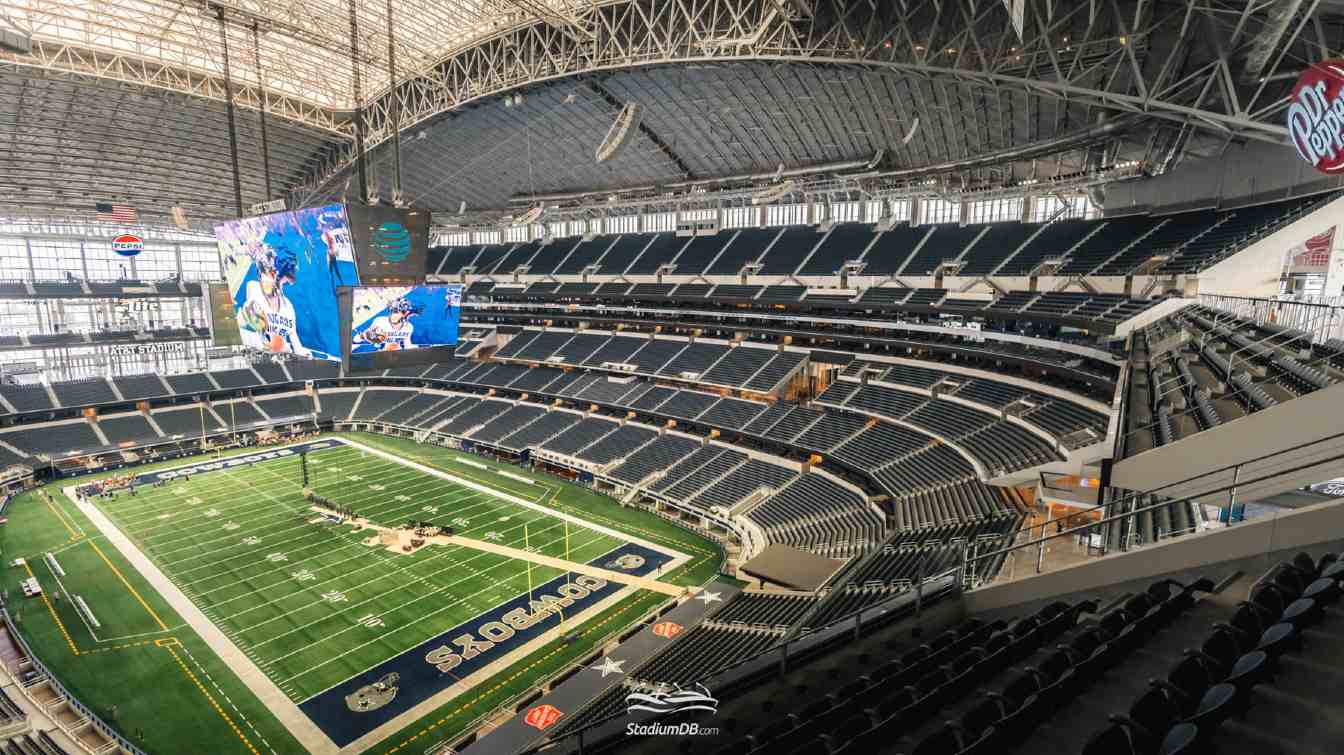 © Grzegorz Kaliciak | Dallas Stadium
Matchday at Dallas Stadium
The stadium teems with life during Cowboys games — e.g., back-to-back shutouts against the Eagles — and during sports events and concerts, such as the 2010 NBA All-Star Game with a record 108,713 spectators, the Cotton Bowl with Manziel’s records, the Big 12 Championship, and the Gold Cup featuring Mexico. The atmosphere is created by distinctive horns and concerts by artists like George Strait and Morgan Wallen, as well as PBR rodeos and motocross.
During the 2026 World Cup, the stadium will host as many as 9 matches: 5 group games, 2 Round of 32 matches, 1 Round of 16 match, and a Semi-final.
Transport and access to Dallas Stadium during WC 2026
Dallas Stadium at Collins Street and Randol Mill is easily accessible by car and public transport. The Trinity Railway Express runs from DFW Airport, transporting fans in about 45 minutes, and airport shuttles shorten the travel time to 30 minutes. You can take the DART Orange Line from Union Station, and the UTA Park & Ride offers a shuttle.
Arlington does not have a permanent rail transport system. Public transport access relies on a temporary bus system connecting the CentrePort commuter rail station (TRE line from Dallas/Fort Worth) to the stadium. An alternative is official shuttle buses from downtown Dallas and Fort Worth.
Walking from Baird Farm Road or cycling around Lake Arlington are options for active fans. Drivers use I-20/30 with 12,000 parking spaces (booking recommended), and an Uber from downtown Dallas takes fans about 25 minutes for $30.
The biggest stadium, the biggest thrills. Buy tickets for WC matches at Dallas Stadium and see football in XXL size!
Estadio Guadalajara
Estadio Guadalajara – location and brief history
Estadio Guadalajara is located in Zapopan, part of the Guadalajara metropolitan area in the state of Jalisco in western Mexico — the country’s third-largest city, known for mariachi culture, tequila production, and charrería traditions. The stadium opened on July 30, 2010, after an exceptionally long and interrupted construction process that began in February 2004 and ultimately cost $149 million. The investment was initiated by millionaire Jorge Vergara after acquiring the Chivas Guadalajara club, with numerous work stoppages due to financial problems and design changes.
The venue replaced the legendary Estadio Jalisco as the modern home of Chivas in Liga MX. During the 2026 World Cup, the stadium will operate under the neutral name Estadio Guadalajara; it was previously known as Omnilife, Akron, and Chivas Stadium. Its most distinctive architectural element is an artificial hill covered with grass, which conceals the facilities underneath the stands and comprises about 70,000 m² of greenery laid on concrete slabs. The stadium hosted the first leg of the 2010 Copa Libertadores final, the opening and closing ceremonies of the 2011 Pan American Games, and eight matches of the 2011 U-17 World Cup, including the Uruguay vs. Brazil semi-final.
Estadio Guadalajara – capacity and layout
The tournament capacity of the stadium during the 2026 World Cup will be 48,071 seats. The stands form a compact, almost spherical shape with two tiers angled close to the 105 × 68 meter pitch, ensuring good visibility from every sector. The facility has an extensive commercial zone and a standard capacity of 49,813 seats, reduced for the tournament in accordance with FIFA requirements.
Before the World Cup, the stadium underwent comprehensive FIFA tests, and earlier, in 2012, the artificial turf was replaced with natural grass, which has been retained. Upgrades included the installation of new LED lighting, improvements to safety, accessibility, and broadcast infrastructure, as well as the modernization of VIP zones, elevators, and air conditioning systems adapted to high temperatures.
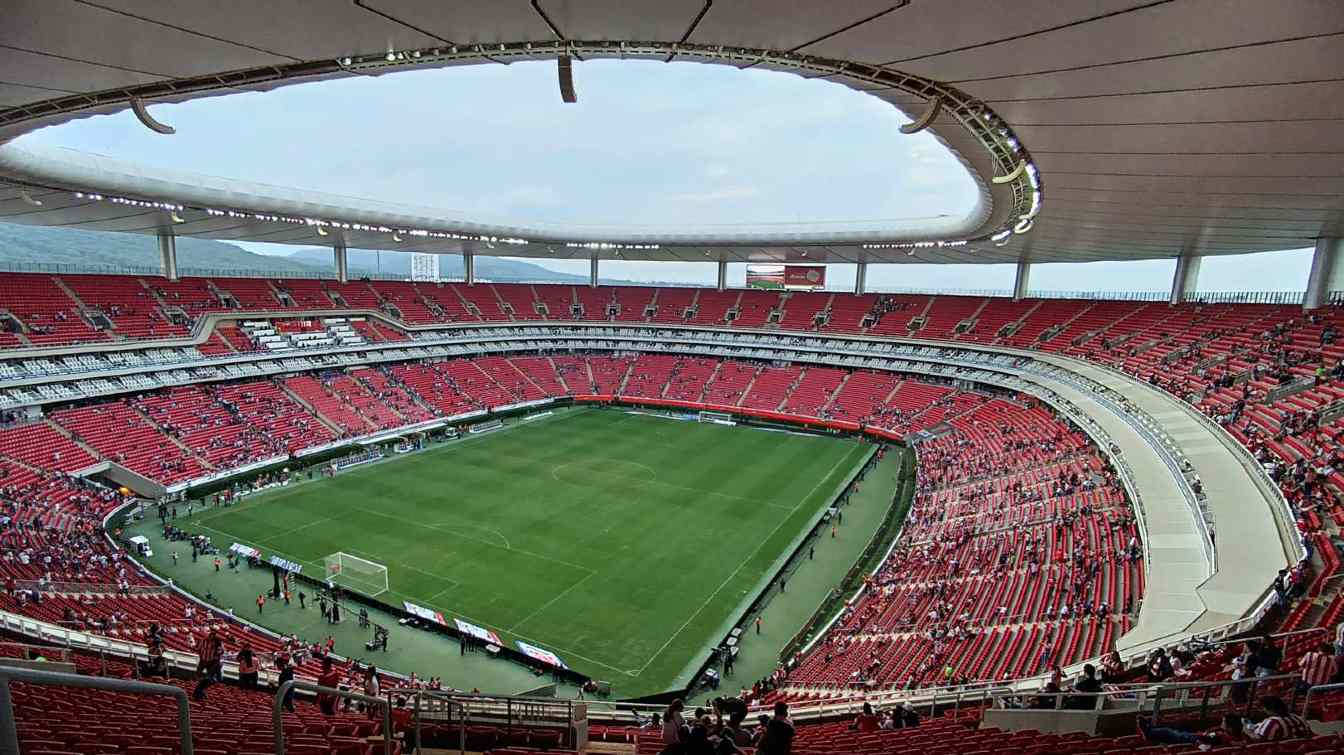 © Alejan98 | Estadio Guadalajara
Matchday at Estadio Guadalajara
Estadio Guadalajara comes alive especially during Chivas Guadalajara matches, regularly filling up with over 45,000 fans, dominated by ultras occupying the north sector who create an intense Mexican fiesta with flags, drums, and ceaseless singing.
The stadium has also been the arena for major non-football events, including the Canelo Álvarez vs. John Ryder boxing match in 2023, which set an attendance record, and concerts by The Weeknd (2023) and Shakira (2025) as part of the Las Mujeres Ya No Lloran World Tour. The proximity of the Sierra Madre mountains and local culinary and musical traditions give matchdays a unique atmosphere, and fans eagerly walk along Avenida Patria to nearby restaurants serving tacos and tequila.
During the 2026 World Cup, the stadium will host four group stage matches, including the Mexico vs. South Korea game.
Transport and access to Estadio Guadalajara during WC 2026
The stadium is located on Avenida Patria in Zapopan, about 15 km from the historic center. The main means of public transport is the Mi Macro Periférico system (BRT rapid bus), with the Estadio Chivas
stop located near the venue (access takes about 15–20 minutes via a special pedestrian corridor). From downtown Guadalajara, you can take Line 3 of the light rail (Mi Tren) to a transfer station with the BRT.
During the World Cup, FIFA plans to launch direct shuttle buses from key city points and the airport (GDL), which will be the most convenient option for tourists. For drivers, parking for about 6,000 cars is available, but using public transport or taxis/Uber (cost from the center is approx. 150–200 MXN) is recommended, as they drop passengers off at the Periférico hub. Cyclists can use the paths near Bajío Park.
The fiesta in the stands is already waiting for you. Buy tickets for WC matches at Estadio Guadalajara and feel the true passion of Mexico!
Estadio Monterrey
Estadio Monterrey – location and brief history
Estadio Monterrey is located in Guadalupe, part of the Monterrey metropolitan area in the state of Nuevo León in northeastern Mexico — the country’s industrial capital known for metallurgy, brewing, and the distinctive Cerro de la Silla mountain. The stadium opened on August 2, 2015, as the largest modern sports facility in Mexico built without public funds, at a cost of approximately $200 million financed by FEMSA and CF Monterrey. It replaced Estadio Tecnológico, which served as the home of Rayados for 63 years.
During the 2026 World Cup, the stadium will operate under the neutral name Estadio Monterrey; it was previously known as BBVA or Bancomer. Its aluminum panel façade references the region's metallurgical traditions and the brewing industry, while the design by Populous and VFO is characterized by a steep 34-degree stand inclination and eco-friendly solutions that earned the facility a LEED Silver certification. The stadium hosted the 2021 MLS All-Star Game, the 2022 CONCACAF W Championship final, and concerts by global stars such as Coldplay, Bad Bunny, and Shakira.
Estadio Monterrey – capacity and layout
The tournament capacity of the stadium during the 2026 World Cup will be 53,460 seats. The stands are two-tiered and inclined at a 34-degree angle, ensuring excellent visibility while maintaining minimum FIFA distances from the 105 × 68 meter pitch.
After expansion in 2016, the stadium can hold about 53,500 spectators, offering numerous suites, a club restaurant, and a unique view of Cerro de la Silla from the northwest sector. Before the World Cup, modern Musco LED lighting meeting FIFA Standard A (enabling light shows) was installed, and tests of the surface, safety, and broadcast technology were conducted.
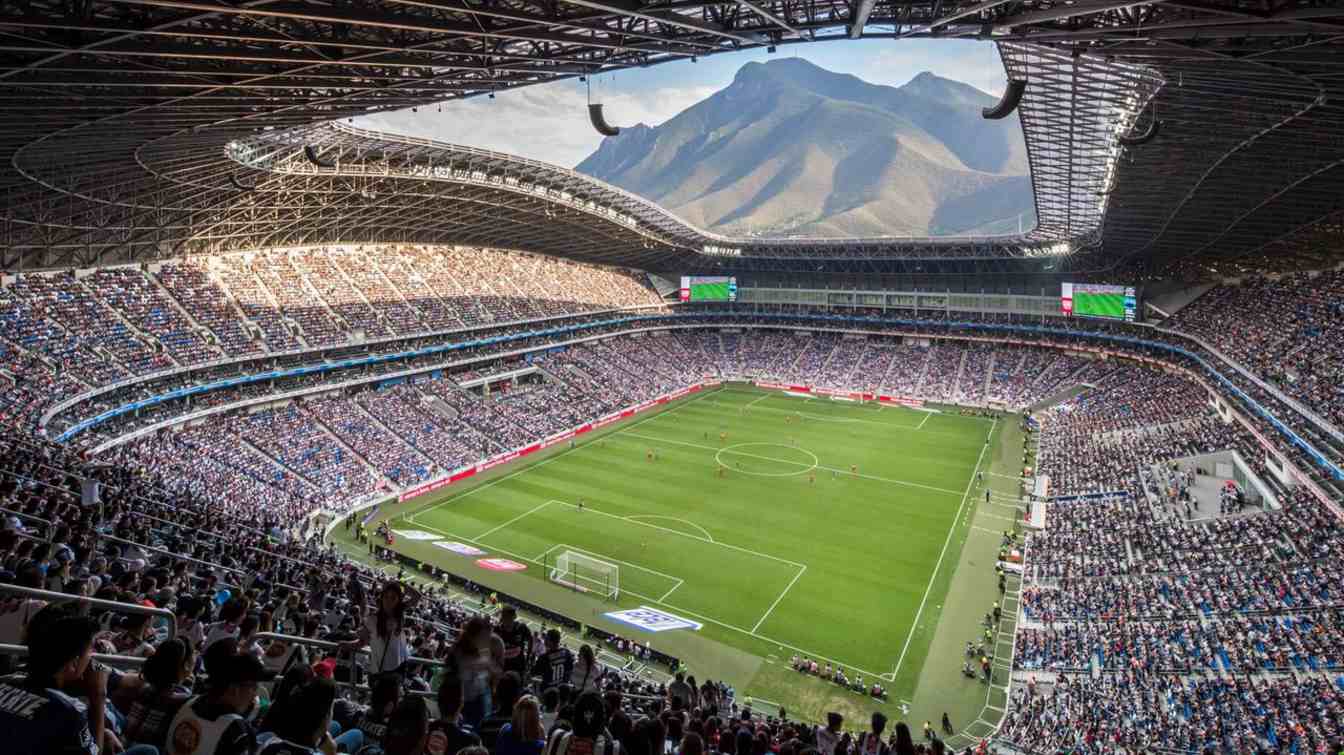 © Populous | Estadio Monterrey
Matchday at Estadio Monterrey
Estadio Monterrey, known as El Gigante de Acero
(The Steel Giant), comes alive during CF Monterrey matches, filling up with over 50,000 fans, including the La Adicción ultras group, who create one of the loudest atmospheres in Liga MX.
The venue hosted the 2022 CONCACAF W Championship final between the USA and Canada and numerous concerts, including record-breaking Coldplay performances with a total attendance of over 112,000 and a Bad Bunny concert that generated around $17 million in revenue. The proximity of the Río La Silla river and an ecological park fosters a green atmosphere around the stadium, with popular tailgating and local Corona beer.
During the 2026 World Cup, matches will mainly be played in the evening local time, between 7:00 PM and 10:00 PM, and the stadium will host 4 matches: 3 group stage games and 1 Round of 32 match.
Transport and access to Estadio Monterrey during WC 2026
The stadium is located in Guadalupe, east of downtown Monterrey. The most reliable means of public transport is Line 1 of the Metro (Metrorrey). You should get off at the Exposición terminal station, from where a marked pedestrian route leads to the stadium through the fairgrounds (approx. 20–25 minute walk) or local buses run.
Note: Do not confuse this venue with the old stadium at the Universidad station (Line 2)! From the airport (MTY) and hotel districts (San Pedro, Valle Oriente), the most convenient access is via dedicated FIFA shuttle buses or taxis/Uber (approx. 20–30 minutes outside rush hour). The stadium offers about 15,000 parking spaces, but due to traffic on Pablo Livas Avenue, organizers recommend public transport.
Football with the most beautiful view in the world? It’s right here! Buy tickets for WC matches at Estadio Monterrey and watch champions play in the shadow of La Silla mountain!
Estadio Azteca
Estadio Azteca – location and brief history
Estadio Azteca is located in the Coyoacán district of Mexico City, at an altitude of 2,200 meters above sea level, in Santa Úrsula, and is known as the Coloso de Santa Úrsula — Mexico's national stadium. Opened on May 29, 1966, after construction began in 1962 designed by Pedro Ramírez Vázquez, it has served Club América and the Mexican national team, with the inauguration ending in a 2–2 draw with Torino. Since 2025, the stadium has been named Estadio Banorte due to sponsor Banorte, but during the 2026 FIFA World Cup, it will retain the neutral name Estadio Azteca or Mexico City Stadium.
The stadium is an icon of world football, hosting the World Cup finals in 1970 (Brazil vs. Italy) and 1986 (Argentina vs. West Germany), featuring Maradona's famous Hand of God
and Goal of the Century,
as well as the Game of the Century
(Italy vs. West Germany). It is the only stadium to host three World Cup editions (1970, 1986, 2026) and the Olympic Games in 1968. It also organized NFL Mexico Games with a record attendance of 112,376 during the Oilers vs. Cowboys match. Renovations in 2015–2019 and 2024–2026 for €110 million included LEDs, the façade, and infrastructure upgrades.
Estadio Azteca – capacity and layout
The capacity is 87,523 seats, making it the largest stadium in Latin America and the eighth largest in the world, with plans to increase to 90,000 after renovation by removing suites. The stands encircle the entire field, with new locker rooms, a player tunnel, and LED screens.
The roof has been repaired multiple times due to leaks, and the high altitude adds a unique character to the stadium. In 2024–2026, modernizations include a 2,000 m² LED façade, structural reinforcements, new seating, and security, with FIFA tests delayed until March 2024. The official reopening is scheduled for March 28, 2026.
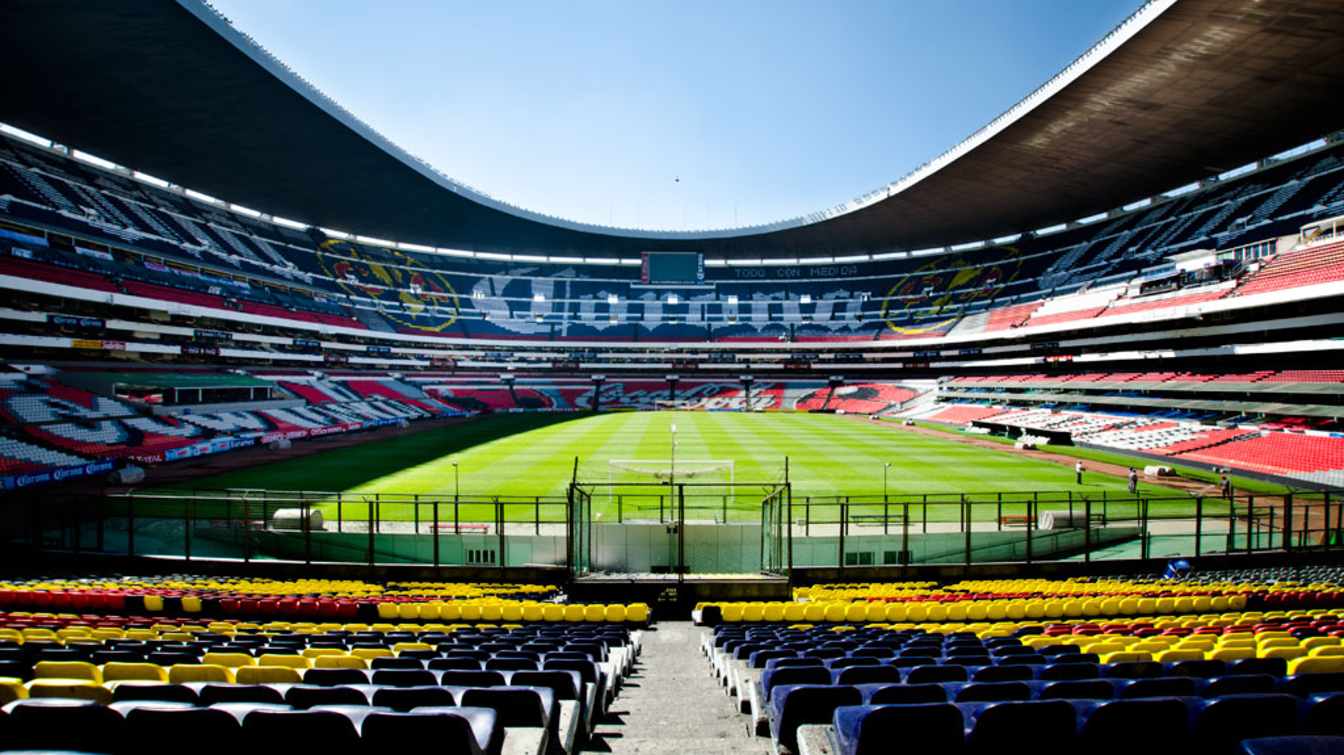 © Stadiony.net | Mexico City Stadium
Matchday at Estadio Azteca
The stadium teems with life during Club América and Cruz Azul matches, as well as Mexico national team games, breaking World Cup attendance records. It hosted the 1968 Olympic final, the Gold Cup, and the NFL Chiefs vs. Chargers game. Concerts, such as Michael Jackson (550,000) and U2 (360°), create a legendary atmosphere. Fans can admire commemorative plaques for Pelé and Maradona and the stadium's Aztec heritage.
During the 2026 World Cup, the stadium will host 5 matches: the WORLD CUP OPENING MATCH – Mexico will start the tournament here, 2 group stage matches, 1 Round of 32 match, and 1 Round of 16 match.
Transport and access to Estadio Azteca during WC 2026
You should take Metro Line 2 to the Tasqueña terminal station, then transfer to the Tren Ligero (light rail) to the Estadio Azteca station. During the World Cup, shuttle buses run from AICM Benito Juárez airport, transporting fans in about 45 minutes, and Metro Line 2 Tasqueña ensures quick access to the station. From the city center, the Light Rail provides a direct connection, and the Nopalera Park & Ride offers a shuttle.
Walking from the platforms or taking a taxi around Coyoacán are convenient options. Drivers use Avenida Insurgentes Sur with parking lots (booking recommended), and an Uber from downtown takes fans about 30 minutes for 200 MXN.
Enter the temple of football. Buy tickets for WC matches at Estadio Azteca and feel the magic of a place where history happens before your eyes!
Buy tickets smartly and be confident about your place at the 2026 World Cup
Waiting solely for the FIFA lottery is a risk, not a strategy. The ticket lottery gives you a chance, but it doesn't give you full control over your trip. You apply for specific matches and categories, but with 48 teams and so many games, you might simply not be drawn for the key fixtures. If you care about a specific city, stadium, sector, and travel dates, you need a plan based on real ticket availability, not just on lottery results.
Why relying only on the lottery isn't worth it?
- The lottery does not guarantee that you will receive tickets for the matches that are the centerpiece of the tournament from your perspective – you might simply get none of your chosen games.
- The closer to the tournament, the less flexibility you have: the choice of sectors and categories shrinks, prices rise, and matching flights and accommodation to the match schedule becomes increasingly difficult.
- By buying tickets outside the lottery, you usually pay more than via the FIFA channel, but you gain what is priceless at the World Cup: guaranteed entry, the ability to sensibly plan your leave, and peace of mind.
- Availability changes all the time – if you are flexible regarding the city, day, or seat category, you can still find tickets at lower price levels, in some cases starting below $200.
How do this guide and our tournament page help you buy tickets smarter?
This guide organizes the entire tournament from a fan's perspective: it shows the format, calendar, regional layout, and realistic travel scenarios. This allows you to first choose a sensible map
(region, cities, stadiums) and only then pick the key matches – instead of leaving it to luck in the draw.
The World Cup 2026 Tournament Page is an extension of this approach:
- All ticket links lead to a verified, secure partner who provides real seat availability, not just general sales announcements.
- Tables for groups, cities, and stadiums are meticulously prepared so you can see the full schedule, dates, and match times in one place.
- If you already know you want to be at the opening match, host nation games, or the
last dance
of Messi or Ronaldo, you can instantly check if tickets for Argentina, Portugal, or the hosts are still within reach. - Every click from the table to a ticket link leads to a transparent offer: electronic ticket delivery, 24/7 customer support, and clear rules – no guessing and no waiting for a potential
miracle
in the lottery.
Instead of starting with the draw, you start with a plan:
- you choose the region and cities that make logistical sense,
- you match games to your vacation, budget, and preferences,
- at every stage, you can check real ticket availability for a given match, team, or stadium with one click.
Thanks to this, you are not just hunting for a ticket,
but consciously building your entire trip: from the first whistle to your return home.
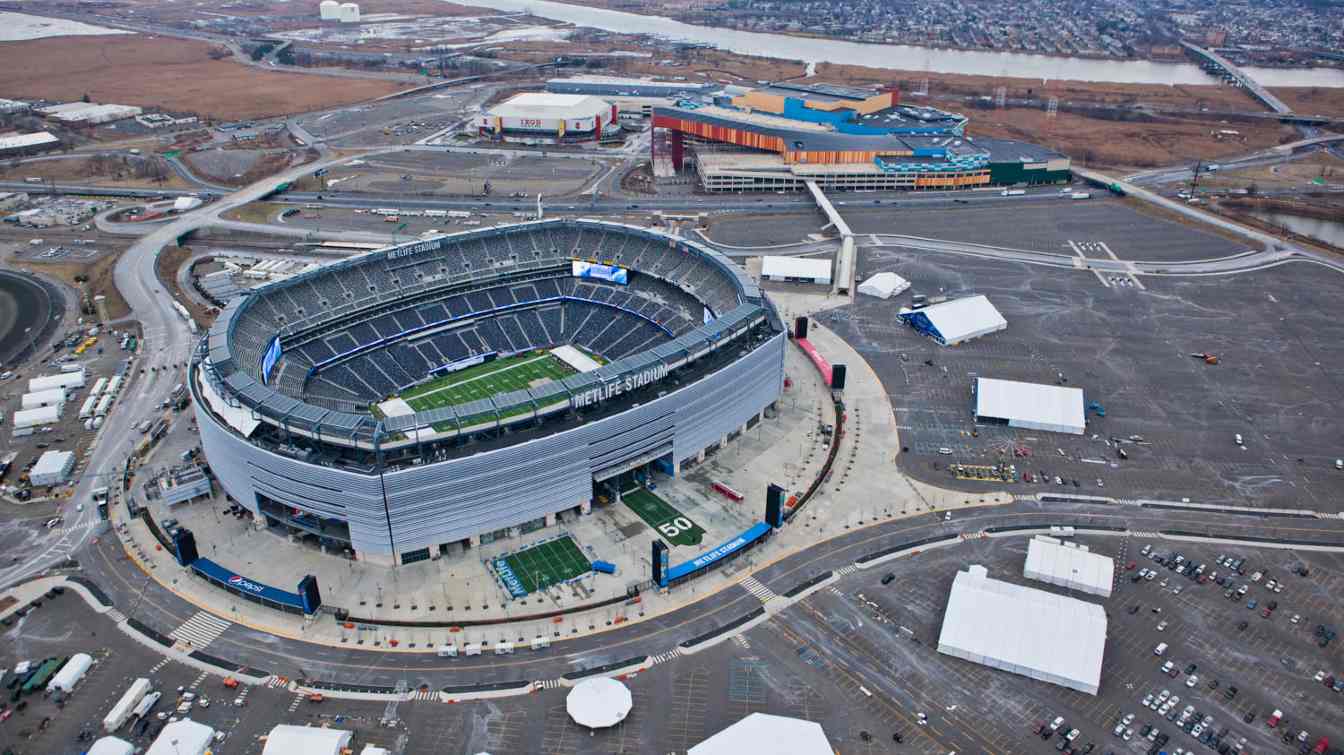 © Anthony Quintano (CC BY 2.0) | MetLife Stadium in New York will host the final of the 2026 FIFA World Cup. Secure your ticket now for this landmark event.
How to get around between cities at World Cup 2026?
Moving between host cities is the biggest hidden cost of this World Cup. The distances are gigantic (Vancouver is further from Miami than Vienna is from Dubai). Here is how to choose the right mode of transport for your route.
USA and CANADA: The Battle with Distances
1. Plane (When is it necessary?)
This is the only sensible option for routes over 600 km (which is 90% of cases).
- Airlines: The
Big Three
dominate in the USA (Delta, United, American), but look for tickets on Southwest Airlines. - Why? They include two checked bags in the ticket price (in other airlines, you pay $35–40 per suitcase unless you fly Business Select / Choice Extra or have elite status). In Canada, Air Canada rules (expensive), with WestJet/Porter as alternatives (cheaper).
- Tip: US airports are leaders in delays. Never plan a flight on matchday with a tight schedule. The safety margin is a minimum of 6 hours.
Tip for flying from Canada: Pre-clearance
Flying from Toronto or Vancouver to a match in the USA? You go through US passport control while still at the airport in Canada, before boarding the plane.
- Advantage: After landing in the USA, you exit the airport like a domestic passenger (no standing in immigration lines).
- Disadvantage: You must be at the airport in Canada much earlier (3h+), because the queue for the US officer is at the departure point.
2. Train (Where does it make sense?)
Rail in the USA (Amtrak) is expensive and slow, EXCEPT for one region: the Northeast.
- Northeast Corridor: If you are traveling between Boston, New York, Philadelphia, and Washington, the train (Acela or Northeast Regional) is unrivaled. You go from city center to city center, avoiding traffic jams.
- Other routes: The train from Los Angeles to Seattle takes 30 hours. That is a sightseeing adventure, not transport to a match.
- Amtrak Rail Pass: Amtrak offers a
USA Rail Pass
(often on promotion for $299–$499 for 10 rides). It only pays off if you plan a tour of many cities, but remember – passenger trains yield right of way to freight trains, so delays of around 4 hours are the norm.
3. Bus (For the budget-conscious)
Megabus, FlixBus, and Greyhound. Cheap (NY-Philadelphia ticket for $15–20), but the standard is low. Bus stations in the USA are often located in rougher neighborhoods. This is an option only for short distances (up to 4–5 hours of driving).
4. Car: The Great American Road Trip
If you plan sightseeing between matches (e.g., the Miami -> Orlando or LA -> San Francisco route), renting a car is the number one option. Fuel is cheaper than in Europe, and roads are wide.
- Credit Card: It's not a myth. Rental agencies in 99% of cases require an embossed credit card (not a debit card!) in the driver's name to block the deposit. Without it, you won't get the keys.
- One-Way Fee: Watch out for the fee for returning the car in a different city. Picking up a car in New York and returning it in Miami can cost an additional $500–1000 just in handling fees.
- Mexico: We advise against renting a car for long routes between cities if you don't know the language and the specifics of local roads (
topes
- speed bumps on highways, road blocks, security issues in some states). In Mexico, it is safer and more comfortable to take a luxury bus.
MEXICO: "Premium" Logistics
Here the rules of the game are reversed. Buses are a luxury, and planes are dirt cheap.
1. "Lujo" Buses (Luxury)
Forget cramped coaches. In Mexico, on routes between cities (e.g., Mexico City -> Guadalajara), buses of the ETN or ADO Platino class reign supreme.
- Standard: Reclining seats like in business class on a plane, touch screens, sometimes even separate toilets for men and women.
- Safety: They are very safe, travel on toll highways, and luggage is checked like at an airport. This is the best way to travel up to 600–700 km.
2. Low-cost flights (Volaris and VivaAerobus)
Mexico has a great network of low-cost airlines (equivalents of Ryanair). Tickets between Mexico City and Monterrey or Cancun often cost $30–50.
- Note: Just like in Europe, watch out for baggage limits. The basic fare (
Zero
) often allows you to bring only a small purse, without even a cabin suitcase. - Note: TUA (Tarifa de Uso de Aeropuerto) is a unique Mexican trap. In Mexico, budget airlines (especially Viva) often show a price of e.g., $20 USD, and then add TUA (Airport Tax), which ranges from $30 to even $60 USD depending on the airport.
Summary (What to choose?)
| Route (Example) | USA/Canada (Recommendation) | Mexico (Recommendation) |
|---|---|---|
| Short (up to 300 km) e.g., NY → Philadelphia |
Train (Amtrak) Fast, city center to city center. |
Bus (ETN/ADO) Comfortable and cheap. |
| Medium (300–800 km) e.g., LA → San Francisco |
Plane Train takes too long, car will get stuck in traffic. |
Bus or Plane Depends on budget, but both options are good. |
| Long (over 800 km) e.g., Dallas → Atlanta |
Plane only Other options are a waste of 2 days. |
Plane (Volaris/Viva) Bus takes a whole day. |
How to choose accommodation and neighborhoods for World Cup 2026?
Hotel prices on matchdays have already surged by 300–500%. If you don't want to pay $1,000 a night for a shabby motel, you need a plan. Here is a survival strategy for three budget levels.
USA & Canada - What challenges can you expect?
Whether you land in Toronto or Los Angeles, you face the same challenges: vast distances and hotel prices that can be eye-watering. The strategies outlined below for the United States can be applied just as effectively in Canada.
Level 1: Budget Survival
Forget the city center. Your targets are so-called satellite towns and alternative accommodation options.
- “Last Subway Station” strategy– In cities like New York or Toronto, look for accommodation at the end of a subway or commuter rail line.
- NY/NJ example: Instead of Manhattan ($500+ per night), search in Secaucus or Newark (but pay close attention to neighborhood safety).
- Los Angeles example: Instead of Santa Monica, look for places near LAX airport (cheap motels) or further east.
- Chain motels – Look for brands such as Motel 6, Super 8, or Red Roof Inn. The standard is very basic, often with “tired” interiors, but a price of $100–150 per night can be a real bargain. Avoid properties rated below 2.5/5, as this often signals serious issues such as bedbugs.
- Hostels – There are very few in the United States. Book immediately once calendars open, often a year in advance.
Level 2: Smart Comfort
Here we aim for Business Hotels
on the outskirts of office districts.
- Brands to look for: Hampton Inn, Holiday Inn Express. They often offer free breakfast (saving you $20 a day). Courtyard by Marriott (usually no breakfast).
- Airports: Airport hotels are often cheaper than those downtown and have excellent connections (shuttle bus to terminal -> train to the city). This is the best quality/price compromise.
- Airbnb (Warning!): In New York, short-term rental of entire apartments (under 30 days) is practically illegal unless the owner lives with you. Don't risk having your booking canceled a week before the match by city inspectors. In other cities (Mexico, LA), it works normally.
Level 3: Premium & Convenience
If budget is not an issue, time is what counts.
Walkable
Stadiums: In cities like Seattle, Vancouver, Atlanta, or Toronto, it is worth paying extra for a hotel within a 1 km radius of the stadium. The ability to walk back after a match, while 70,000 people fight for an Uber, is priceless.- Downtown: In the USA, city centers can be... empty on weekends (office districts). On matchdays they will come alive, but remember that
Downtown
in the USA (e.g., LA, Houston) is often a concrete desert after 6:00 PM.
How to read location? (The Kilometer Trap)
In North America, distance in kilometers doesn't matter. Travel time is what counts.
Hotel 10 km from the stadium
in Los Angeles can mean a 1.5-hour drive in traffic.- Always check the location on Google Maps with the date and time set (e.g., Friday 5:00 PM).
- Golden Rule: Look for accommodation near a rail/subway line that goes to the stadium. Avoid relying solely on buses or Uber.
When to book?
We are already past the group draw (December 2025). We know where specific teams are playing, which means the first wave of bookings has swept away
the cheapest options.
- ACT NOW: There is no time to wait. Prices won't drop, they can only go up. This is the last moment to catch anything of a reasonable standard.
Second Chance
Strategy (March/April): If everything is booked or astronomically expensive now, wait for the opening of the FIFA Resale Platform. That's when many fans change plans, return tickets, and... cancel hotels. This is your chance tocatch a drop
– set price alerts in apps like Booking/Expedia.- Last Minute (Risky): On matchday, prices sometimes drop as hotels try to sell off the last empty rooms, but with the scale of the World Cup, it's a gamble I don't recommend.
MEXICO: Survival Map (Where to Sleep and Where Not to Go?)
We approach Mexico very differently than the United States and Canada, as it is a country with a distinct character and a different set of travel priorities. While time and budget were the key considerations in North America, in Mexico the focus shifts toward safety, location choice, and the quality of accommodation. It is a unique destination that requires conscious planning — distance from the stadium becomes secondary, while the safety zone in which you stay becomes crucial. Instead of looking for the cheapest motel on the outskirts of the city, it is far better to concentrate on proven, secure neighbourhoods.
1. Mexico City (CDMX)
A city of contrasts. Two blocks can divide a world of luxury from slums.
- Green Zone (sleep here)
- Roma Norte / Condesa – Hip, green neighborhoods full of cafés and police presence. Safe, European vibe, excellent food. More expensive, but worth it.
- Polanco – District of embassies and luxury. The safest area in the city, but very pricey.
- Zona Rosa / Reforma – Business and tourist center with good hotels at reasonable prices.
- Red Zone (avoid like the plague)
- Tepito – The famous
Barrio Bravo
. Trade in everything illegal. Walk in with a phone in your hand, and you may walk out without it. - Iztapalapa – Huge eastern district with a high crime rate. Around Estadio Azteca (Santa Úrsula) it is usually fine during the day, but avoid side streets after a match. Use official transport or Uber.
- Doctores – Right next to safe Roma, but can feel sketchy at night.
- Tepito – The famous
2. Monterrey
A modern and wealthy city, surrounded by difficult neighborhoods.
- Green Zone
- San Pedro Garza García – Considered the safest and wealthiest city in Latin America. Plenty of hotels and shopping malls. The best place to stay.
- Barrio Antiguo / Macroplaza – Strict tourist center. Excellent during the day; at night stick to main pedestrian streets.
- Red Zone
- San Bernabé and hillside areas (La Risca) – Neighborhoods on mountain slopes, often controlled by local criminal groups. Tourists should avoid them completely.
- Fomerrey neighborhoods – Local rule of thumb: if the area is called “Fomerrey + a number”, do not go there.
3. Guadalajara
- Green Zone
- Providencia / Chapalita – Quiet, affluent neighborhoods with plenty of greenery.
- Centro Histórico – Safe and interesting during the day. At night, move back to the hotel zone.
- Red Zone
- Oblatos / Analco – Eastern part of the city. Not recommended after dark.
Golden Rule of Transport in Mexico
At night, never hail a taxi from the street (libre
). This can lead to anything from overcharging to secuestro exprés (express kidnapping for ATM ransom).
- Use only Uber or DiDi (GPS tracking and driver details).
- Or order a Sitio Taxi – registered taxis booked by hotel or phone.
Travel Safely to World Cup 2026
Organizing a trip to three vast countries with vastly different regulations is a logistical challenge. The key to success is the Golden Rule
: start with the USA. A visa or authorization for the United States often opens doors to Canada and Mexico, drastically simplifying bureaucracy. Below you will find specific procedures for each country and scenarios for fans from different parts of the world.
Entry Documents – Your Checklist
USA: The First Step
Most fans from Europe travel under the Visa Waiver Program. Your obligation is to obtain ESTA (Electronic System for Travel Authorization). You submit the application online on the official website; it costs $21 and is valid for 2 years. If you do not qualify for the visa waiver program (e.g., fans from Africa, parts of Asia), you must apply for a B1/B2 tourist visa.
Do not search for applications on Google, or you will end up with expensive intermediaries. Go to the link above and scroll down to the How to Apply
section. There you will find a direct redirection to the DS-160 form (visa application) and a list of embassies where you can schedule an interview with a consul. This page also allows you to check the current wait time for an appointment in your city (under Global Support Strategy
), which is crucial when planning a trip for specific matches. Treat this address as the official communication hub that will guide you step-by-step through the bureaucracy.
New for 2026: The Department of State has launched the FIFA PASS system – if you have a match ticket, you can apply for a priority appointment with a consul, which is key in countries with long wait times.
Canada: Expanded eTA
Here, the electronic eTA system also applies (cost C$7, valid for 5 years), linked to your passport. You submit the application at canada.ca.
Important change: Canada has expanded the list of countries eligible for eTA (including the Philippines, Morocco, Thailand), provided the traveler has held a Canadian visa in the last 10 years OR holds a current US visa.
Tip: When filling out the application (for a visa or eTA), enter FIFA World Cup 26
in the purpose of travel field – this is an official recommendation from the Canadian government intended to speed up application processing.
Mexico: Forms and Exemptions
Mexico requires filling out the FMM migration form (Forma Migratoria Múltiple), which can be completed online or on the plane. Keep the bottom part (the slip
), because you will have to hand it back upon departure – losing it means a fine and problems at the airport.
Most important point: If you hold a valid visa for the USA, Canada, Japan, the UK, or the Schengen area, you are exempt from the obligation to have a Mexican visa. A valid passport (min. 6 months) and FMM are enough. This makes the US visa the most valuable document in your wallet.
Scenarios for Fans (Who has it easier?)
Scenario A: Fan from Europe
Your path is the simplest, fully digital. You get an ESTA for the USA and an eTA for Canada online. You enter Mexico on your passport (as an EU tourist, you don't need a visa). All formalities will take you one evening in front of a computer.
Scenario B: Fan from Africa or Asia
Your strategy must be based on a US visa (B1/B2). If you get it, you automatically open the way to Mexico (visa exemption) and potentially simplify entry to Canada (possibility to use eTA instead of the full visa procedure for selected nations). If you start with a Mexican visa, you will still have to apply separately for entry to the USA and Canada, tripling costs and time.
HEALTH: Policy, Water, and Thermal Shock
This is not a place for savings. Medical costs in the USA are astronomical – a simple ER visit with a broken arm can cost as much as your entire World Cup trip.
USA
Travel insurance with a very high coverage amount (minimum 100,000–200,000 EUR/USD) is an absolute necessity.
Mexico
Pay attention to "Montezuma's Revenge" (stomach problems) – drink only bottled water. Also remember the altitude: Mexico City lies over 2,200 m above sea level. Combined with the June heat, this can be a shock to the body.
Climate
The World Cup takes place in summer. In Miami and Houston, expect extreme humidity and heat. In Dallas and Monterrey – dry scorching heat. Air conditioning in the USA is often set to "fridge" mode, so the temperature difference between the street and the stadium will be a thermal shock.
FINANCES: Card in the North, Cash in the South
USA and Canada
Cash is slowly disappearing. At many new stadiums (e.g., SoFi Stadium, Mercedes-Benz Stadium), a cashless rule applies – you will only pay by card or phone. Have a physical multi-currency card (Revolut, Zen, etc.) and a digital wallet on your phone.
Mexico
Here, cash (Pesos) is still king on the street. You will pay by card in a hotel and shopping mall, but street tacos or local transport often require bills. Do not pay in dollars, the exchange rate will be very unfavorable for you.
Official Government Websites (Save them!)
Before planning, always check current announcements directly at official sources. Avoid intermediaries charging unnecessary fees.
- USA
- travel.state.gov (visas)
- esta.cbp.dhs.gov (ESTA)
- Canada
- Mexico
- Multiple Immigration Form (FMM) (migration institute)
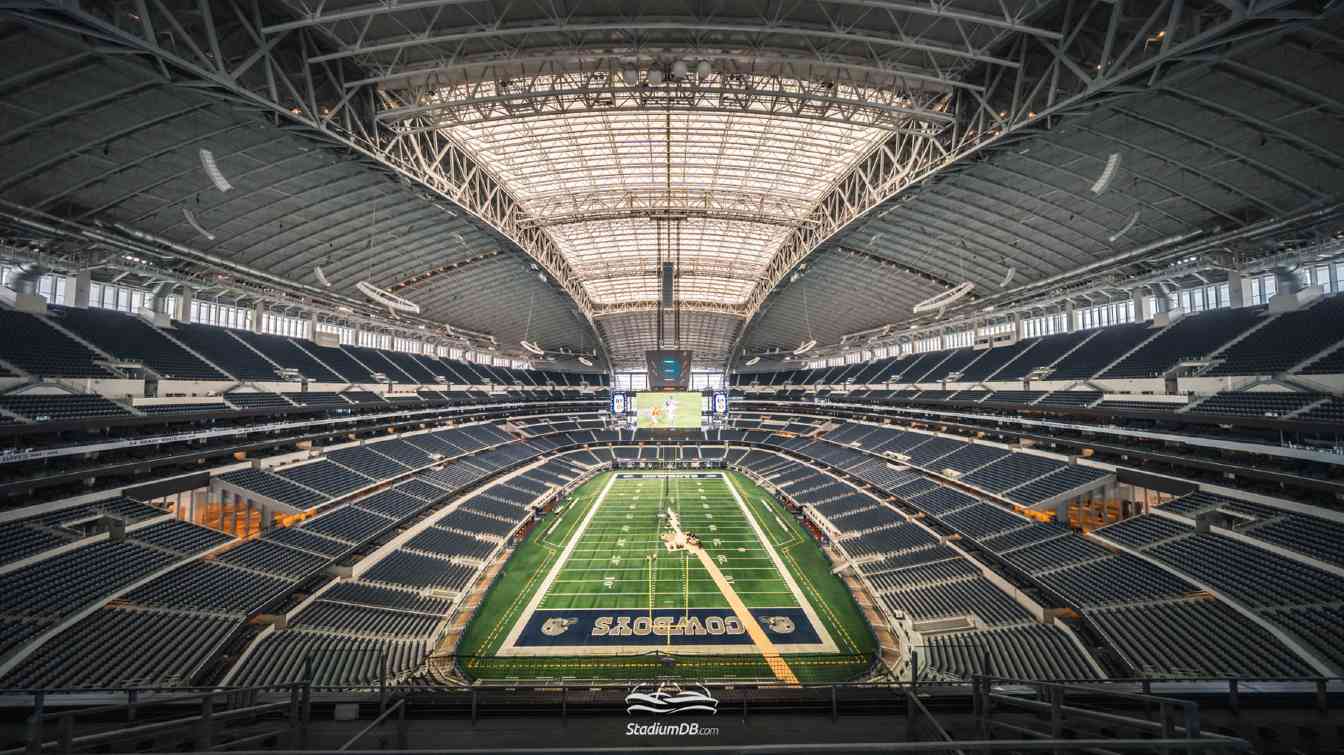 © Grzegorz Kaliciak | The stadium in Dallas, AT&T Stadium, will have the largest capacity of all World Cup venues, with up to 94,000 seats.
Planning a Matchday at World Cup 2026
This is not an ordinary league game. The scale of the World Cup in the USA, Canada, and Mexico dictates rules that can surprise even veterans. Here is your tactical plan from dawn till dusk.
STEP 1: Before Leaving – what to take, what to leave
Going to a match in North America starts long before you reach the stadium. The first shock for European fans is the obsession with the Clear Bag Policy. Forget the backpack, fanny pack, or purse you normally take to matches in Europe. If your bag isn’t transparent, you simply won’t get in.
Only clear plastic or vinyl bags are allowed, and even those must stay within strict size limits (around 30 × 15 × 30 cm). Colored backpacks, even very small ones, are rejected at the gate. Some stadiums allow tiny, logo-free clutch bags the size of a hand, but enforcement varies, so it’s safer not to risk it at all. Another common mistake is arriving with luggage. Stadiums do not offer storage lockers. If you come straight from the airport with a suitcase, security will turn you away. You must leave your bags at the hotel or use luggage storage services in the city center, such as Bounce or Stasher.
One item you absolutely must bring is a power bank. Your ticket is on your phone, payments are made with your phone, and transport after the match often depends on ride-hailing apps. A dead battery doesn’t just mean inconvenience — it can mean you’re completely stuck.
STEP 2: Getting there – timing and access
Reaching the stadium requires much more time than in Europe. A good rule is to be at the gates around three hours before kickoff. It sounds extreme, but security checks resemble airport screening, and distances from drop-off points or parking areas to the stands are enormous.
Around the stadium, so-called “last mile” zones are usually established. These areas are closed to regular car traffic, which means Uber or taxis will not drop you directly at the entrance. Expect a 20–30 minute walk from the designated drop-off point, often through parking lots or controlled pedestrian corridors.
STEP 3: Inside the stadium – money, food, comfort
Once inside, the first thing to remember is that cash is essentially useless. Stadiums across the United States and Canada are fully cashless. Payments are made by card or phone only. If you arrive with paper dollars, you’ll have to look for special “Cash-to-Card” machines that convert cash into prepaid cards — something that usually wastes time and patience.
In many Mexican stadiums, the system works differently but can be just as inconvenient. Payments are often handled via a stadium prepaid card. If you only have cash, you must go to a special cashier point, deposit pesos, and receive a plastic card to use at food and drink stands. Any unused balance is often difficult or impossible to recover after the match.
Food prices should be treated as part of the event experience rather than normal dining. Expect roughly double standard prices — a hot dog or slice of pizza commonly costs $15–20. Alcohol will be available, unlike at the 2022 World Cup in Qatar, but it is expensive. Beer usually costs around $14–18 per can, and in the United States alcohol sales typically stop midway through the second half.
If the match takes place in cities like Houston, Dallas, Atlanta, or Los Angeles, the stadium will be enclosed and heavily air-conditioned. The temperature difference can be brutal: 35°C outside and around 20°C inside. A light sweatshirt is not optional — it’s a comfort essential.
STEP 4: Return – the hardest part of the day
Leaving the stadium is often more challenging than getting in. You exit together with 70,000–80,000 people, and unlike in Europe, the crowd does not disperse naturally into surrounding neighborhoods. Almost everyone is heading to cars, trains, or shuttle buses at the same time. If the stadium is located in or near downtown — as in Atlanta, Seattle, Vancouver, or Toronto — you’re lucky. After the match, fans spill directly into city streets, bars, and hotels. The smartest strategy is not to rush for the subway immediately. Walk to a nearby pub, wait an hour, and let the human traffic jam clear.
The situation is much tougher at so-called parking-lot stadiums in places like New Jersey, Miami, Los Angeles, Dallas, or San Francisco. These venues sit in the middle of vast parking areas surrounded by highways, often without sidewalks leading anywhere useful. Ordering an Uber right after the match can cost $150–200 and still involve an hour-long wait. In these cases, public transport is usually the only reliable option. Organizers typically provide special trains or buses, such as NJ Transit services to New York. It will be crowded and slow, but it works. Another option is official shuttle buses taking fans to transport hubs away from the stadium, where it’s easier to continue the journey.
Finally, it’s worth having emergency plans. At open stadiums, heavy storms can interrupt matches and force fans to shelter inside the concourse. Do not leave the stadium during such evacuations — once you exit, your ticket often becomes invalid and re-entry may be denied. Before entering, agree with friends on a clear “Point Zero” outside the stadium — a statue, large flag, or distinctive landmark. If phones die or signal collapses, this is the only realistic way to find each other again.
In very hot cities such as Monterrey or Mexico City, heat exhaustion is a real risk. If you feel weak, don’t push through it. Look for cooling stations or volunteers wearing medical vests, sit in the shade, and ask for help. Stadium medical services are well organized, but you need to signal them early.
Would you like to take a closer look at the 2026 World Cup stadiums? In our YouTube video, we’re not only above, next to, and inside the stadiums — we also show the host cities and the atmosphere of the tournament. See it for yourself!
FAQ
1. Where is the best place to look for World Cup match tickets?
The safest way is to start with our tournament page with full schedule and ticket links, where you can see real, constantly updated seat availability and prices in one place, and every link leads to a verified ticket partner operating in a transparent model. The FIFA lottery is just an additional option – it relies on a draw and gives no guarantee that you will get tickets for key matches, cities, or dates, so it shouldn't be the foundation of your trip plan.
2. How much do group stage tickets cost?
Ticket prices depend primarily on the match, city, category, and time of purchase – not a single price list. Official FIFA sales offer a limited pool in fixed price categories, but the availability of the most attractive games runs out quickly, leaving mainly more expensive levels.
Outside the lottery, ticket prices for the group stage are generally high, and it is worth stating this clearly — in many cases they reach several hundred dollars, and for top-tier matches even several thousand, which may come as a surprise to European fans. This is driven not only by the prestige of the tournament, but also by the specifics of the U.S. market: high organisational costs, limited availability in the lowest price categories, and strong domestic and international demand. However, if you are flexible in terms of host city, match date and seating category, it is still possible to find tickets for selected group matches around $200 or slightly above. Rather than guessing, it is best to check the actual price ranges for a specific match, where current prices by category and differences between seating sections are clearly visible — allowing you to choose a match based on your budget, not the other way around.
3. Do I need a visa for the USA, Canada, and Mexico if I have a match ticket?
A match ticket alone does not replace a visa or electronic travel authorization. For the USA, most fans from Europe need an ESTA or B1/B2 visa, for Canada – an eTA or visa, and for Mexico – an FMM form and in selected cases a visa, though a valid US/Schengen visa often exempts you from the Mexican visa requirement. Detailed scenarios for different countries can be found in the chapter on safety and regulations.
4. Does a match ticket entitle me to free public transport?
For the 2026 World Cup, there is no uniform, tournament-wide rule for free public transport based on a match ticket. Some cities may introduce local solutions (e.g., special lines or promotional tickets), but you need to follow them separately in announcements from the given city or organizer. In this guide, we assume that you plan and pay for transport yourself – practical access information can be found for each stadium in the chapter Stadiums of WC 2026: stadium guide.
5. What are the biggest differences between the match experience in the USA, Canada, and Mexico from a fan's perspective?
The USA is primarily about scale: huge, often partially roofed NFL stadiums, a strong event
culture (tailgating, shows around the match), a high level of organization, but also long commutes and a fully cashless
stadium ecosystem. Canada offers a combination of modern infrastructure and a slightly calmer atmosphere – with fewer cities, it is easier to build a logistically sensible plan from Toronto or Vancouver, often combining them with nearby US cities. Mexico is the most intense football
experience: hot stands, the rhythm of a Mexican fiesta, cheaper daily costs, but a greater need to watch out for safety outside the stadium and wisely choose accommodation, neighborhoods and transport. You can find more about safety during the World Cup in the chapter Travel Safely at World Cup 2026.
6. What is a Fan ID and will it be needed for WC 2026?
Fan ID was a fan identification system used, for example, at the 2018 World Cup in Russia, combining a stadium ticket with the function of a document entitling entry to the country. For the 2026 World Cup, there are no plans to introduce an analogous, global Fan ID – the basis remains the match ticket plus the required entry documents for the USA, Canada, or Mexico. Entry rules and fan identification are discussed in the chapter Travel Safely to World Cup 2026.
7. How to get to stadiums in the USA without a car?
In most host cities in the USA, access to the stadium relies on urban/commuter rail, subway, light rail, or dedicated shuttle buses from downtown and airports; only some stadiums are located in the strict center where walking makes sense. The most important rules – including the differences between downtown
and parking lot stadiums
– are described in the chapter Planning a Matchday at World Cup 2026.
8. Can I bring backpacks into the stadium?
A so-called clear bag policy applies at stadiums in the USA and Canada – backpacks and regular bags are generally prohibited. You will only bring in a transparent bag of limited dimensions and possibly a very small purse/clutch. Detailed rules, including the consequences of arriving with luggage from the airport, are described in the section Planning a Matchday at World Cup 2026.
9. Are stadiums in Mexico safe for tourists?
The World Cup stadiums themselves in Mexico (Estadio Azteca, Estadio Guadalajara, Estadio Monterrey) will be covered by extensive security measures, and access zones will be controlled by police and tournament services, which significantly limits the risk for tourists. However, reasonable behavior outside the stadium is key – choosing safe accommodation neighborhoods, using Uber/Sitio Taxi, and avoiding specific areas after dark. Details can be found in the chapter How to get around between cities at World Cup 2026?
10. In which city will I see the most World Cup matches?
Dallas (9), Atlanta (8), and New York (8) will host the most games, being key arenas for both the group stage and the knockout phase – including semi-finals and the final. Every match, date, time, and assigned stadium can be found on our World Cup 2026 tournament page.
11. Is it possible to sensibly combine matches in two countries (e.g., USA + Mexico) in one trip?
Yes, but only with a very conscious plan. The most realistic layouts are blocks
of the group stage in one country plus single matches in another – e.g., several games in the southern USA (Texas, Miami) and one or two matches in Mexico City or Monterrey. It is crucial to keep a margin of 1 day for each international flight and take into account border controls and time differences. We presented several ready-made templates in the chapter Host cities and regional breakdown.
12. Are tickets paper or mobile?
The dominant standard for WC 2026 will be mobile tickets – assigned to an app or phone wallet, scanned at the stadium entrance. Our verified ticket partner delivers World Cup match tickets in digital form. In the guide, we emphasize the importance of a charged phone and a spare powerbank in the section Planning a Matchday at World Cup 2026.
13. Can I buy alcohol at stadiums?
Yes, during the 2026 World Cup, alcohol will be available at stadiums and in official fan zones in the USA, Canada, and Mexico. As an official FIFA partner, Budweiser will supply beer. Prices will depend on the country and local realities, and sales will be subject to local regulations and age verification. Comprehensive information about each venue separately can be found in the section Stadiums of WC 2026: stadium guide.
14. Can I choose a specific sector and row when buying?
When buying, you can often choose a specific section and row, but this depends on the platform and seat pool. Our verified partner sales show a map of the venue with sectors; after clicking, you select a sector, view the sightline, and then indicate the desired row before payment. You can purchase a ticket for every World Cup match on our tournament page dedicated to World Cup 2026.
15. Is it worth buying packages of matches at one stadium instead of traveling to several cities?
Yes, for most fans this is the most rational option. A package of 2–3 matches at one stadium or in one corridor
(e.g., Dallas, Atlanta, New York/New Jersey, Toronto + Boston) minimizes the number of flights, the risk of delays, and transport costs, while allowing you to truly feel the atmosphere of the stadium and city. Touring many cities in a short time makes sense mainly for people who tolerate intense travel very well and are ready to pay for flexible flight tickets and accommodation reserved with a margin. We presented several ready-made templates in the chapter Host cities and regional breakdown.
16. Why can ticket prices for the same match differ?
Ticket prices for the same match differ mainly due to seat categories (e.g., tier level), different sales products, and sales phases. FIFA uses so-called variable pricing and may adjust prices between phases depending on demand and availability, without automatic dynamic
changes in real-time. Service fees, taxes, and currency exchange also apply. If you don't want to wait for the FIFA lottery, buy tickets now thanks to our tournament page, with a transparent table of matches and ticket links.
17. Are the stadiums roofed and do they protect against heat or rain?
It depends on the stadium: some venues have full roofs or retractable roofs, but many have only partial roofing over the stands, which does not always protect against sideways rain or heat. FIFA planned to use roofed stadiums more often due to the risk of high temperatures. Despite this, the final will take place at an open-air venue in New York. Secure your place at the most important match of the World Cup now.
18. Is there Wi-Fi access at the stadium?
Wi-Fi is available at many large stadiums, but quality can vary because the network is heavily loaded on matchday. Organizers are also preparing upgrades: for example, in Toronto, a contract for network and Wi-Fi services for the World Cup is planned, with lasting improvements. It is worth being prepared for various scenarios. Technical issues are discussed in the section Planning a Matchday at World Cup 2026.
19. Will I pay with cash at stadiums in the USA and Canada?
In the USA and Canada, more and more stadiums operate cashlessly: card and contactless payments are the norm in catering, shops, and parking lots. For example, Lumen Field in Seattle explicitly communicates that it accepts only cards and contactless payments at events. Be prepared thanks to the chapter Planning a Matchday at World Cup 2026.
20. Can ticket prices increase closer to the start of the tournament?
Yes, prices can increase, but the mechanism depends on the channel. FIFA uses variable pricing
and may change prices between sales phases after analyzing demand and availability; this is not an automatic real-time change within a single sales window. Additionally, the resale market can drive prices up. The later it gets, the smaller the choice of seats. That is why many fans do not wait until the last minute. Visit our World Cup 2026 tournament page and secure your seat in the stands.
This website is not affiliated with or endorsed by the tournament organizers or FIFA. Tickets are sold through our ticket marketplace which feeds from integrations with ticket aggregators.