 StadiumDB
England: Nottingham Forest will expand its iconic stadium! Riskily large capacity
source: StadiumDB.com ; author: Paulina Skóra
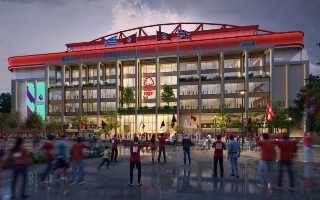 Nottingham Forest has submitted a new, comprehensive set of planning applications aimed at completely reshaping the future of the City Ground. The project envisions a phased redevelopment of the stadium along the River Trent, alongside a significant increase in capacity.
Advertisement
Phased redevelopment of City Ground on the River Trent
The new concept represents the most ambitious vision for stadium development in the club’s history and is intended to secure its long-term future for decades to come. Forest emphasize that their objective is to remain at City Ground rather than relocate to a new stadium outside the current site. The submitted documents outline a phased reconstruction of three sides of the stadium, along with extensive public realm improvements on the southern side of the River Trent. Two linked applications have been submitted to Rushcliffe Borough Council.
The first is a full planning application covering the demolition and complete reconstruction of the Peter Taylor Stand, the infilling of the corners near the Trent End, and redevelopment of the stadium’s surroundings. The second is an outline application defining the scale and access principles for a future redevelopment of the Brian Clough Stand. Upon completion of the first phase, the stadium’s capacity would rise from just over 31,000 to approximately 45,000 seats. The second phase would allow the club to reach the target capacity of 52,500 spectators.
Shift in strategy compared to earlier stadium expansion plans
The new applications mark a departure from the planning permission granted in 2025, which envisioned a stadium of around 35,000 seats combined with associated residential development. That project, developed since 2019, was repeatedly revised due to ownership and environmental constraints.
The current strategy focuses exclusively on stadium expansion and supporting infrastructure. The club has abandoned plans for riverside housing, judging this element to be financially risky in the context of rising construction costs.
Tweet Nottingham Forest https://x.com/NFFC/status/2008108718848614559
— Nottingham Forest (@NFFC) June 26, 2025
City Ground capacity and the club’s sporting ambitions
Nottingham Forest argue that the scale of the investment is a direct consequence of the club’s sporting growth. Promotion back to the Premier League in 2022, qualification for European competitions in 2025, and consistently high demand for tickets have meant that thousands of supporters are unable to attend matches regularly. Club officials stress that expanding the stadium is essential to maintaining sporting and financial competitiveness, as well as improving hospitality offerings, safety standards, and spectator comfort.
Under the plans, the existing Peter Taylor Stand will be completely demolished and replaced with a significantly larger three-tier structure. The project is designed to be delivered in phases, allowing matches to continue during construction, including works carried out above the current Trent End roof.
Infilling the corners between the stands is intended to create a more enclosed stadium bowl, enhance acoustics, and strengthen the matchday atmosphere. Hospitality capacity will increase to more than 5,500 seats, with new spaces designed to operate beyond matchdays as conference, event, and community facilities.
The new Peter Taylor Stand will become the most distinctive architectural feature of the stadium. Its roofline is expected to reach approximately 67 metres, while the main structural arch could extend to as much as 82 metres. The design includes a continuous red roof band that could later be extended to the remaining stands, giving the stadium a unified visual identity. The façades are intended to reference local architecture through the use of stone inspired by Nottingham’s historic sandstone.
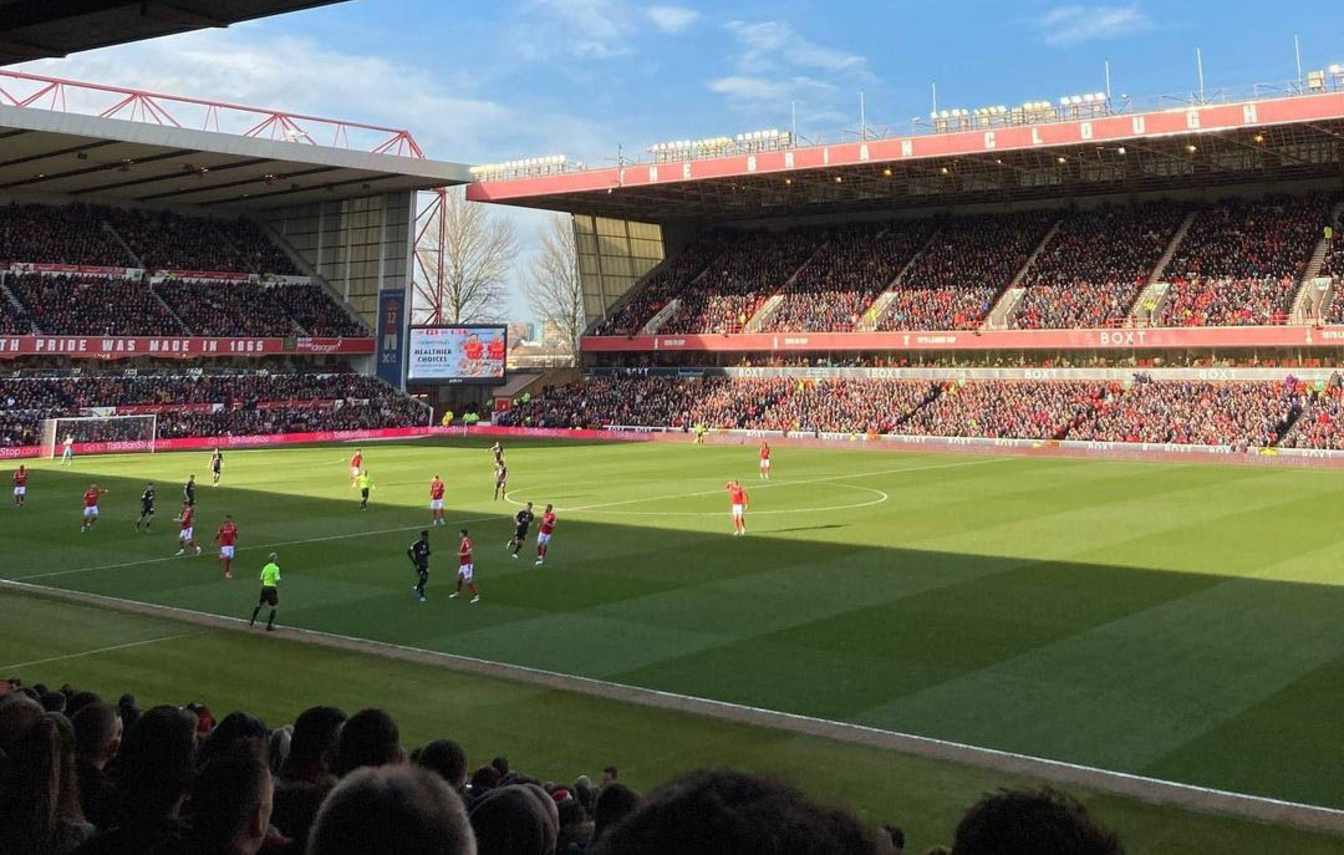 © Harry Edmo | The attendance record at City Ground stands at 49,946 spectators and was set in 1967 during a match between Nottingham Forest and Manchester United.
Public space and redevelopment of the Trent waterfront
A major element of the project is the comprehensive transformation of the area surrounding the stadium. Plans include new public squares, pedestrian and cycling routes, and the opening up of areas previously inaccessible to residents. The expansion aims to reinforce City Ground’s role as a year-round meeting place, rather than solely a football venue.
The project also include the demolition of the current club shop, the Champion Centre training facility, and rowing boathouse buildings. Facilities used by the Nottingham Rowing Club are to be relocated elsewhere, with their relocation forming a prerequisite for the commencement of certain construction phases.
City Ground expansion timeline through 2033
If planning approval is granted, works on the Peter Taylor Stand and the Trent End corners are scheduled to begin after the conclusion of the 2025/26 season. The reopening of the stadium with a capacity of around 45,000 seats is planned for the start of the 2030/31 season. Redevelopment of the Brian Clough Stand would follow in a subsequent phase, with completion of the entire project anticipated before the 2033/34 season. The club conducted extensive consultations with local authorities and residents, and the feedback received influenced the final shape of the project, particularly in relation to transport, noise, lighting, and flood risk.
City and regional authorities view the expansion of City Ground as a central component of the redevelopment of Nottingham’s riverside area and the so-called Trent Sports Quarter. The investment is expected to deliver long-term economic benefits, strengthen the city’s brand, and create a new multifunctional public space. The decision of Rushcliffe Borough Council will be one of the most significant in the municipality’s planning history, with implications extending far beyond the stadium itself and shaping the future of the entire Trent waterfront.
Advertisement