 StadiumDB
Italy: Conflict around the Como stadium project. Who will compromise?
source: StadiumDB.com ; author: Jakub Ducki
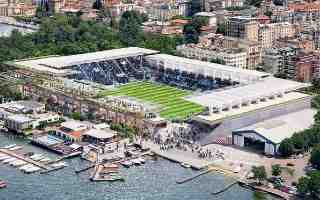 In Como, Italy, tensions are rising over the redevelopment project of the Sinigaglia stadium. Although some institutions have approved the revised concept, police authorities, residents and local politicians have raised serious concerns. The dispute focuses on safety, parking and administrative procedures – and the case has already reached the courts.
Advertisement
Architectural design compromises
Soprintendenza (regional, state-run authority) accepted the club’s revised proposal, which incorporates most of the heritage authority’s comments. The maximum height of the new development was reduced to 19 metres— a compromise between the originally planned 22 metres and the initially requested 16 metres. This height was considered the minimum needed to correctly place the lighting system under the roof structures of the stands of the new stadium for Como, eliminating the need to keep the existing floodlight towers.
The project includes glazed enclosures on the north and south stands to preserve views of the surrounding Cardina mountains and Lake Como. The east stand will be shifted by 6 metres (instead of the originally requested 15 metres), in order to protect the existing tree-lined avenue and maintain a continuous green screen that masks the stadium. In later design phases, a detailed agronomic plan will be required, covering both protection of the existing trees during construction and new plantings.
Reversing stands raises serious doubts
The Como Police Headquarters voiced significant concerns about the planned reversal of the stands’ layout. Based on experience from the most recent Serie A season, the proposed configuration would create a number of issues during the inflow and outflow of both away and home supporters. The external area intended for away fans (the west sector) would not provide enough manoeuvring space for buses transporting supporters.
A particularly problematic point is the expected route for away-fan buses, which would run along via Fratelli Rosselli near the venues Pizza Goal
and Pan Pero
—traditional meeting places for Como ultras. This could lead to dangerous friction between home and away supporters in a constrained area, contrary to guidelines for the safety of sports venues.
Another issue is the insufficient away section capacity, limited to 980 seats. In the context of Como 1907’s European ambitions and matches against top Serie A clubs, this number would not be enough to meet ticket demand. Police suggest that an entire away stand—possibly modular—should be reserved exclusively for visiting supporters.
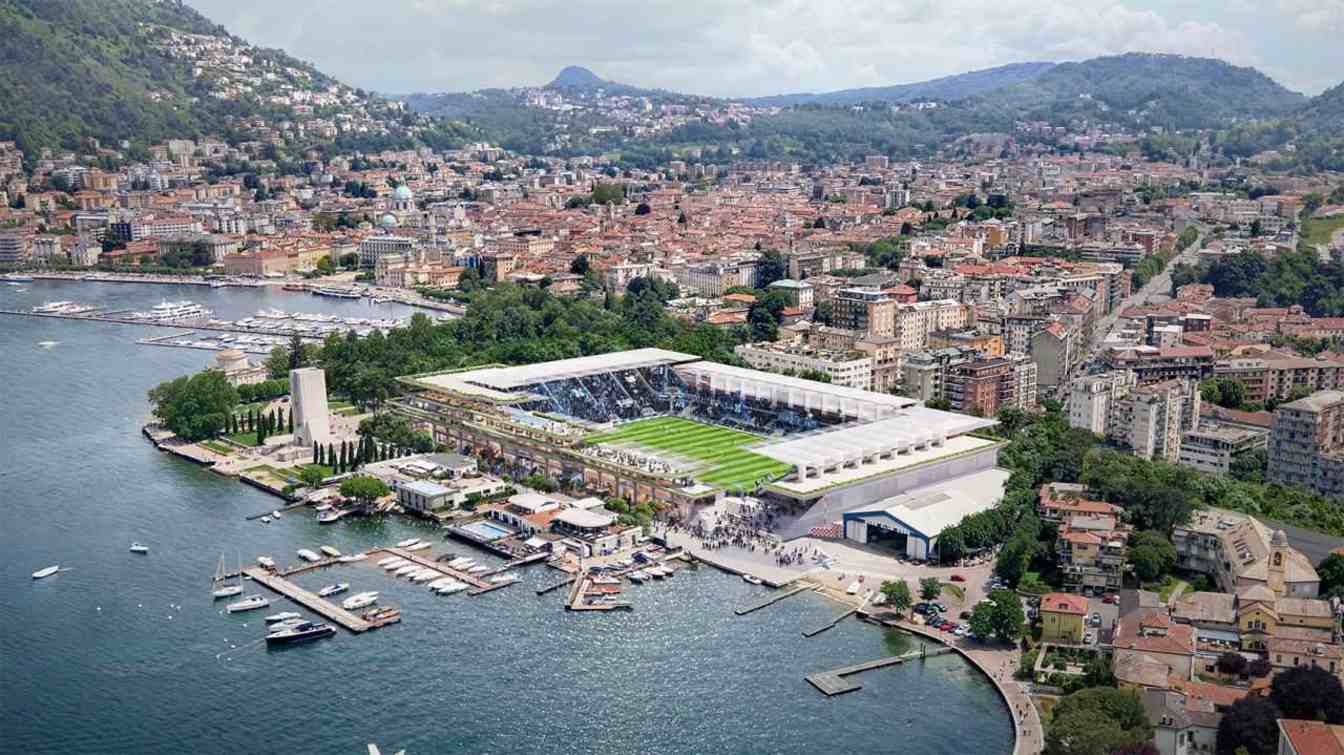 © Populous
Parking and mobility – a flashpoint of conflict
The planned multi-storey car park in the so-called Pulesin area, designed for 400 spaces, has triggered strong opposition from residents and some local politicians. The site is about 1.2 km from the stadium, near the roundabout connecting via per Cernobbio, via Borgovico nuova and via Bellinzona. This area is already heavily burdened by traffic—school and commuter flows on weekdays and tourist traffic at weekends.
The Lombardy Region stressed the need for a comprehensive traffic study to verify the capacity of the modified junctions both under normal conditions and during sports events. Particular attention should be paid to alternative solutions to traffic lights at the Borgovico–Martinelli intersection, given the importance of Borgovico as a main northern access route into the city.
Building the Pulesin car park would rule out the Borgovico-bis bypass, which critics say would further increase traffic in the area. The Democratic Party in Como proposed an alternative: the former Stecav site on viale Innocenzo, only about 650 metres from the stadium. Architect Giuseppe Cosenza, a former city official, argued that the municipality should steer the entire operation, rather than adapting to private investors’ demands.
Aero Club Como took a cautious stance, noting that the planned development could conflict with land covered by a municipal concession issued in February 2025. The club pointed out that the lack of detailed plans, sections and elevations with dimensions makes it impossible to assess constraints arising from obstacle limitation surfaces required under aviation rules.
ASF, the local public transport operator, again requested a test run of buses carrying away supporters on the route envisaged in the project. A decision to change the route should only be made after practical verification that such an arrangement is feasible.
Appeals to administrative court
The Committee for the Protection of the Stadium Area in Como, represented by lawyer Mirella Quattrone, authorised attorney Veronica Dini to file an appeal with the Regional Administrative Court (TAR) in Milan against the Municipality of Como’s decision of 7 January 2026. The committee alleges procedural irregularities, arguing that some opinions were not issued due to missing documentation, others were highly critical, and yet the municipality approved the project.
The decision to appeal is not surprising—residents have been calling for dialogue with the city for some time and do not rule out further legal actions at later stages. After the formal filing, the committee plans to hold a public meeting to explain the reasons and objectives behind its steps.
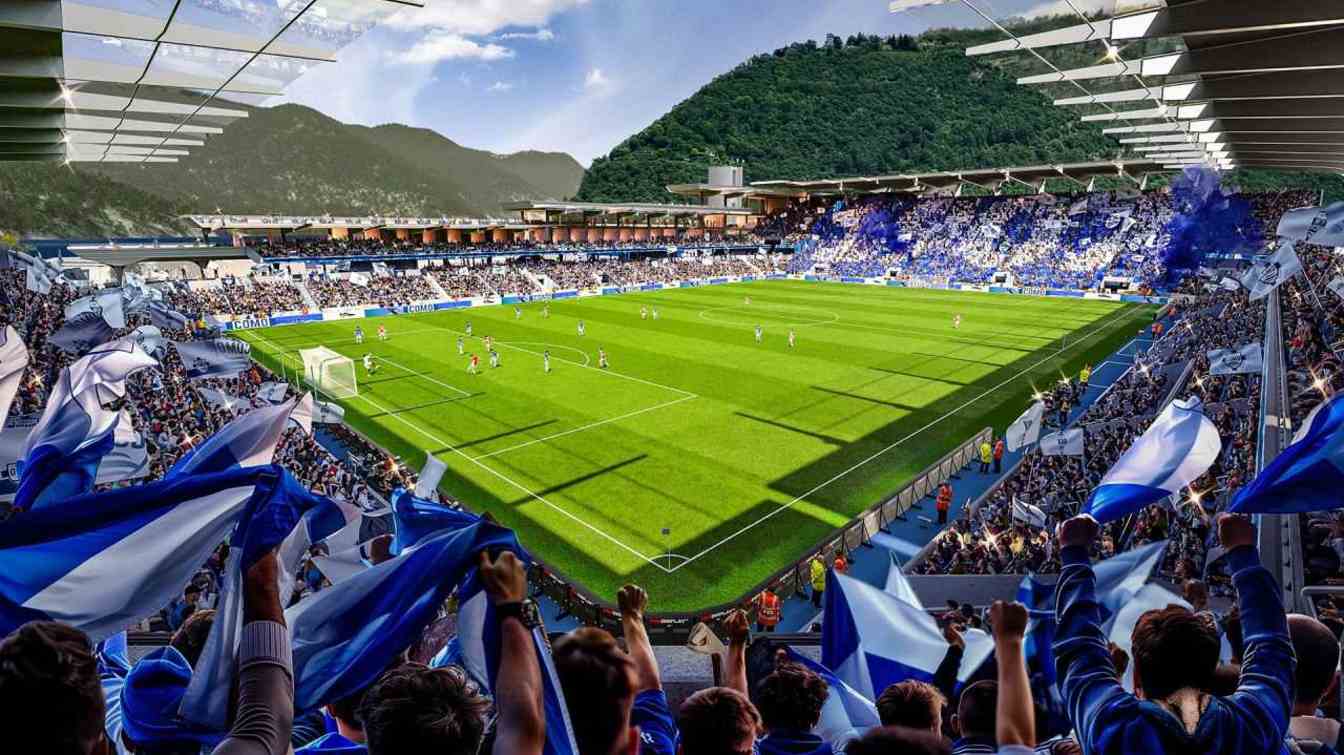 © Populous
Position of city authorities
Mayor Alessandro Rapinese, commenting to local broadcaster Espansione TV, said procedural responsibility lies with the management level, while confirming that the political direction remains unchanged. The city administration intends to continue working with Como 1907 to deliver the new Sinigaglia, despite opposition from residents’ committees.
In the mayor’s view, if there are legal elements to be examined, it is reasonable to submit them to the competent bodies. City authorities remain convinced the stadium must be modernised and do not intend to halt the investment process.
Advertisement