 StadiumDB
Spain: Málaga launches process to choose a site for a new stadium
source: StadiumDB.com ; author: Jakub Ducki
 Málaga has launched a formal process that could define the future of the club’s stadium. Several locations, competing urban visions and the ambition of a top-class venue are now on the table, with the coming weeks set to shape one of the city’s key infrastructure decisions.
Advertisement
13 weeks to identify the best location for Málaga’s stadium
The contract was awarded via the municipal company Promálaga. Formally, it covers technical support to examine possible sites within the city and to produce decision-making material based on technical and economic parameters.
The city says the aim is a top-class venue with a capacity of 45,000–55,000 seats, at least UEFA Level 4 requirements, referenced as aligned with the UEFA Stadium Infrastructure Regulations (June 2025). In practical terms, this points to a stadium designed not only for domestic competitions but also for major UEFA events, with infrastructure requirements spanning areas such as safety and security management, functional zoning and media/broadcast operations.
“Hire” with Bernabéu and Qatar 2022 credentials
Public attention focuses on the choice of contractors. TYPSA is an engineering and consultancy group with sports-infrastructure experience; the city’s communication highlights its involvement in projects such as Santiago Bernabéu redevelopment. Fenwick Iribarren Architects is a practice specialising in sports and stadium architecture, associated with projects for the 2022 World Cup venues in Qatar and with Nou Mestalla project in Valencia.
The team is also expected to be complemented by partners covering legal and urban-planning expertise and by a stadium-operations/business specialist, signalling that the assessment will look beyond construction feasibility toward operating and revenue models.
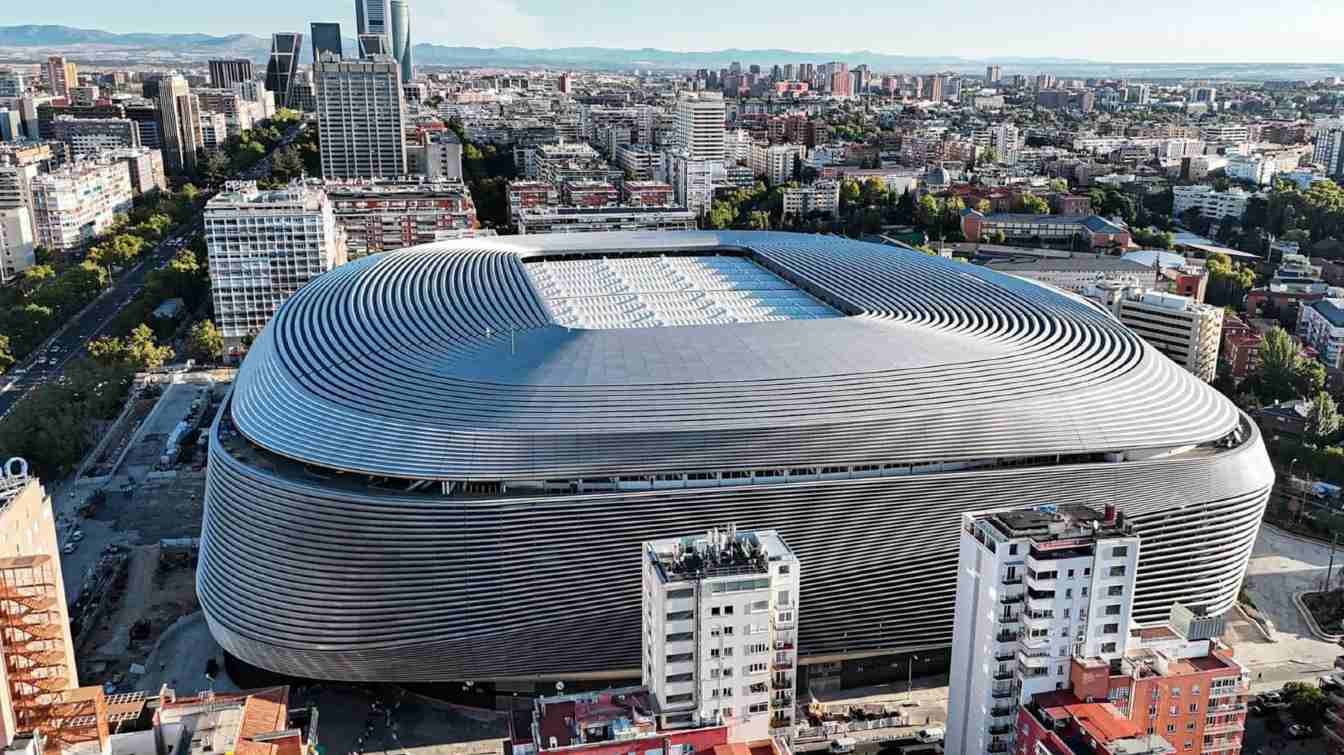 © Bernabéu | Estadio Santiago Bernabéu sets the direction for stadium design projects in Spain and across Europe.
Five locations on table — with room for more
The city has put forward five initial options for analysis. Some stay within the footprint of existing infrastructure, while others imply a new urban-development approach.
The starting set includes: La Rosaleda (expansion/modernisation of the current stadium under a plan previously associated with the 2030 World Cup bid concept), a university-expansion area in Teatinos (defined by specific bordering avenues and a stream), San Cayetano (area referenced in the 2011 PGOU), Lagar de Oliveros, and Manzana Verde (a fan-proposed option that overlaps with a housing programme of 923 dwellings, including 803 protected homes).
The city also indicates that additional alternatives may emerge during the study and should be assessed as well.
How “new Rosaleda” work is structured
The schedule is split into two parts: five weeks for data gathering and an initial diagnosis of the candidate sites, followed by eight weeks for a multi-criteria analysis (AMC) leading to a recommended option.
A key milestone is an early filtering stage: after a preliminary review that should be completed within two weeks of the kick-off meeting, at least three locations must be selected for detailed assessment, with the current La Rosaleda site mandatory among them. The detailed comparison is expected to consider planning, design and physical constraints, sustainability, urban mobility, social impact, economics and potential return on investment.
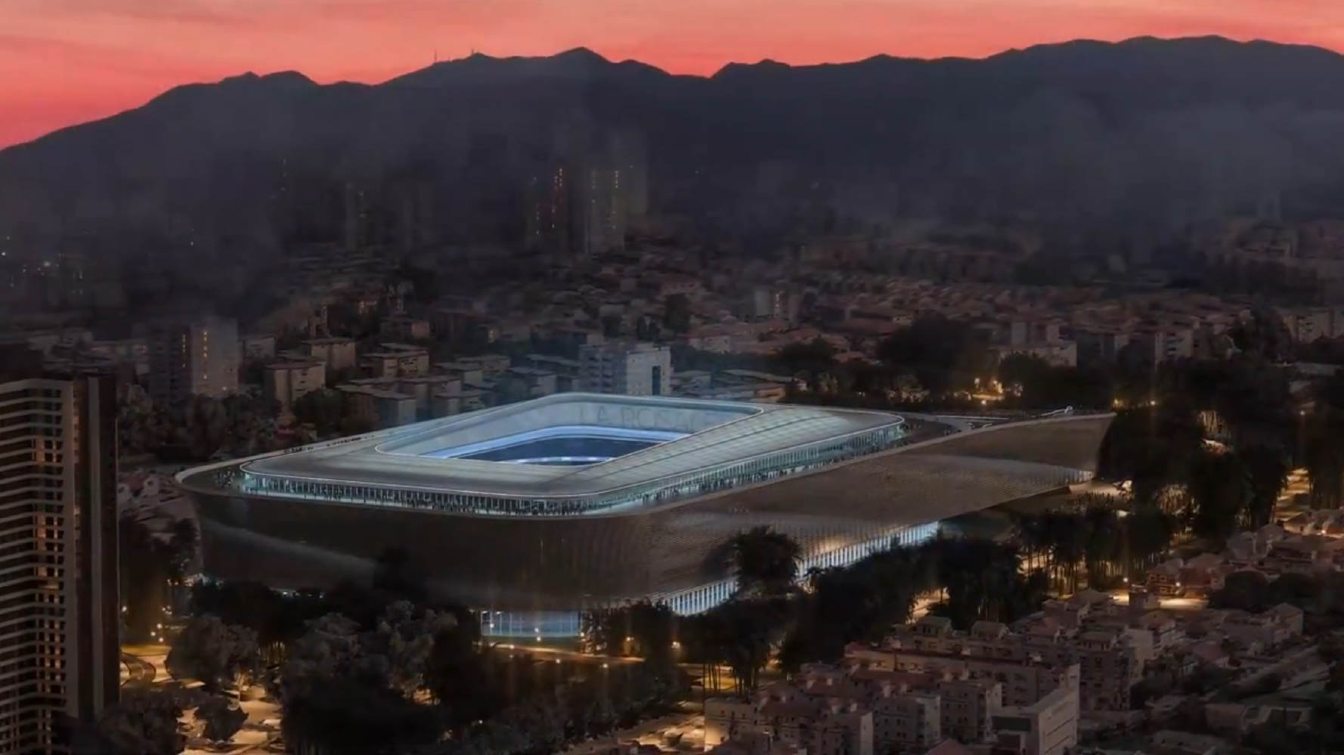 © Junta de Andalucía | A new stadium for Málaga had been planned for a long time. The project was linked to the 2030 World Cup, from which the city has since withdrawn as a host.
The final deliverable should be a report naming the optimal location plus a roadmap
covering procedures, indicative timelines and cost estimates, regardless of whether the eventual management model is public or private.
The recommendation does not, however, determine the final decision. Although the study is meant to provide solid arguments and bring structure to the debate, it has been explicitly stated that its outcome will not be binding. The document is intended to be a tool, not a ruling.
In practice, this means that even if the report identifies the best site, the final decision will remain with the public institutions involved in the project. The process also leaves room for additional technical or feasibility studies to be commissioned later in order to validate the chosen option.
Advertisement