 StadiumDB
England: Elland Road modernization approved. Bigger than Everton’s new stadium?
source: StadiumDB.com; author: Paulina Skóra
 Elland Road is facing its biggest transformation in decades. Approval from the city paves the way for a phased redevelopment of Leeds United’s stadium, aimed at expanding its scale, improving fan comfort and embedding the historic venue in the club’s long-term vision.
Advertisement
Phased modernization of Elland Road will increase capacity
The decision to expand Elland Road was taken during a several-hour meeting of Leeds City Council’s planning panel, which approved the redevelopment project by a majority vote. The approved plan increased the stadium’s capacity from 37,645 to approximately 53,000 seats. The approved application has a hybrid character. In the first phase, specific works are planned for the West Stand, along with interventions in the north-west and south-west corners of the stadium. At the same time, outline planning permission has been granted for a subsequent phase, which will include the redevelopment of the North Stand and the north-east corner. This model of implementation allows for flexible construction planning and adjustment of the schedule to the sporting calendar.
Leeds United assures that Elland Road will remain fully operational throughout the entire expansion period. Home matches will be played without relocating the team to another venue, which is crucial both for supporters and for maintaining continuity of matchday revenues. The main phase of construction works is set to begin after the end of the current season in order to minimize the impact of the investment on matchdays.
The expansion of Elland Road will make the Leeds United stadium the seventh-largest football stadium in England. The project includes the redevelopment of the West and North Stands, as well as changes within the South Stand. The club emphasizes that the goal of the modernization is not only to increase the number of seats, but also to improve fan comfort, sightlines from the stands, and the overall quality of matchday infrastructure.
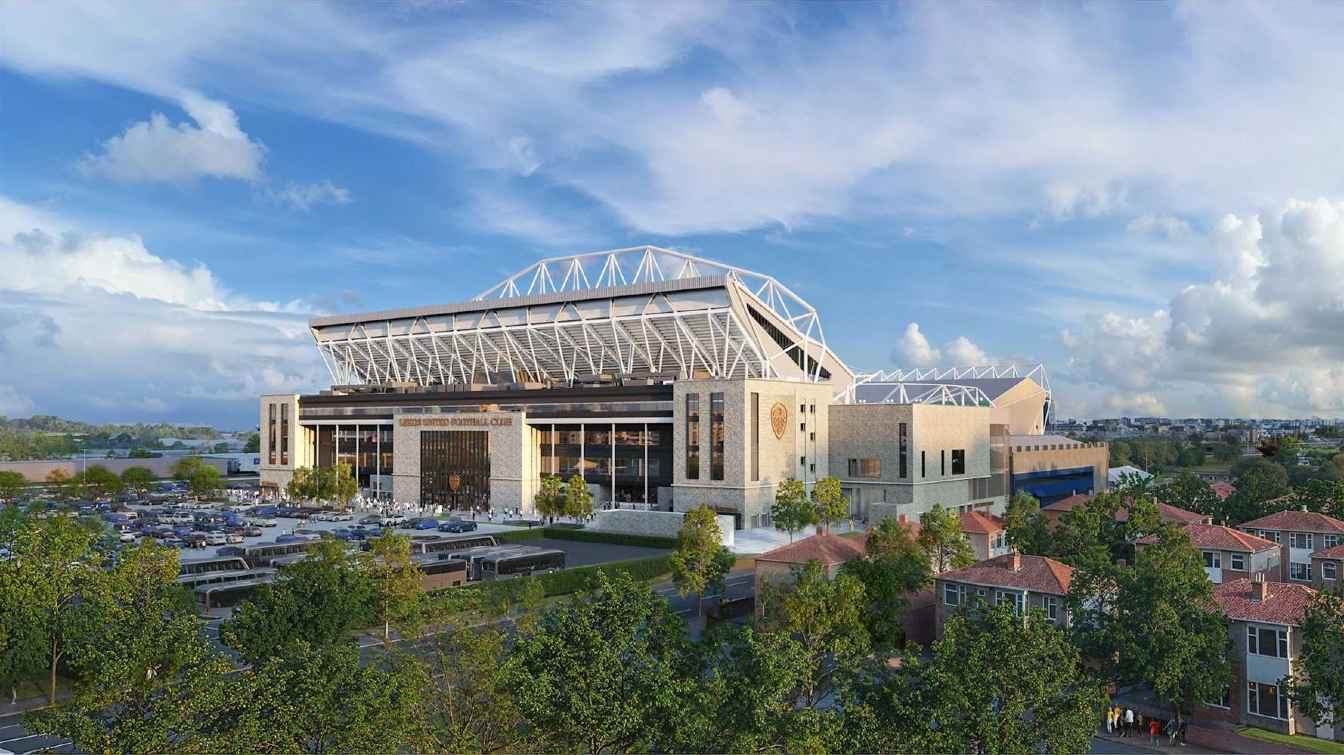 © Leeds United Football Club | The Elland Road stadium design proposes an expansion to a higher seating capacity than, for example, Everton’s new stadium.
The new Elland Road project delivered by BDP
Although the original concept for the expansion of Elland Road was prepared by the KSS studio and progressed to the third stage of the design-and-build process, Leeds United decided to launch a new tender for the continuation of design works. Ultimately, the contract was awarded to BDP, which has a studio in Leeds and was previously responsible, among other things, for the masterplan of the areas surrounding the stadium. The club hopes that the local presence of the designers will allow the stadium to be better integrated into the city’s urban structure.
After completion of the modernization, Elland Road is expected to meet the highest UEFA requirements. This will open the door to bidding for the hosting of major international tournaments and prestigious sporting events. For Leeds United, this also means greater commercial attractiveness and the possibility of further development beyond domestic league competitions.
Elland Road as a symbol of sporting and urban ambitions
One of the key arguments in favor of the stadium expansion is the enormous demand for tickets. The club reports that there are currently around 26,000 people on the waiting list for season tickets. Increasing the capacity of Elland Road is expected to significantly reduce this list and provide access to the stadium for a larger number of Leeds United supporters.
According to club estimates, the investment could generate approximately £29 million annually for the economy of the Leeds region. The stadium expansion is expected to contribute to the creation of new jobs, stimulate local businesses, and support further regeneration of the areas surrounding Elland Road. City authorities emphasize that the stadium acts as a development anchor
for this part of Leeds, attracting both residents and visitors.
Approval for the expansion of Elland Road is seen as a breakthrough moment both for Leeds United and for the city itself. The club treats the investment as the foundation of its long-term sporting and financial strategy, while local authorities view it as a catalyst for further infrastructure projects. If all stages are completed according to plan, Elland Road will become a modern stadium that matches the ambitions of Leeds United and the growing expectations of its supporters.
 © Leeds United Football Club | Leeds United plan to establish themselves in the Premier League long-term, with a larger stadium playing a key role in that strategy.
Advertisement