 StadiumDB
Germany: Fans win. Ministers drop strict stadium rules
source: StadiumDB.com; author: Paulina Skóra
 On the eve of a controversial meeting of Germany’s interior ministers (IMK) in Bremen, the German Football Association (DFB) and the German Football League (DFL) sent a letter to the IMK declaring their support for Bundesliga fans.
Advertisement
Fans stand shoulder to shoulder with German football officials
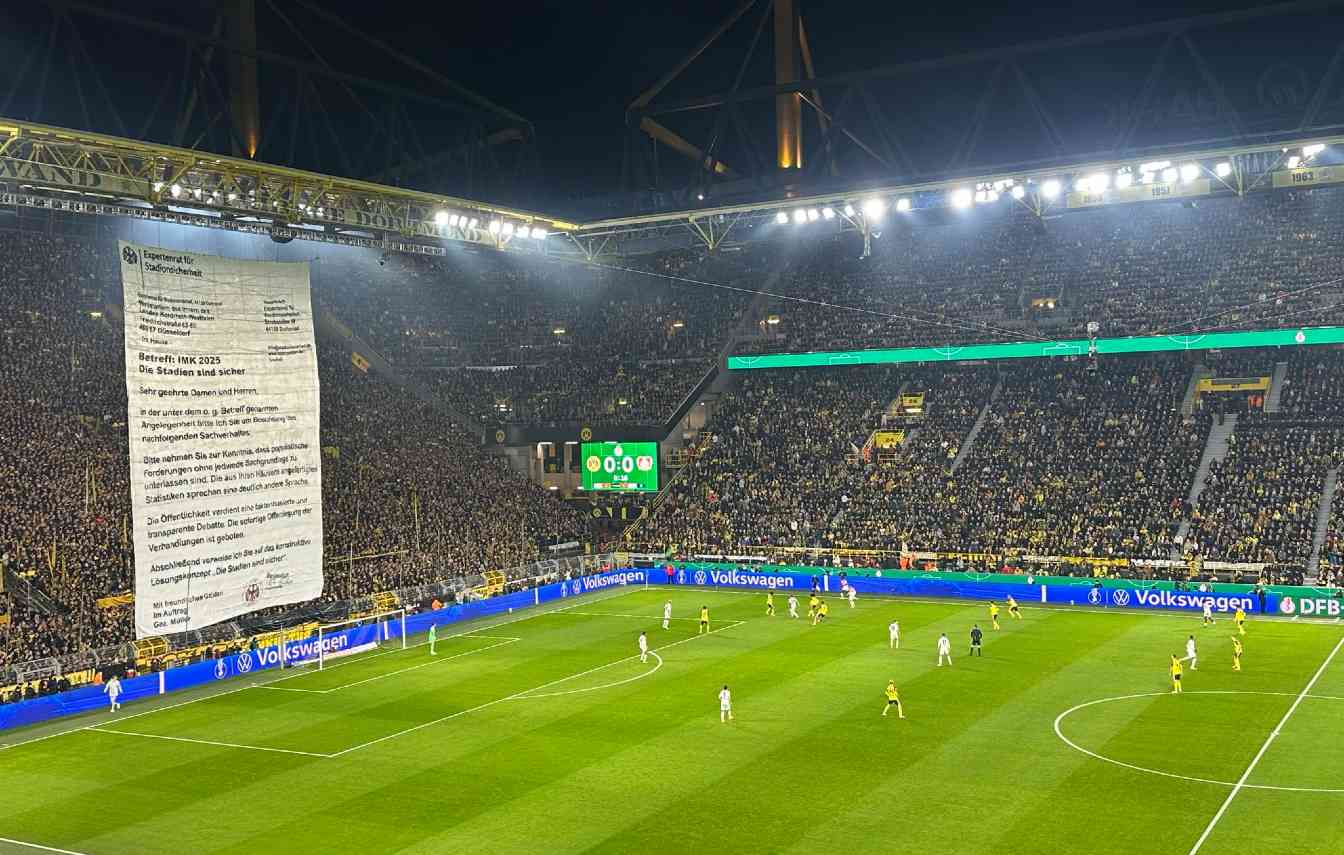
Borussia Dortmund supporters went a step further, displaying a huge banner at Signal Iduna Park before their German Cup match against Bayer Leverkusen. The banner featured a letter from the North Rhine-Westphalia interior minister backing their position. Protests against the IMK lasted three weeks and were a response to proposed draconian security measures. The federal inter-state working group (Bund-Länder-offene-Arbeitsgruppe
, BLoAG) held a session on additional security protocols under the slogan Fußball ohne Gewalt
(Football without violence
), having already met several times. The IMK meeting on 3 December was expected to produce concrete guidelines.
Ruling ministers divided
Among the 16 German interior ministers, opinions were split between supporters and opponents of strict measures. Bavarian minister Joachim Herrmann (CSU) tried to calm tensions, stressing that personalized tickets or stadium bans using facial recognition were not on the agenda. Partially true — some federal states still backed strict rules, especially in standing sections frequented by ultras.
Ministers Armin Schuster (Saxony, CDU) and Daniela Behrens (Lower Saxony, SPD) expressed support in interviews for closer coordination of Stadium Security Alliances,
aimed at applying strict measures uniformly. Legal publication LTO revealed a draft resolution by Behrens and Christian Pegel (SPD, Mecklenburg-Western Pomerania) citing rising stadium violence and proposing a national stadium ban commission.
Federations defend their stance
While such regulations could affect German football, the DFB and DFL would not be legally obliged to enforce them. Clubs could reject local authorities’ requests for personalized tickets or mandatory fan ID, although a national commission could intervene if needed. Fans had no direct voice at the conference, but their position was supported by the DFB and DFL. The federations’ letter stressed that personalized tickets are ineffective, clash with fan culture, create extra costs and delays at entrances, and increase risks of accidents and crowding. They called for a transparent debate, warning that ignoring fan input would be poorly received by the public and the law.
IMK drops controversial proposals
The protests worked. At the Bremen conference, ministers decided that personalized tickets, extensive document checks, facial recognition, and AI monitoring would not be introduced, and pyrotechnics were not added to the agenda. Ulrich Mäurer (SPD), IMK chairman, emphasized that measures must be proportionate and that most fans behave peacefully. Local stadium ban committees will continue operating under consistent procedures and increased transparency.
The decision is seen as a victory for Germany’s fan movement. Despite earlier radical proposals, federations and clubs showed that blanket, strict measures are unnecessary and that dialogue with supporters remains key for safety and culture in stadiums.
Advertisement